
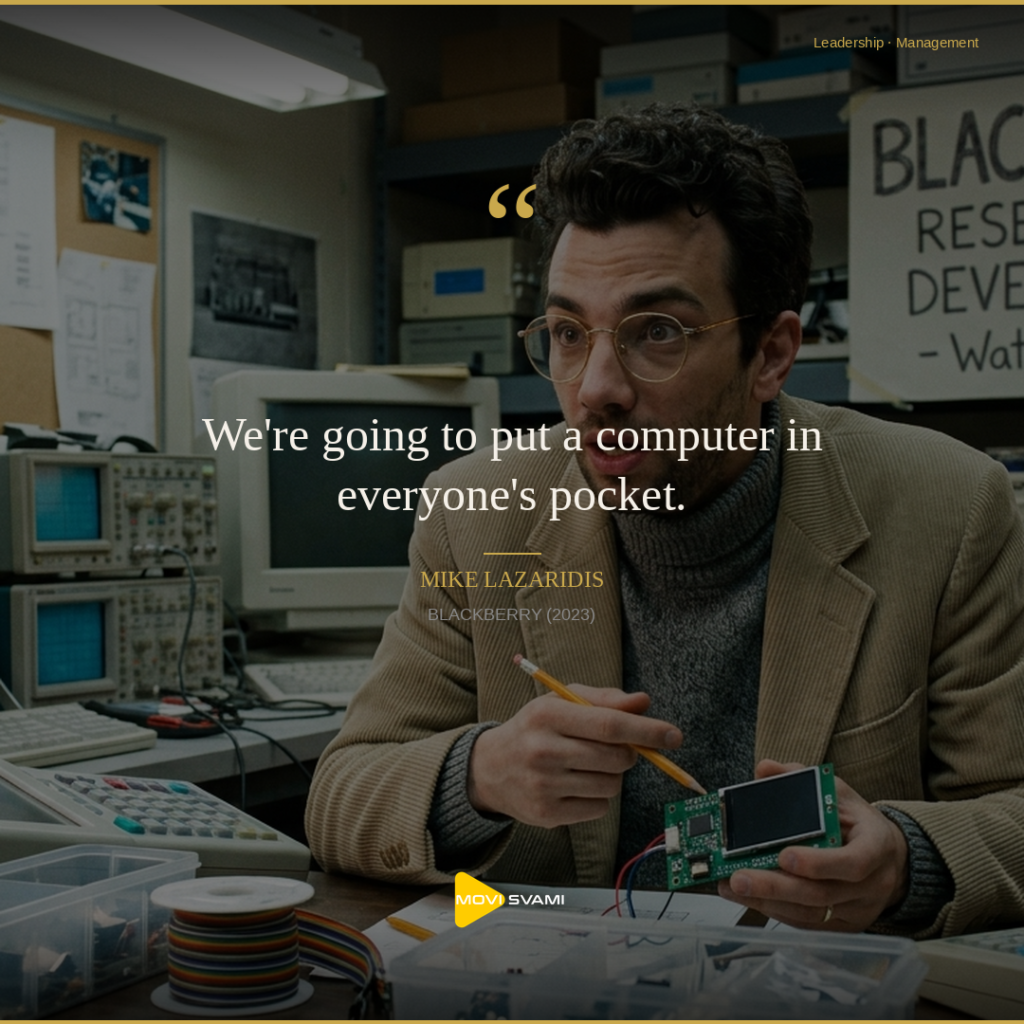
In the cramped engineering bay of a Waterloo office park, amid the solder smell of prototype boards and the hum of failing modems, Mike Lazaridis voices a heresy. It is 1996, or thereabouts. The mobile phone is a brick that makes calls. The personal digital assistant is a niche accessory for the clinically over-organized. The internet, for most, remains a desktop tether. And yet, here is a quiet engineer insisting that these discrete failures of technology—too dumb to compute, too bulky to carry, too disconnected to matter—are not separate problems but a single, invisible infrastructure gap waiting to be collapsed into something that does not yet have a name. The BlackBerry is not yet a product. It is a category error in the eyes of every incumbent. That is the moment. The recognition that the market is optimizing for the wrong constraint, and that the future belongs to whoever has the technical audacity to solve for something customers cannot yet articulate they are missing.
“We’re going to put a computer in everyone’s pocket.”
Lazaridis delivers the line not as a marketing slogan but as an engineering specification, a statement of fact that sounds, in the context of the era, like science fiction. In Matt Johnson’s *BlackBerry*, this declaration functions as the film’s fulcrum: the point where Research in Motion stops reacting to market signals and starts emitting them. The stakes are not merely financial, though the company is undercapitalized and chasing Motorola’s shadow. The stakes are epistemological. To claim the phone will become a computer is to reject the prevailing ontology of consumer electronics, in which form factors and functional categories were assumed to be immutable. Lazaridis is not proposing a better phone; he is proposing that the very definition of “phone” is a temporary constraint imposed by battery chemistry, bandwidth scarcity, and a failure of imagination. What hangs in the balance is the willingness to allocate scarce technical resources—engineering hours, capital, reputation—toward a use case that market research cannot validate because the infrastructure to support it does not yet exist.
This reveals a leadership principle distinct from the mythology of the “visionary founder” who simply dreams bigger. True pre-market vision is not optimism; it is the disciplined identification of infrastructure latency. Markets are efficient at solving for visible friction—customers complain, competitors respond, prices adjust. But they are systematically blind to infrastructural voids that precede demand. The executive with disruptive capacity is not the one who listens loudest to the customer, but the one who diagnoses which technical limitations are artificially suppressing latent behavior. Lazaridis saw that executives were already tethered to their desks by email, already craving the continuous flow of information that desktop computing provided. The gap was not desire; it was the physics of connectivity. The audacity lay in solving the packet-switching, the keyboard miniaturization, the server architecture—the unglamorous plumbing—before a single focus group could validate the need.
This timing—technical before commercial—creates a specific managerial tension. It requires betting on asymmetry: the conviction that your technical solution will create the market rather than serve it. Most organizations are structured to de-risk through incrementalism, which guarantees they will enter new categories only after the infrastructure gaps have been made visible by others. The BlackBerry story, in its ascent if not its decline, is a case study in the rewards of refusing that de-risking instinct.
Consider three scenarios where this principle applies today.
First, the integration of ambient artificial intelligence into legacy enterprise workflows. Most organizations are currently treating AI as a feature to be bolted onto existing software stacks—an efficiency gain here, a chatbot there. But the invisible infrastructure gap lies in the latency of decision-making itself. The executive who recognizes that AI is not a tool but a new layer of organizational nervous system—one that requires re-architecting data pipelines, governance protocols, and human-machine interface design before the ROI is calculable—occupies the same position as Lazaridis in 1996. They are building the pocket before the market knows it needs a computer.
Second, the reconstruction of supply chain visibility. The pandemic revealed that global logistics operated on information infrastructure designed for an era of predictable equilibrium. The current rush to “resilience” often manifests as inventory stockpiling or nearshoring—visible, tactical responses. The deeper gap is the lack of real-time, multi-tier visibility into sub-tier supplier health, enabled by sensor networks and distributed ledger architectures that do not yet interface cleanly with ERP systems. The leader who invests now in the technical standards and data interoperability required for true supply chain transparency is solving an invisible infrastructure problem that most competitors are addressing with temporary inventory buffers.
Third, the architecture of decarbonization. Regulatory pressure has created a market for carbon accounting software, yet most solutions treat emissions measurement as a reporting exercise—a photograph of historical impact. The invisible gap is the absence of operational infrastructure that embeds carbon intensity into real-time procurement and production decisions. Building the systems that translate lifecycle assessment data into automated, moment-by-moment supply chain optimization requires technical investment in standards and APIs that do not yet have network effects. It requires the audacity to build the enabling layer before the compliance market demands it.
The BlackBerry story ultimately reminds us that category leadership is temporary, but the methodology of pre-market vision is durable. The question is not whether your current product roadmap is ambitious, but whether you are allocating technical capital toward the constraints that everyone else assumes are permanent.
What infrastructure limitation are your customers currently working around—compensating for with inefficiency, inconvenience, or improvised process—that they have ceased to notice as a problem worth solving?