
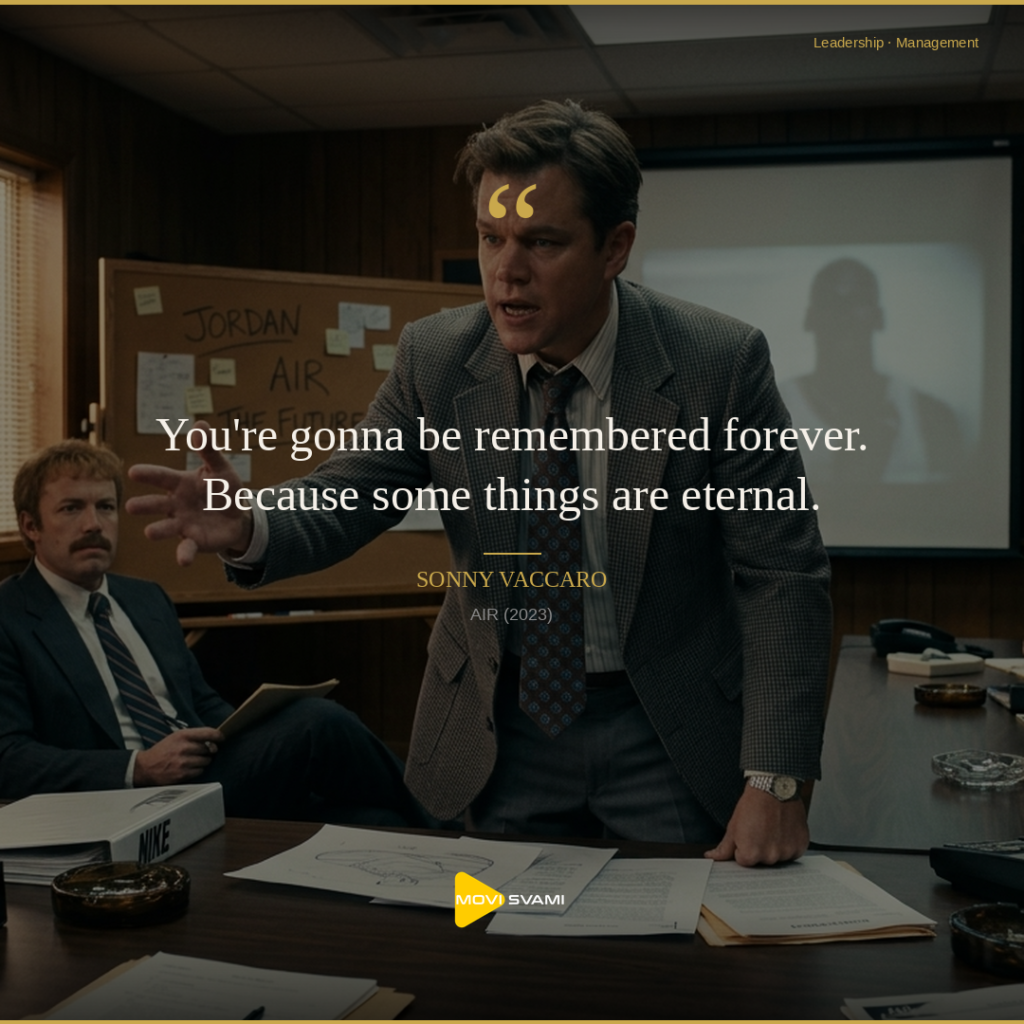
In the spring of 1984, inside a conference room thick with cigarette smoke and existential dread, Sonny Vaccaro made a wager that should have ended his career. Nike’s basketball division was on the verge of dissolution, hemorrhaging market share to Converse and Adidas. Rather than distribute the company’s entire $250,000 basketball marketing budget across a portfolio of promising rookies—the prudent, diversified approach demanded by risk management theory—Vaccaro proposed something heretical: invest every cent in one unproven player, a kid from North Carolina named Michael Jordan. It was not merely a financial decision but a declaration of faith that utility could be transcended by mythology. When the board balked at the concentration of risk, Vaccaro understood what they did not: some bets are not about probability but about eternity.
The moment crystallizes in Ben Affleck’s *Air* when Vaccaro, portrayed with relentless intensity by Matt Damon, sits across from Jordan’s parents and delivers the line that redefines the architecture of modern branding: “You’re gonna be remembered forever. Because some things are eternal.” He was not pitching footwear. He was offering participation in the construction of a cultural monument. The stakes extended far beyond Nike’s quarterly earnings or Jordan’s rookie contract; Vaccaro was articulating a theory of value creation that treated athletic performance as raw material for mythology. While Adidas offered money and Converse offered prestige, Vaccaro offered immortality. He recognized that Jordan was not simply a superior athlete but a narrative vessel—a figure capable of carrying the aspirational weight of an entire generation.
This scene illuminates a leadership principle that remains disruptive four decades later: iconic entrepreneurship requires the deliberate rejection of optimization in favor of resonance. Traditional corporate strategy prioritizes risk mitigation through diversification, spreading resources across multiple bets to ensure that no single failure becomes catastrophic. Vaccaro’s approach inverted this logic, arguing that cultural significance—that which achieves the status of “eternal”—requires absolute commitment. The calculus is not financial but anthropological. Products that embed themselves in human mythology operate outside the depreciation curves of ordinary consumer goods; they become artifacts of identity rather than items of utility. For executives, this demands a shift from asking “What margin does this generate?” to asking “What story does this enable our customers to tell about themselves?”
The implication is profound: legacy is not a byproduct of sustained profitability but of concentrated belief. Vaccaro understood that Nike could not out-spend its competitors, but it could out-mean them. By aligning the brand with Jordan’s trajectory before the market validated that trajectory, Nike was not purchasing endorsement; it was co-authoring origin myth. This requires a tolerance for ambiguity that quarterly-earnings culture systematically destroys. It necessitates viewing partnerships not as transactional cost centers but as narrative infrastructure—investments in symbolic capital that appreciates on timelines invisible to traditional accounting.
Consider three concrete scenarios where this principle disrupts conventional executive decision-making. First, in product portfolio strategy, the Vaccaro approach demands the courage of concentration. Every organization maintains a roster of “safe” incremental innovations designed to protect market share, often at the expense of transformative moonshots. The strategic imperative is to identify which initiative carries mythological potential—the capacity to redefine a category rather than merely compete within it—and to starve the marginal projects to feed the exceptional one. This is the difference between Apple’s resource allocation to the iPhone and Microsoft’s diffuse efforts during the Zune era. Executives must ask: are we diversifying to minimize regret, or concentrating to maximize significance?
Second, in talent acquisition and human capital strategy, this framework challenges the competency-based hiring models that dominate corporate recruiting. Vaccaro selected Jordan not based on his college statistics—impressive but not singular—but on his capacity to embody an archetype. Similarly, organizations seeking cultural impact must hire for gravitational pull rather than functional fit. This applies whether recruiting a creative director for a luxury fashion house or a CTO for a fintech startup. The question shifts from “Can this person execute our current strategy?” to “Does this person personify the future we are trying to summon into existence?” It requires betting on individuals who generate their own weather systems, disrupting the industries they enter.
Third, in brand architecture and partnership design, Vaccaro’s vision demands moving beyond the sponsorship paradigm. Most contemporary brand partnerships remain transactional: logo placement for audience access, a financialized exchange of attention for capital. The eternal approach treats partnerships as collaborative world-building. When Red Bull cultivates extreme athletes or when Patagonia aligns with environmental litigators, they are not buying impressions; they are constructing cosmologies. Executives must evaluate partnerships by their capacity to generate lore—stories that will be retold decades hence—rather than by immediate reach metrics. This requires contractual structures that prioritize creative risk-sharing over impression guarantees.
The basketball shoes Vaccaro placed on Jordan’s feet became more than rubber and leather; they became touchstones for identity, artifacts of aspiration that generated billions precisely because they were never treated as mere products. The lesson is not that every bet must be all-or-nothing, but that no legacy is built through hedging.
As you review your current strategic plan, ask yourself: Which initiative are you currently underfunding because it feels too uncertain, too concentrated, too divorced from immediate ROI—yet burns with the unmistakable heat of cultural necessity? What would happen if you stopped diversifying your belief and started betting on eternity?