
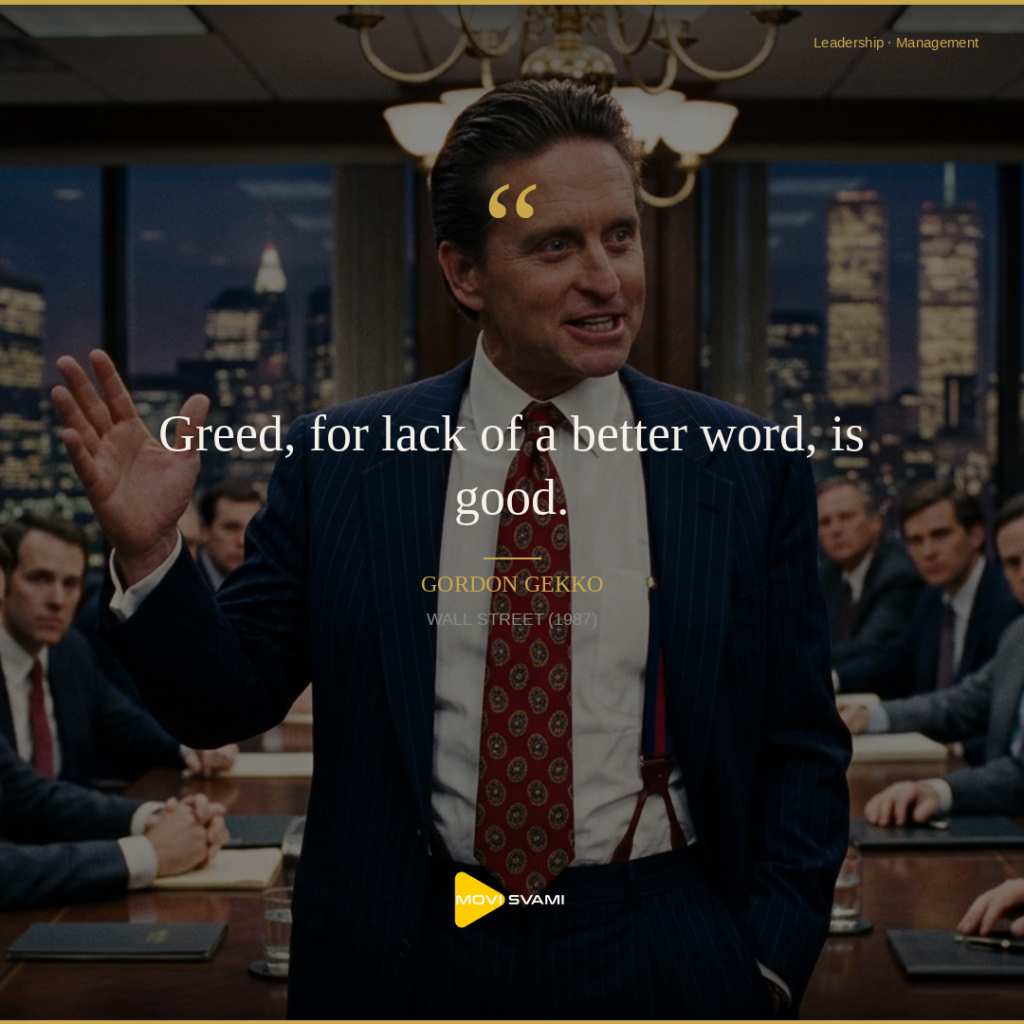
The fluorescent glare of the Teldar Paper shareholders’ meeting has lost none of its menace in the decades since Oliver Stone captured it. There stands Gordon Gekko—hair slicked to a knife’s edge, suspenders like armor, the room hushed not by reverence but by the anticipatory silence that precedes a blade. When he utters the line, “Greed, for lack of a better word, is good,” he is not offering a moral philosophy. He is delivering a diagnosis. The camera lingers on the faces of institutional investors who have spent years presiding over stagnation; they recognize, in Gekko’s surgical precision, an indictment of their own complacency. It is a moment of pure, predatory clarity—the kind that separates those who allocate capital from those who merely administer it.
To understand the quote, one must look past the Reagan-era aesthetics and grasp the structural critique embedded in Gekko’s soliloquy. He is not advocating for theft; he is attacking the “survival of the unfittest” that occurs when corporate bureaucracies prioritize their own preservation over shareholder value. Teldar Paper, in his analysis, is a bloated organism—layered with vice presidents who produce nothing, hoarding capital in inefficient silos while the market punishes the stock. Gekko’s “greed” is a proxy for allocative efficiency: the ruthless impulse to move resources from dying ventures to productive ones, to recognize when an asset is worth more in pieces than as a whole. The stakes were never merely financial; they were ontological. He was forcing the room to confront whether they were stewards of capital or merely curators of institutional inertia.
The leadership principle embedded in this scene is what we might call *visionary audacity*—the capacity to recognize undervalued opportunities before the market corrects itself, coupled with the conviction to act at massive scale. This is not optimism; it is asymmetrical insight. Gekko’s edge lay not in aggression but in seeing, three months earlier, that Teldar traded at a discount to its breakup value when the board still believed its own annual reports. Most executives can identify gaps between price and value; few possess the constitution to bridge those gaps with capital and consequence. The audacity required is temporal: you must be willing to be vilified as a vandal before you are vindicated as a visionary. It demands an appetite for informational advantages—what Gekko elsewhere calls “the most valuable commodity”—and the stomach to bet the portfolio on them while consensus still considers you reckless.
Consider the executive facing a stagnant division that was once the company’s crown jewel. The unit consumes twenty percent of overhead yet generates shrinking margins, maintained primarily by legacy employee loyalty and nostalgia among the senior leadership team. The “Gekko” moment arrives not when you decide to cut costs, but when you recognize—before the quarterly earnings force the issue—that the capital imprisoned in that division represents an opportunity cost bleeding the firm’s future. The visionary act is the willingness to dismantle, spin off, or liquidate despite the institutional antibodies that attack any threat to the status quo. It requires acknowledging that protecting jobs in a dying business is not stewardship but slow-motion liquidation of the enterprise’s vitality.
Or examine the pre-consensus investment decision. A competitor’s R&D lab has produced a technological breakthrough the market dismisses as niche; your analysts see a ten-year trajectory that others grade as speculative. Here, the voracity is intellectual: the refusal to accept the market’s current pricing of the future. To allocate forty percent of your capital expenditure to an unproven adjacency—while your board prefers “balanced” portfolios and incremental innovation—is to accept the Gekko premise that capital must seek its highest return, not its safest harbor. The leader who acts recognizes that structural inefficiencies exist not only in balance sheets but in collective perception. They move before the McKinsey reports validate the opportunity, capturing the asymmetric returns that accrue only to those who arrive early.
Finally, consider talent arbitrage. Most organizations promote based on tenure-weighted performance curves, rewarding the reliable vice president over the prodigious twenty-nine-year-old whose impact is nonlinear and therefore threatening. A leader applying visionary audacity operates with voracity for undeployed human capital—identifying the engineer, strategist, or operator who has not yet been price-corrected by the market’s consensus. It requires the ruthlessness to reorganize reporting lines around potential rather than seniority, to concentrate authority in the hands of those who see the gaps you see, even when it disrupts the hierarchy. This is greed in its most constructive form: an insatiable demand for excellence that refuses to be diluted by bureaucratic politeness.
What are you looking at right now—inside your portfolio, your organization, or your industry—that the collective wisdom has systematically undervalued? And more importantly, do you possess the voracity to act on that conviction before the correction occurs?