
There is a moment in Miami, standing outside a sun-bleached food truck with a Cuban sandwich in hand, when Carl Casper recognizes that his greatest professional humiliation might actually be his liberation. The night before, he was the disgraced head chef of a prestigious Los Angeles restaurant, fired after a public meltdown that went viral; the morning after, he is unemployed, divorced, and estranged from his son. Yet in this stripped-bare condition—no brigade to command, no Michelin aspirations to maintain, no investor expectations to satisfy—he glimpses something his decade of success had obscured: the possibility of ownership without abstraction. This is not a fallback. It is a deliberate demolition.
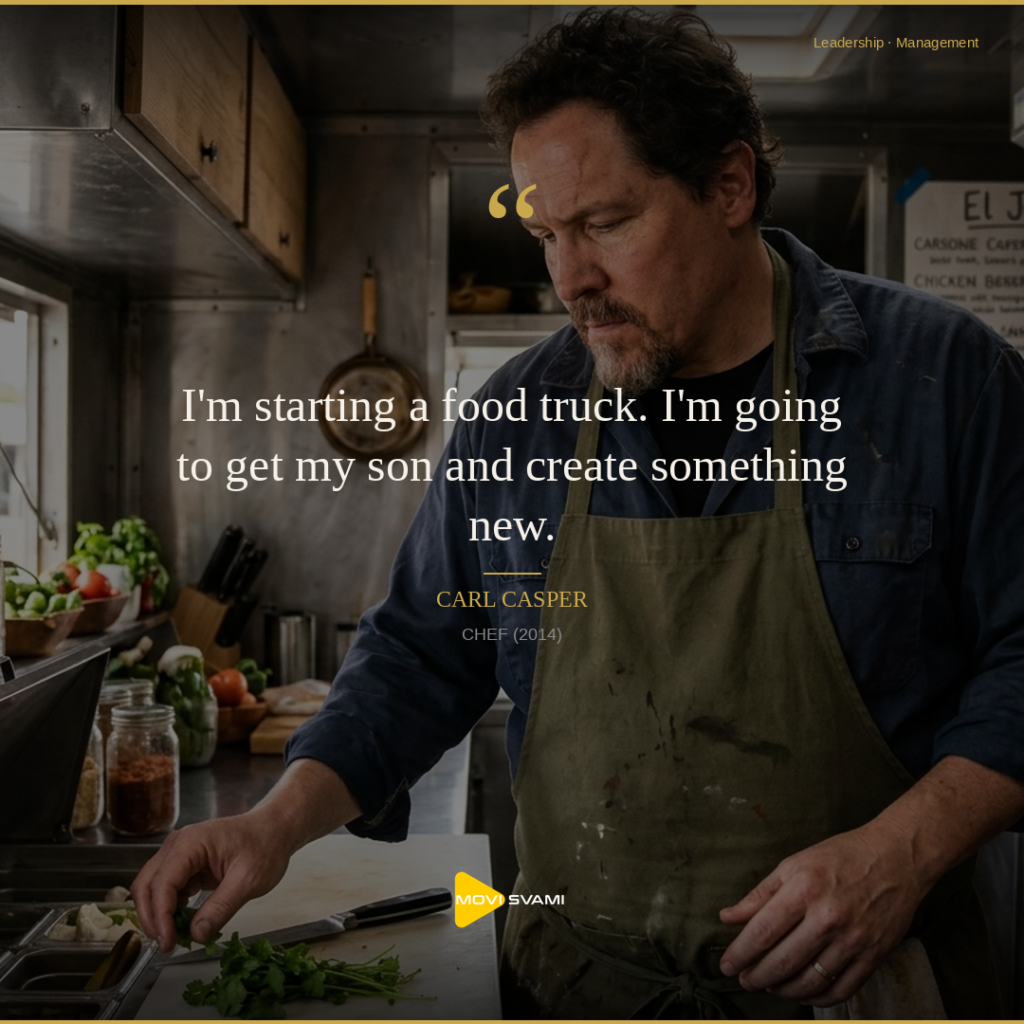
“I’m starting a food truck,” Carl tells his ex-wife Inez, his voice carrying the particular certainty that arrives only after catastrophic loss. “I’m going to get my son and create something new.” The statement is delivered not in the chaotic aftermath of his firing, but in the quiet afterward, once the adrenaline of conflict has drained and only the essential remains. Carl is not planning a comeback in the traditional sense. He is abandoning the architecture of his former career—the financiers, the critics, the sommelier, the maître d’—to reclaim the direct relationship between his hands and his craft. The stakes are existential: his relationship with his son Percy hangs in the balance, his financial security is tentative, and his professional identity must be rebuilt from scrap metal and elbow grease. The food truck represents a radical downsizing of operational footprint paired with an expansion of creative autonomy. It is the moment when an artisan chooses to become an entrepreneur by refusing to scale through delegation.
This pivot reveals a counterintuitive leadership principle: that creative emancipation often requires dismantling prestige to reclaim craft, and that true scale frequently begins with authentic, hands-on ownership. In modern business orthodoxy, “scaling” implies abstraction—adding layers of management, distancing the founder from the work, building infrastructure that generates returns while the owner becomes a steward of capital. Carl’s trajectory inverts this logic. The food truck forces operational proximity; he cannot delegate the soul of the experience to a sous-chef or a brand consultant. Every Cuban sandwich he presses, every route he maps, every customer interaction is unmediated. This is not mere sentimentality. It is a strategic recognition that when the distance between decision-maker and end-user becomes too great, organizations succumb to entropy—optimizing for metrics that no longer correlate with value creation. By downsizing to a mobile kitchen, Carl achieves a scale of influence that his previous operation, despite its white-tablecloth status, could not provide: the ability to iterate immediately, to fail cheaply, and to align every asset with a singular creative vision.
Executives facing strategic inflection points can observe three distinct applications of this principle in their own contexts. Consider first the corporate refugee—the C-suite leader who departs a Fortune 500 position to launch a specialized consultancy or boutique studio. The temptation is to immediately replicate the infrastructure of the former employer: the support staff, the leased headquarters, the layered hierarchy that signals legitimacy. Yet the leaders who successfully navigate this transition adopt the food truck model, resisting the urge to scale employee headcount before validating product-market fit. They accept the temporary discomfort of direct client delivery, of doing the work without the buffer of departments, because only through this proximity can they discern where true value resides. The prestige of the former title is traded for the clarity of the P&L, and in that narrowing, they find the room to maneuver that corporate policy had long denied them.
A second scenario emerges in the technology sector, where founders of maturing SaaS companies confront the bloat of their own success. After years of accepting enterprise clients whose demands dilute the core product, they face a choice between continued revenue growth and architectural integrity. The Carl Casper approach here is not to hire more customer success managers to mediate the gap, but to fire the clients—deliberately downsizing revenue to strip the product back to its essential MVP. This strategic retrenchment, while terrifying to boards trained on hockey-stick growth, restores the operational proximity necessary for true innovation. By refusing to scale through feature creep and abstraction, these founders reclaim the ability to ship meaningful updates, to maintain coding standards, and to attract users who align with the product’s authentic purpose rather than its compromised enterprise variant.
Finally, consider the legacy institution—a family-owned manufacturing firm or professional services partnership that has expanded through decades of acquisition and geographic sprawl. When quality erodes and brand equity dissipates across too many touchpoints, leadership faces the temptation to double down on centralization and corporate governance. The alternative, drawn from Carl’s reinvention, is institutional deleveraging: closing the satellite offices, retreating from the speculative markets, and returning the core team to the physical space where the craft originated. This is not nostalgia but risk management. By compressing the operational footprint to match the founder’s direct sphere of influence, the organization regains the ability to enforce standards, to narrate its own story without the interference of regional managers, and to rebuild the trust that scale had fractured.
What infrastructure are you maintaining right now not because it serves your craft, but because it validates your status? The truck is rusted, the hours are longer, and the margins are thin—but you can finally touch the work again.