
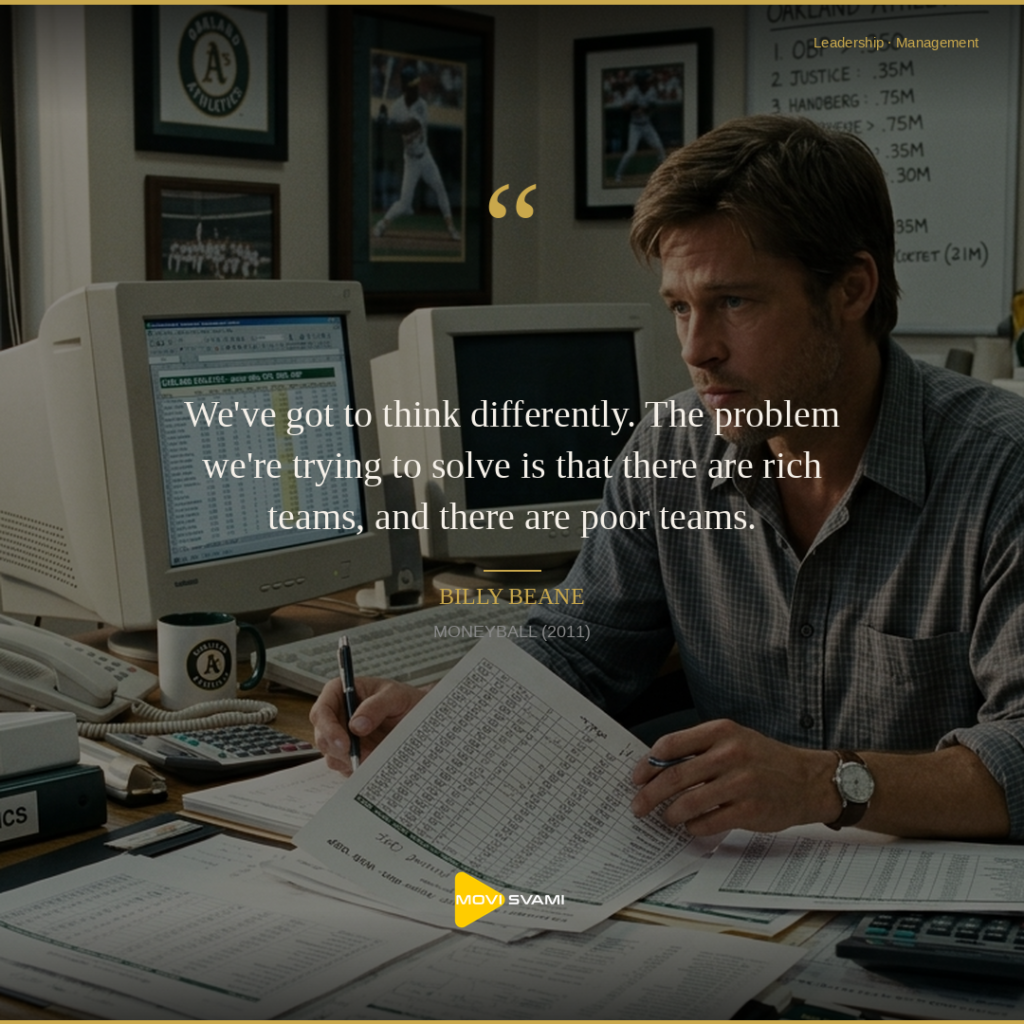
The conference room smells of stale coffee and leather-bound ledgers. Around the table sit scouts decades deep in the game, men who can spot a “natural swing” from the crack of the bat. Billy Beane walks in not with a gut feeling, but with a stack of printouts. He muted the highlight reels—the ones showing physique and speed—and asked a single, alien question: “Does he get on base?” The silence that followed wasn’t just confusion; it was the quiet terror of expertise becoming obsolete. The Oakland Athletics were hemorrhaging stars to free agency, their payroll a shoestring compared to the Yankees’ empire. Beane wasn’t merely tinkering with a roster; he was attempting financial ventriloquism, making a small-market franchise speak with the voice of a giant. The stakes were existential. Lose, and the team faced contraction or relocation. Win using the old rules, and bankruptcy was the only trophy.
—
“We’ve got to think differently,” Beane told his assistant GM, Peter Brand, staring at the chasm between their forty-million-dollar payroll and the big-market monoliths. “The problem we’re trying to solve is that there are rich teams, and there are poor teams.” The quote distilled a brutal reality that most sports franchises—and most businesses—prefer to romanticize with phrases like “competitive spirit” or “culture.” Beane wasn’t interested in morale. He was addressing a structural insolvency disguised as a competitive disadvantage. The Athletics couldn’t spend their way out of mediocrity. To survive, they needed to arbitrage inefficiency, to find value that the market’s “old guard” couldn’t see because they were blinded by aesthetics and tradition. It was a liquidity crisis masquerading as a talent drought.
This moment reveals a leadership principle rarely discussed in executive seminars: the discipline to distinguish between *vanity metrics* and *value metrics*, particularly when the former wear the convincing disguise of the latter. For a century, baseball scouts treated attributes like “wrist thickness” and “throwing velocity” as leading indicators of future production. They were anything but. These were lagging indicators of past amateur success, descriptive rather than predictive, and they came with a premium price tag. Beane’s epiphany was financial as much as it was statistical. By isolating on-base percentage (OBP)—a direct, causal link to run production—he identified a metric that generated wins cheaply. Wins generated revenue; revenue stabilized the balance sheet. The leadership lesson is austere: organizations die when they optimize for proxies (how a process looks) rather than outcomes (what the process earns). Reallocating capital away from subjective “potential” toward empirical “production” requires the courage to invalidate your own institutional lore.
—
**The Talent Acquisition Trap**
Consider the corporate equivalent of Beane’s scouts: the hiring manager fixated on pedigree. A candidate’s alma mater, years at a brand-name firm, and interview polish function as the business world’s “five-tool player”— comforting heuristics that feel predictive but often describe access more than ability. These are lagging indicators of socioeconomic advantage, falsely treated as leading indicators of performance. The Beane method in HR means disregarding the glossy scouting report and isolating the OBP: actual output per dollar of salary. Which portfolio pieces drove revenue? What code shipped without technical debt? By purchasing the “undervalued asset”—the candidate with unconventional experience but measurable skill—managers stabilize their human capital balance sheet, acquiring production at a discount while competitors overpay for credentials.
**The Sales Activity Mirage**
In sales organizations, the equivalent of “athletic tools” is often activity volume: calls made, emails sent, meetings booked. Managers celebrate the busiest reps, assuming motion equals progress. But in volatile markets, activity is a lagging indicator of effort, not a leading indicator of revenue. The spreadsheet doesn’t lie; unit economics do. Beane’s discipline applied here requires shifting evaluation from inputs to efficiency ratios—close rates by segment, customer lifetime value acquired per touchpoint, pipeline velocity. A rep generating half the call volume but converting high-retention enterprise clients is your on-base percentage specialist. Stop incentivizing the busywork that looks like hustle but dilutes margin. Reallocate compensation toward the specific behaviors that correlate with retained revenue, not just initial signatures.
**The Operational Efficiency Blind Spot**
Operations and product teams often fetishize “ship velocity”—features launched, sprints completed, uptime percentages—as evidence of health. These metrics are comforting abstractions, like a scout praising a player’s “confidence.” They describe motion while obscuring value creation. The Beane shift demands asking: which features actually drive adoption? Which processes reduce cost-per-outcome? A manufacturing line optimized for speed (output per hour) that ignores defect rates and rework costs is purchasing a .300 hitter who never walks; the glamor masks the inefficiency. Leaders must construct dashboards that weight outcome-per-resource-unit, ruthlessly deprecating legacy workflows that consume capital without advancing the score. Financial health returns when you stop paying for activity and start buying results.
—
As you review your quarterly plans, ask yourself: which of your most trusted KPIs are merely describing the past while pretending to predict the future? If Billy Beane were auditing your division tomorrow, which “proven” indicators would he dismiss as expensive folklore, and what unfashionable metric—quietly efficient, stubbornly productive—would he advise you to buy instead?