
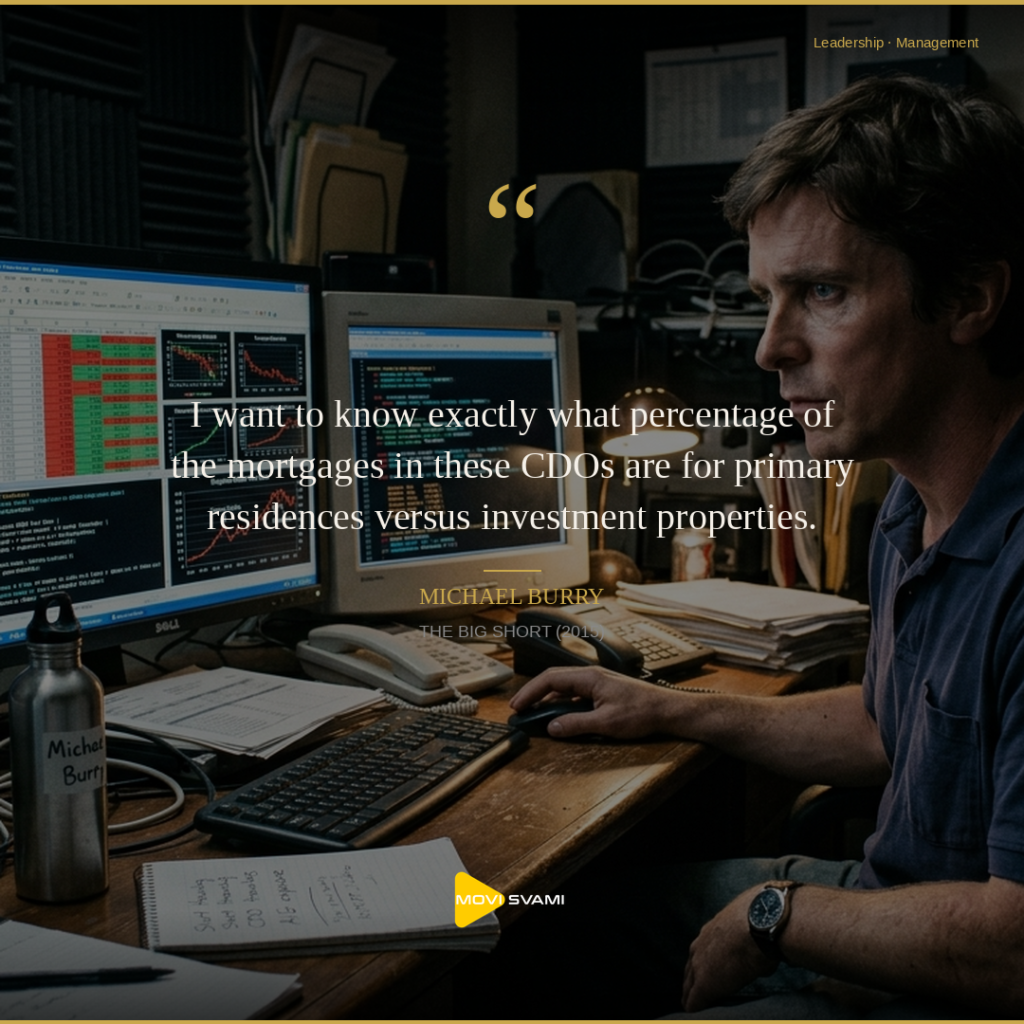
The heavy metal drums pound in the background as the camera lingers on a glass eye, then shifts to Michael Burry hunched before dual monitors in a dimly lit San Jose office. It is 2005, and while the broader financial ecosystem operates on the theological certainty that housing prices never fall, Burry is manually parsing thousands of individual mortgage files in a customized spreadsheet. The scene from *The Big Short* captures a peculiar isolation: a fund manager choosing to ignore the polished pitch decks and AAA ratings that comfort his peers, instead opting to stare at raw data that refuses to align with the prevailing narrative. The tension is not merely financial; it is existential, pitting one man’s insistence on granular truth against an institution’s preference for aggregated serenity.
“I want to know exactly what percentage of the mortgages in these CDOs are for primary residences versus investment properties.”
Christian Bale’s portrayal of Burry delivers this line not as a casual inquiry, but as a demand for epistemological transparency that the market structure is expressly designed to obfuscate. While Wall Street trafficked in collateralized debt obligations rated as bulletproof based on broad diversification metrics, Burry recognized that consolidation had become a mechanism of concealment rather than risk distribution. By insisting on disaggregating the tranches—separating owner-occupied homes from speculative investment properties—he exposed the rot at the foundation: loans extended to borrowers with no income, no jobs, and no assets, all bundled together and blessed with pristine credit ratings.
The stakes extended far beyond his fund’s survival; he was identifying the arterial bleeding that the industry’s consolidated risk assessments camouflaged as systemic health. His spreadsheet revealed that the apparent cardiac stability of the housing market masked localized necrosis—individual mortgages that were functionally worthless, yet invisible to executives reviewing only top-line tranche ratings.
This moment transcends finance cinema; it articulates a fundamental leadership pathology that persists across industries. Organizations routinely suffocate under the weight of their own dashboards, mistaking consolidated metrics for operational reality. When Burry drills down past the CDO ratings to individual loan characteristics, he demonstrates that leadership requires an autopsy-level curiosity about component parts, even when—especially when—summary statistics suggest wellness. The aggregated risk score is seductive precisely because it is efficient, offering executives a single heartbeat monitor for complex organisms. Yet as Burry’s methodology revealed, consolidated health metrics often mask localized hemorrhaging until institutional cardiac arrest becomes inevitable.
True institutional stewardship demands the discipline to distrust aggregation when it contradicts ground-level observation. It requires the intellectual honesty to recognize that risk models are not reality, but representations vulnerable to compositional errors. Burry’s refusal to accept the CDO’s composite grade—insisting instead on examining the specific nature of the underlying mortgages—models a leadership imperative: the granularity of the component analysis must match the severity of the potential downside.
Consider the procurement director reviewing a supplier health dashboard that displays green across all global regions. The aggregate suggests resilience; the reality, exposed only by examining individual vendor balance sheets, might reveal that a critical semiconductor supplier in Southeast Asia is leveraging unsustainable debt loads to maintain delivery schedules. Like Burry parsing individual mortgage files, the effective supply chain leader must resist the anesthesia of consolidated supplier scores and interrogate the specific financial structures and operational capacities of individual partners. The 2020-2022 global shortages taught us that aggregate inventory metrics could report optimal levels while specific component categories faced existential scarcity—the arterial bleeding invisible to those trusting only the consolidated pulse.
A chief revenue officer examining quarterly churn rates may observe a steady 5% attrition that appears manageable within industry benchmarks. Yet this aggregation conceals catastrophic vulnerability within specific cohorts—perhaps enterprise accounts purchased through a particular channel partner exhibit 40% churn while SMB segments mathematically mask the hemorrhaging. Burry’s methodology suggests dissecting the tranche: analyzing retention not as a monolithic metric but as a composition of customer types, acquisition periods, and usage patterns. The leader who accepts the consolidated churn rate without examining the underlying “mortgages”—the individual account health indicators and engagement telemetry—risks sudden institutional cardiac arrest when a seemingly stable revenue stream reveals itself as speculative fiction.
In advanced manufacturing, aggregate defect rates reported at the plant level often obscure concentrated failure modes within specific production lines or shifts. A quality director relying solely on consolidated Six Sigma scores may miss that Line 3 is producing micro-fractures at rates that will trigger catastrophic field failures, while Lines 1 and 2 compensate with near-perfect output. Burry’s insistence on knowing the granular composition of the CDO parallels the necessity of drilling down to individual machine tolerances, operator certifications, and raw material batches. The consolidated risk score becomes a dangerous anesthetic, allowing leadership to defer intervention until systemic collapse is irreversible and the patient cannot be resuscitated.
As you review your organization’s next quarterly business review, consider what resides beneath the executive summary’s reassuring aggregation. Where is your spreadsheet that questions the composition behind the consolidated score? Before your next strategic decision, ask yourself: which critical vulnerability are my dashboards designed to hide, and do I have the institutional courage to demand the granular truth that precedes the collapse?