
# That’s What Loyalty Is: Building Unshakeable Team Trust
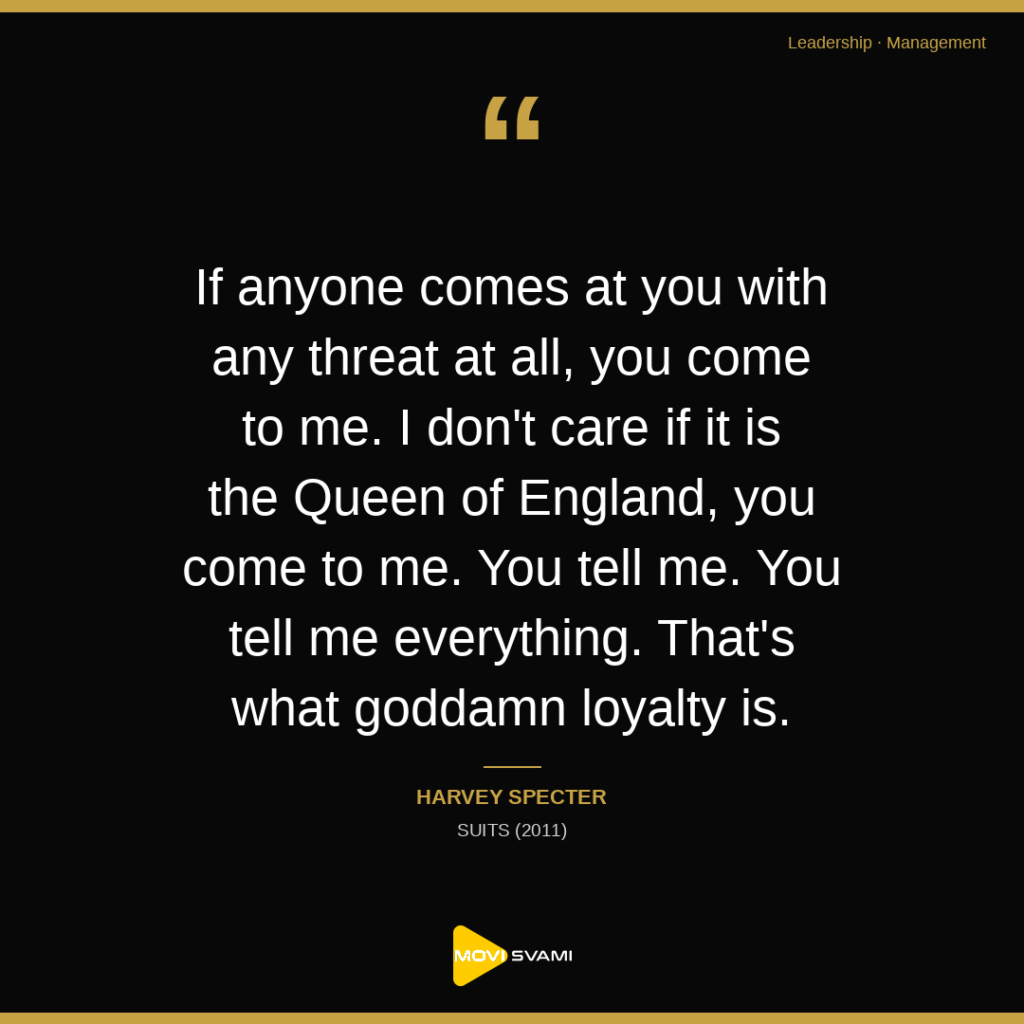
The tension in *Suits* Season 2, Episode 10—*”The Pledge”*—is palpable. Mike Ross, the brilliant yet underqualified associate, is cornered by a threatening figure from his past, a man who has infiltrated the firm and now seeks to expose him. As Mike hesitates, unsure whether to trust his colleagues, Harvey Specter steps in with a line that crystallizes the essence of loyalty: *”If anyone comes at you with any threat at all, you come to me. I don’t care if it is the Queen of England, you come to me. You tell me. You tell me everything. That’s what goddamn loyalty is.”* This moment isn’t just a dramatic flourish; it’s a masterclass in leadership. In a world where trust is currency, Harvey’s words redefine what it means to lead—not as a figure of authority, but as a shield.
Harvey’s quote emerges in a context where loyalty is both a weapon and a vulnerability. Mike, the show’s de facto protagonist, has spent years navigating a precarious balance between brilliance and precarity. When a former associate, now armed with damning evidence, confronts him, Mike’s fear is justified. The stakes are existential: his career, his safety, and the very fabric of the firm he’s trying to infiltrate. Harvey’s response is not just about protecting Mike—it’s about redefining the relationship between mentor and mentee. By demanding absolute transparency, Harvey isn’t just ensuring Mike’s loyalty; he’s reinforcing a covenant that transcends hierarchy.
This moment underscores a fundamental truth: loyalty in leadership isn’t about blind allegiance. It’s about creating an environment where vulnerability is met with unflinching support. Harvey’s words are a promise that no threat, no matter how formidable, will be met with silence. In that moment, he’s not just a boss—he’s a co-conspirator in the team’s mission. The stakes aren’t just personal; they’re existential for the team’s cohesion. When Mike trusts Harvey with his deepest fears, he’s not just choosing a leader—he’s choosing a partner in the fight for their shared goals.
The principle at play here is profound: loyalty is the bedrock of psychological safety, and psychological safety is the linchpin of effective leadership. Harvard Business Review’s research on high-performing teams emphasizes that trust is not just a nice-to-have—it’s a necessity. When team members feel safe to speak up, take risks, and admit mistakes, innovation and collaboration flourish. Harvey’s approach exemplifies this. By establishing himself as a non-negotiable confidant, he creates a culture where trust is not earned through performance but guaranteed through presence.
This has real-world implications for managers navigating the complexities of modern leadership. In high-stakes environments, leaders often face the dilemma of balancing accountability with compassion. Harvey’s model suggests that true leadership is about choosing to protect, not punish. It’s about recognizing that loyalty isn’t passive—it’s an active commitment to the well-being of the team. When a leader signals that they will stand between their team and external threats, they’re not just fostering trust; they’re building a fortress of collective resilience.
Consider the first real-world application: a team member facing external pressure or crisis. Imagine a scenario where a junior team member is being harassed by a client or a competitor. The pressure is intense; the individual might feel isolated, fearing retaliation or career sabotage. A leader applying Harvey’s principle would act as a shield, ensuring the team member knows they can speak up without fear. This isn’t just about resolving the immediate crisis—it’s about reinforcing a culture where vulnerability is met with support. For example, a manager might privately intervene with the client, redirecting the harassment while publicly affirming the team member’s value. The message is clear: loyalty isn’t a transaction; it’s a commitment.
The second application involves building trust in high-stakes project environments. In these settings, where the margin for error is razor-thin, trust can be the difference between success and failure. A leader inspired by Harvey’s ethos would prioritize transparency and open communication. For instance, during a critical product launch, a manager might hold regular check-ins where team members can voice concerns without fear of judgment. By creating a space where ideas and mistakes are shared freely, the leader fosters a culture of collective accountability. This mirrors Harvey’s approach: when team members know they can rely on each other, the project isn’t just completed—it’s elevated.
The third application focuses on protecting vulnerable team members from organizational politics. Organizational politics can erode trust, particularly for junior employees or those in marginalized roles. A leader who embodies Harvey’s principle would actively shield these individuals from undue scrutiny. For example, if a new hire is caught in a bureaucratic feud, the leader might advocate for their inclusion in key decisions, ensuring their voice is heard. This isn’t about favoritism—it’s about recognizing that loyalty means standing up for those who lack the power to defend themselves. By doing so, the leader not only protects the individual but also reinforces the team’s integrity.
In a world where trust is increasingly fragile, Harvey Specter’s definition of loyalty offers a blueprint for leadership. It’s not about grand gestures or empty promises—it’s about showing up, consistently, for the people who rely on you. The next time you’re faced with a team member in crisis, a high-stakes project, or a power imbalance, ask yourself: *Am I the kind of leader who would stand between them and the threat?* That’s what loyalty is. And that’s what leadership is.
**Reflection Question**: How can you create a culture where your team feels safe to trust you with their most vulnerable moments?