
# I’m Mad as Hell: The Power of Authentic Emotional Leadership
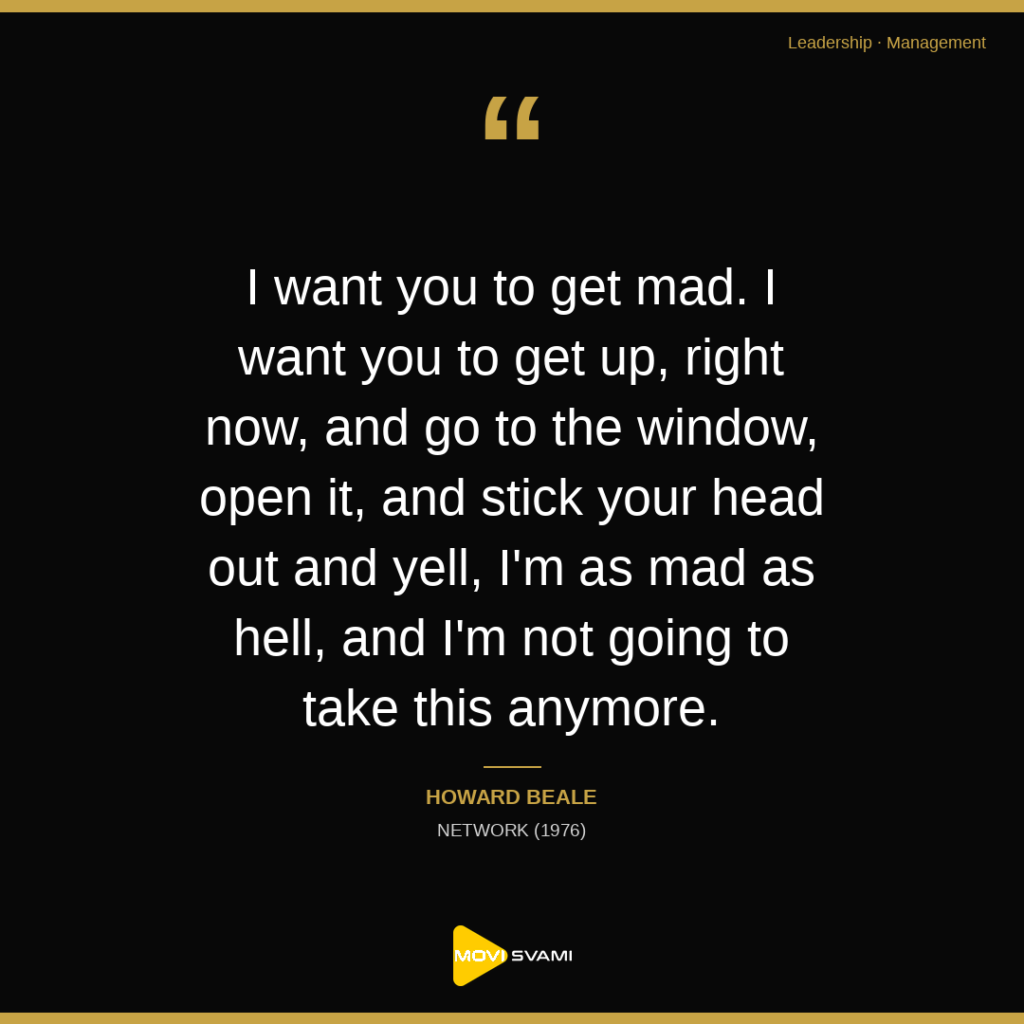
The screen cuts to black. A single spotlight illuminates Howard Beale’s face, sweat glistening on his brow, his voice trembling with a mix of rage and desperation. “I want you to get mad. I want you to get up, right now, and go to the window, open it, and stick your head out and yell, ‘I’m as mad as hell, and I’m not going to take this anymore!'” The words, delivered in a fit of raw, unfiltered emotion, rupture the sterile world of network television—a world built on calculated detachment, corporate control, and the illusion of objectivity. This moment, from *Network* (1976), is not just a cinematic climax; it is a searing indictment of the systems that prioritize profit over humanity. It is also a masterclass in leadership. Howard Beale’s breakdown is not a failure—it is a revolution. And in an era where leaders are often trained to suppress emotion in favor of composure, his unapologetic outburst reveals a radical truth: authenticity and emotional expression can galvanize followers to embrace their humanity.
Howard Beale’s moment of catharsis comes at the end of a film that exposes the rot of a media empire built on manipulation. A once-celebrated news anchor, Beale is reduced to a pawn in a corporate scheme: his breakdown is engineered by the network to provoke outrage and boost ratings. When he finally erupts, it is not scripted, not rehearsed—it is a collision of exhaustion, rage, and a desperate yearning for connection. The scene is both absurd and haunting. Beale’s outburst, which initially seems like a farcical spectacle, becomes a cultural phenomenon, a symbol of the collective frustration with a system that dehumanizes individuals. The stakes are clear: the network’s control over truth and emotion is shattered by a single, unfiltered moment of vulnerability. In this moment, Beale is not just a character—he is a metaphor for the human spirit’s refusal to be silenced.
This scene underscores a critical leadership principle: authenticity is not a weakness; it is a power. Howard Beale’s emotional outburst is not about chaos—it is about connection. In a world where leaders are often incentivized to appear calm, composed, and in control, Beale’s vulnerability cuts through the noise. His raw emotion does not diminish his authority; it amplifies it. Authentic leadership is not about hiding one’s feelings but about expressing them in ways that align with values, not just outcomes. It requires emotional intelligence—the ability to recognize, understand, and harness emotions in oneself and others. Beale’s breakdown is a reminder that motivation is not born from perfection or detachment, but from the courage to be real. In real-world management, this translates to leaders who acknowledge the complexity of human experience, who do not suppress frustration or fear, but who use those emotions as fuel for collective action.
In the modern workplace, leaders face a paradox: they are expected to be both authoritative and approachable, strategic and empathetic. Howard Beale’s example challenges the notion that emotional expression is a liability. Consider a manager navigating a company-wide merger. The process is fraught with uncertainty, resistance, and fear. A leader who dismisses these emotions in favor of a polished, detached demeanor risks alienating the team. Instead, a leader who acknowledges the anxiety, shares their own doubts, and invites open dialogue can transform fear into focus. By modeling authenticity, they create a space where employees feel seen, heard, and empowered to contribute. This is not just about morale—it is about clarity. When leaders express their humanity, they invite others to do the same, fostering a culture where vulnerability is strength, not weakness.
Another scenario where Howard Beale’s principles apply is in revitalizing a demoralized team. Imagine a department stagnating under the weight of outdated processes and unmet goals. The manager, caught in a cycle of burnout and frustration, might be tempted to issue directives or retreat into silence. But Beale’s example suggests a different path: a leader who shares their own sense of frustration, who admits that the current approach isn’t working, and who invites the team to co-create solutions. This requires courage, but it also requires empathy. By embracing their own emotional state, the leader models the very behavior they wish to inspire. The result? A team that feels trusted, valued, and motivated to innovate. Authenticity here is not about sentimentality—it is about creating a shared narrative of purpose that transcends individual egos.
Finally, consider a leader tasked with breaking through complacency in a high-performing organization. In such environments, the danger lies not in underperformance, but in the comfort of the status quo. A leader who clings to traditional methods risks stagnation. Howard Beale’s outburst, though extreme, offers a lesson in disrupting complacency: the power of unfiltered truth. A leader who openly expresses frustration with the current approach—whether it’s a lack of innovation, ethical compromise, or employee engagement—can spark a reckoning. This is not about rebellion for rebellion’s sake, but about rekindling a sense of purpose. By confronting the “madness” of complacency, the leader invites the team to reimagine what is possible. In doing so, they transform passive compliance into active collaboration.
So, what does this mean for leaders today? The quote “I’m as mad as hell, and I’m not going to take this anymore” is not a call to chaos, but a call to authenticity. It challenges leaders to ask: When was the last time I expressed my true emotions in a way that inspired others? In a world that often rewards detachment, Beale’s moment reminds us that the most powerful leadership comes from the willingness to be human. Reflect on a time when you needed to speak your truth—was it too difficult? How might embracing that vulnerability have changed the outcome? The answer, like Beale’s outburst, may just be the spark that ignites a movement.