
# Feedback is Fuel, Not Flattery
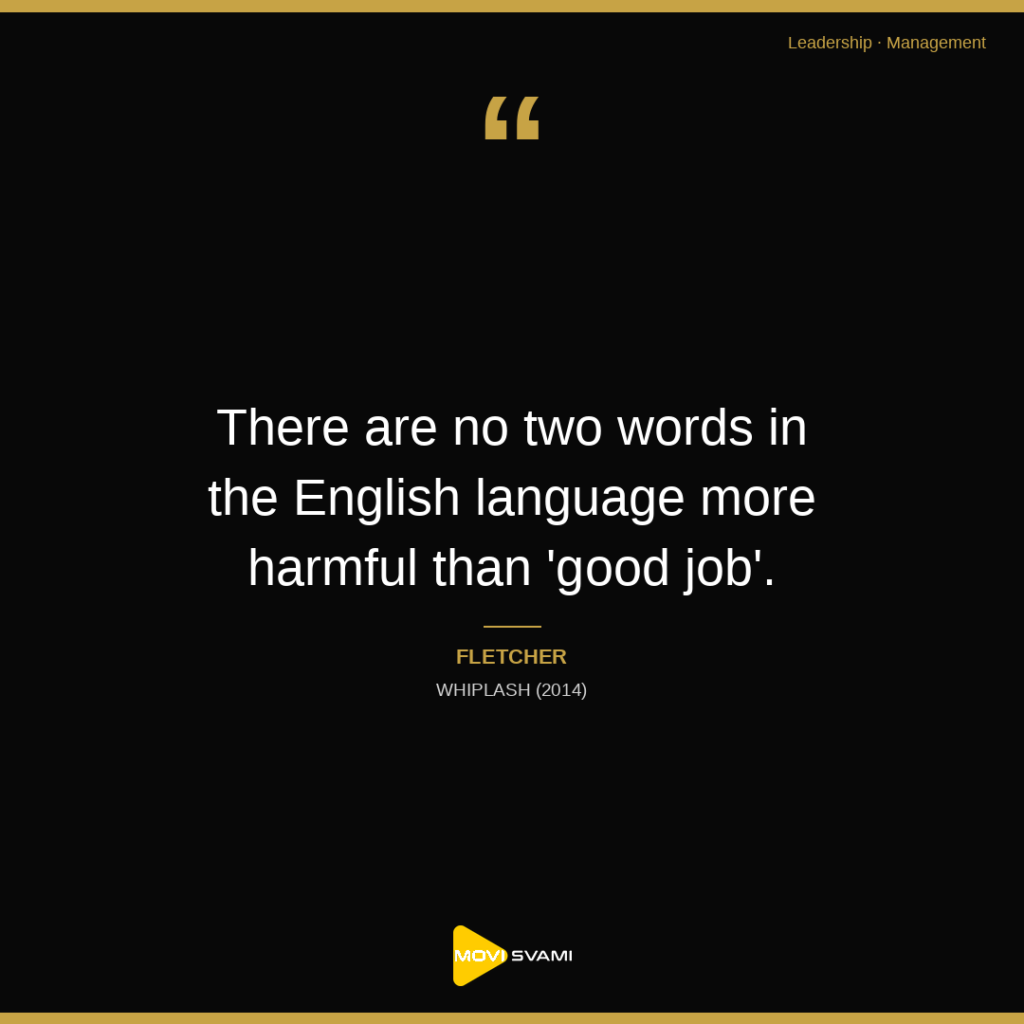
The scene opens with Andrew Neiman, a talented but insecure jazz student, playing a solo in a dimly lit practice room. The music is raw, imperfect—yet undeniably alive. But when the final note fades, the room falls silent. Fletcher, the merciless jazz professor, leans forward, his face a mask of disdain. “You’re not even close,” he growls. “You’re not even trying.” The tension is palpable, a collision of ambition and expectation. This is not a moment of encouragement—it’s a reckoning. And in that moment, Fletcher delivers a line that has since become a mantra for those who believe in the power of unflinching feedback: *”There are no two words in the English language more harmful than ‘good job’.”*
## The Harm of Harmless Words
Fletcher’s words are not mere criticism; they are a surgical strike against complacency. In *Whiplash*, his role is not to nurture but to annihilate. He is a conductor who demands perfection, a mentor who sees talent as a fire to be stoked, not a flame to be preserved. The stakes are high: Andrew’s journey is a race against mediocrity, a battle to transcend his own limitations. Fletcher’s harshness is not born of malice but of a singular, unyielding belief: that true excellence is forged in the crucible of relentless scrutiny.
The phrase “good job” is, to Fletcher, a crutch—a way to let talent rest on its laurels. It is a form of emotional armor, designed to protect the ego rather than sharpen the edge. In the context of the film, this is not just about music; it is about identity. Andrew’s self-worth is tied to his performance, and Fletcher’s refusal to indulge in hollow praise forces him to confront the uncomfortable truth: that growth requires discomfort. The stakes are not just artistic—they are existential. Fletcher’s feedback is a mirror, unflattering and unvarnished, reflecting the raw reality of where Andrew stands.
## Leadership as a Weapon of Excellence
Fletcher’s approach to leadership is a paradox: he is both a tyrant and a catalyst. His methods are extreme, but they reveal a deeper truth about management—true leadership is not about comfort; it is about clarity. The most effective leaders do not sugarcoat reality. They do not dilute the message to avoid confrontation. Instead, they cut through the noise, forcing their teams to confront the uncomfortable truth of their performance. Fletcher’s relentless pursuit of excellence is not about punishment; it is about precision. He is not trying to break Andrew—he is trying to refine him.
This principle transcends the theater. In any organization, the risk of complacency is as dangerous as the risk of failure. Leaders who rely on platitudes like “good job” may avoid conflict, but they also stifle growth. The most transformative leaders are those who recognize that feedback is not a transaction—it is a tool. It is fuel. To wield it effectively, one must be willing to remove the softness, to strip away the flattery, and to deliver the truth, no matter how harsh. Fletcher’s philosophy is not about cruelty; it is about courage. It is about the willingness to say, “This is not enough,” even when it is the hardest thing to say.
## Real-World Applications: When Feedback is the Catalyst
In the real world, Fletcher’s philosophy manifests in scenarios where mediocrity is the default, and progress is the exception. Consider a startup founder who refuses to let their team settle for “good enough.” Instead of praising incremental improvements, they demand radical innovation. This is not negativity—it is a refusal to accept the status quo. In a world where disruption is the only constant, such leaders understand that complacency is the enemy of evolution.
Another example is a sports coach who sees “good job” as a barrier to greatness. Imagine a basketball coach who, after a practice, doesn’t congratulate the team on their effort but instead drills them on their weakest plays. This is not unkindness—it is a commitment to mastery. The coach’s feedback is not about ego; it is about the game. By cutting through the noise of praise, they force players to confront the gaps in their skill, ensuring that every drop of sweat is spent on improvement.
Even in corporate settings, Fletcher’s approach can be transformative. A project manager who avoids vague praise and instead identifies specific areas for growth can turn a team of performers into a team of innovators. Instead of saying, “Great work on the report,” they might ask, “How can we make this data more actionable?” This shift from flattery to focus ensures that feedback is not a reward but a roadmap. It is the difference between “good enough” and “good enough for what?”
## The Reflection Question
Leadership is not about avoiding conflict—it is about choosing the right kind of conflict. Fletcher’s words challenge us to ask: What do we prioritize when giving feedback? Are we protecting our teams from discomfort, or are we pushing them toward excellence? In a world where mediocrity is often rewarded, the most effective leaders are those who recognize that true progress is born not from praise, but from the courage to say, “This is not enough.”
As you reflect on your own leadership style, consider this: When was the last time you delivered feedback that cut through the flattery? And when was the last time you heard feedback that forced you to grow? The answer may reveal more about your leadership than you think.