
### From Buried Hopes to Unstoppable Resilience: How Anne Shirley’s Journey Offers Lessons for Modern Leaders
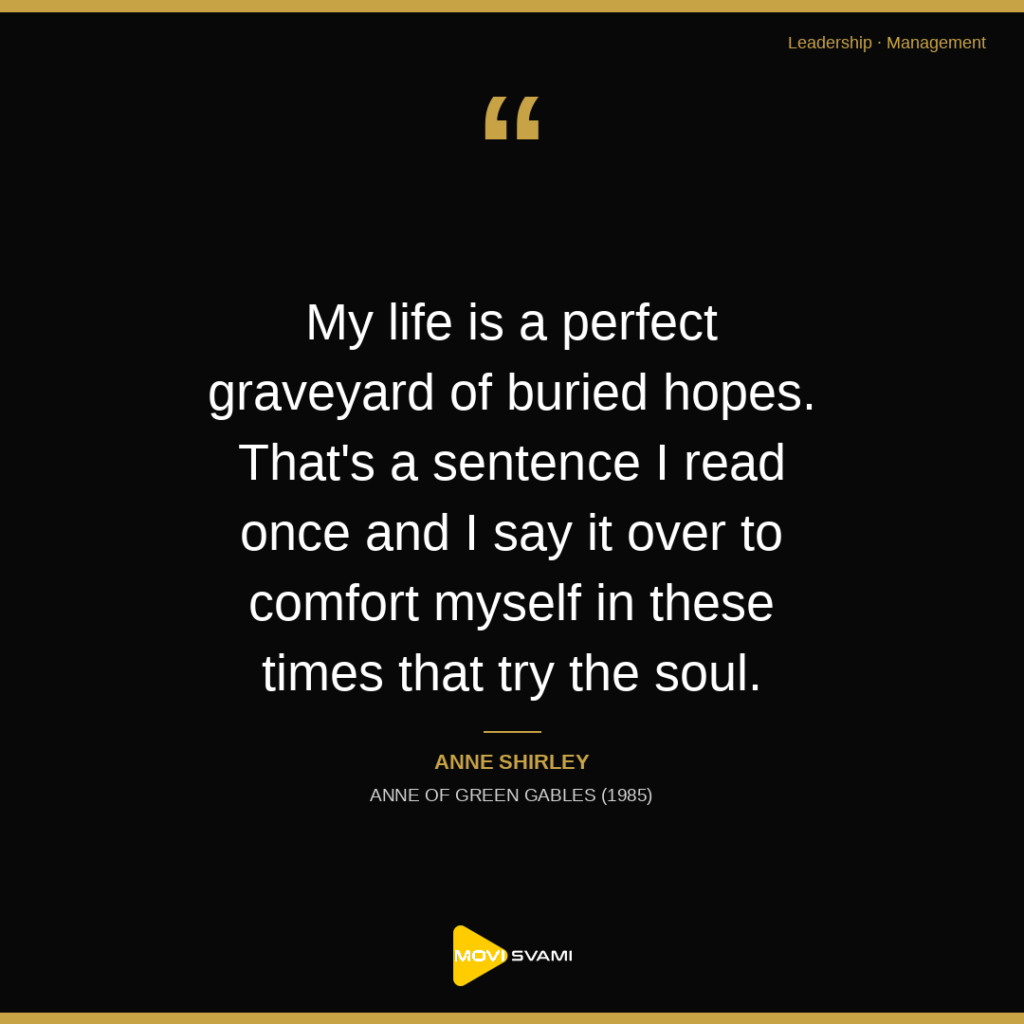
In the 1985 adaptation of *Anne of Green Gables*, Anne Shirley’s whispered admission—’My life is a perfect graveyard of buried hopes’—captures a moment of profound vulnerability. This line, delivered during a quiet introspection, reveals a truth that echoes across centuries: resilience is not the absence of failure, but the capacity to transform it into purpose. Anne’s journey, marked by missteps and misfortunes, becomes a blueprint for leadership in the face of adversity. Her story invites us to examine how leaders can harness vulnerability as a strategic tool, turning setbacks into opportunities for growth.
Anne’s quote is not merely a confession of despair but a testament to her introspective nature. It reflects a leadership philosophy rooted in self-awareness and emotional intelligence. By acknowledging her ‘graveyard of buried hopes,’ Anne does not succumb to defeat; instead, she confronts her inner landscape, which becomes the foundation for her future resilience. This mirrors the modern leader’s need to engage in continuous self-assessment, recognizing that growth often begins with the willingness to confront imperfection.
Resilience in leadership is not about avoiding failure but redefining its role in the journey. Anne’s ability to transform her personal setbacks—such as her initial misinterpretation of her adoption or her social missteps—into opportunities for connection and growth exemplifies this principle. Her resilience is not passive; it is an active process of reimagining purpose. Leaders who embrace this approach understand that challenges are not endpoints but inflection points. By reframing setbacks as data points, they can pivot strategies, recalibrate goals, and foster innovation.
#### Real-World Applications of Resilience in Leadership
**Strategic Pivots in Business**: Consider a tech startup facing a product failure. Instead of viewing it as a loss, the leadership team could analyze the feedback, reposition the product, and launch a new iteration. Anne’s story mirrors this by showing how her initial ‘misfits’ became strengths. Similarly, a CEO navigating a merger might transform cultural clashes into innovation by fostering collaboration and empathy. The lesson: failures are data points that fuel strategic evolution.
**Team Dynamics and Adaptation**: In a corporate setting, a manager facing high employee turnover might approach the challenge as an opportunity to reevaluate engagement strategies. By embracing vulnerability, the leader can initiate candid conversations, uncover root causes, and implement targeted solutions. Anne’s journey teaches that transparency and self-reflection are critical to rebuilding trust and purpose. Leaders who acknowledge their own struggles create psychological safety, enabling teams to do the same.
**Personal and Professional Growth**: Leaders often face personal setbacks, such as health issues or career transitions. Anne’s resilience shows that these moments can be reframed as catalysts for reinvention. For example, a leader recovering from a professional setback might use the experience to develop new skills, mentor others, or pivot into a different industry. This aligns with the concept of ‘growth mindset,’ where challenges are seen as opportunities for learning and development.
#### Reflecting on Resilience
Anne Shirley’s journey is a poignant reminder that resilience is not about perfection but purpose. Her ability to transform her ‘graveyard of buried hopes’ into a foundation for growth challenges the notion that leadership requires unshakable composure. Instead, it demands the courage to confront vulnerability, reframe setbacks, and align challenges with a larger mission. As leaders navigating an increasingly complex world, we must ask ourselves: How do we transform our own ‘buried hopes’ into sources of strength? What purpose do we reclaim when faced with failure, and how does that shape the legacy we leave?