
The summer heat in Gettysburg, Pennsylvania, in 1971 did not discriminate. It pressed down on every player arriving at the training camp for T.C. Williams High School, regardless of whether he had ridden the bus from the east side of Alexandria or the west. The air was thick with humidity and something else: the raw, unspoken hostility of a Virginia town being forced to integrate its schools, its streets, and, most reluctantly, its football team. Coach Herman Boone stepped off a bus with a mandate he had not asked for and a certainty that no one in that community wanted him to succeed. The white players had their own leaders. The black players had theirs. Neither group considered the other worthy of a locker room, let alone a huddle. Boone was not merely an outsider. He was a symbol of a social order that half the team resented and the other half feared would be dismantled the moment the season turned difficult.
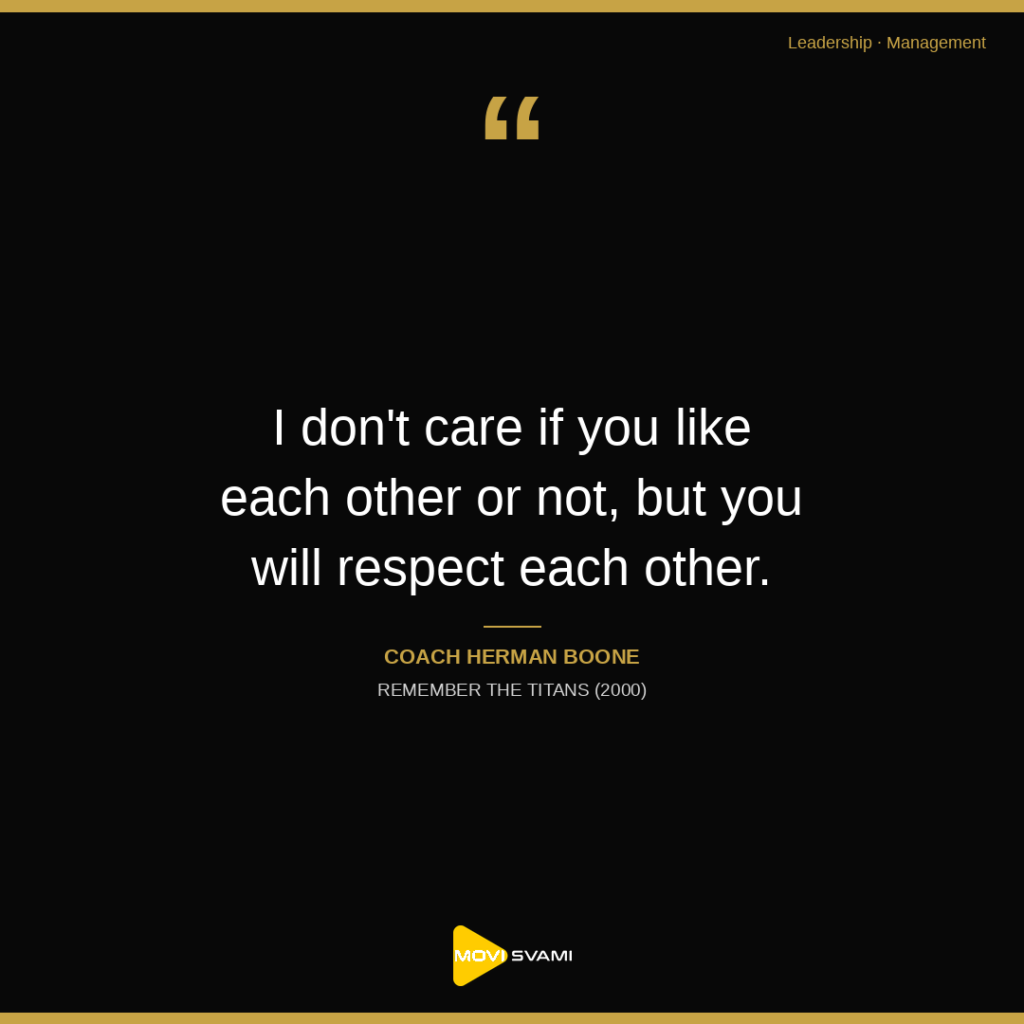
It was in that crucible, before a single snap of a regulation game, that Boone delivered the line that would define not only his season but a lasting model of leadership under pressure. “I don’t care if you like each other or not, but you will respect each other.” He did not deliver it as a suggestion, a team-building mantra, or a plea for tolerance. He delivered it as a structural fact. The team would not function on affection. It would function on accountability. And that accountability would begin with his own relentless, unvarnished presence. The statement was not designed to win hearts. It was designed to eliminate excuses. In a single sentence, Boone removed the comfortable alibi of personal preference and replaced it with an operational imperative.
The conventional leadership impulse in moments of deep division is to pursue harmony first. Leaders are tempted to orchestrate bonding exercises, issue statements of shared values, or encourage open dialogues about feelings before any real work has been done. Boone rejected that sequencing. He understood that trust does not emerge from manufactured intimacy; it emerges from the experience of being held to the same exacting standard by someone who refuses to look away from the difficulty of the task. Authentic leadership, in this sense, is not a personality trait. It is a behavioral contract. Boone did not ask his players to suppress their identities or their anger. He asked them to bring both onto the field and to direct them toward a common standard of excellence that was larger than any individual grievance. By making respect a prerequisite for participation rather than a reward for agreement, he created a space where performance could become the dominant identity.
What made this contract credible was Boone’s willingness to subject himself to it. He did not govern from a distance. He slept at the camp, ran the conditioning drills until he was sick, and listened when his own rigidity needed correction. Authenticity is often miscast as self-expression or vulnerability for its own sake. In Boone’s case, it was something tougher and more useful: the disciplined alignment of word and action. When leaders demonstrate that they are not exempt from the standards they set, they transform respect from an emotional preference into a rational choice. Players do not need to like the person holding them accountable if they believe that person is honest. Honesty, consistently demonstrated, becomes the bridge across the deepest barriers because it removes ambiguity. Everyone knows where they stand, what is expected, and what the consequences are for falling short. That predictability is the foundation of trust across lines of difference.
First, establish behavioral standards before expecting cultural cohesion. Organizations undergoing merger integration, geographic expansion, or diversity initiatives often invert the sequence. They invest heavily in narratives of unity and shared purpose before defining what respectful collaboration actually looks like in practice. Boone’s approach suggests that cohesion is an output, not an input. Leaders should define the non-negotiable behaviors of engagement—how decisions are contested, how feedback is delivered, how credit is distributed—and then rigorously enforce them. When teams experience fairness in action, the sentiment of trust follows as a natural byproduct. The language of culture should always lag slightly behind the evidence of structure.
Second, model accountability in public before demanding it in private. Boone’s authority was not derived from his title. It was derived from his visibility. He did not delegate the hardest parts of integration to assistant coaches or to team captains. He walked into the gymnasium where players were fighting, stopped the chaos with his physical presence, and made it clear that the standard had already been set. Contemporary leaders often undercut their own standards by exempting themselves from scrutiny. Authentic leadership requires what might be called exposed accountability: admitting errors in judgment, correcting course when data contradicts intuition, and treating one’s own conduct as the primary case study for the culture being built. When a leader’s own behavior is the document teams study, the standard becomes self-evident.
Third, engineer proximity under explicit rules. One of Boone’s most effective decisions was structural. He forced integrated bus seating, integrated room assignments, and integrated positional pairings. He did not hope that proximity would yield tolerance; he designed the environment so that players had no alternative but to interact, and then he defined the terms of that interaction. In modern hybrid or remote organizations, leaders cannot assume that casual proximity will produce trust. They must intentionally create cross-functional workflows, mixed reporting structures, and collaborative assignments that bring differing perspectives into necessary contact. The key is that these interactions must operate under a visible code of respect. Without that code, proximity can amplify friction rather than reduce it. Structure without standards accelerates conflict; structure with standards accelerates capability.
The enduring lesson of Boone’s leadership is that authenticity is not a soft skill. It is a structural one. It operates by making the rules of engagement so clear and so consistently applied that liking becomes irrelevant. People do not have to agree with one another to perform exceptional work together. They do, however, need to believe that the person leading them will not flinch from the truth, will not play favorites, and will not pretend that difficult differences do not exist.
In a professional landscape saturated with conversations about psychological safety and belonging, it is worth remembering that safety is not the same as comfort. Boone offered his players no comfort in that summer camp. He offered them something more durable: a leader whose honesty they could depend on. The question for today’s executives is whether their own teams can say the same. If you stripped away the likability, the perks, and the polished mission statement, would your people still trust you to hold the line on what matters most?