
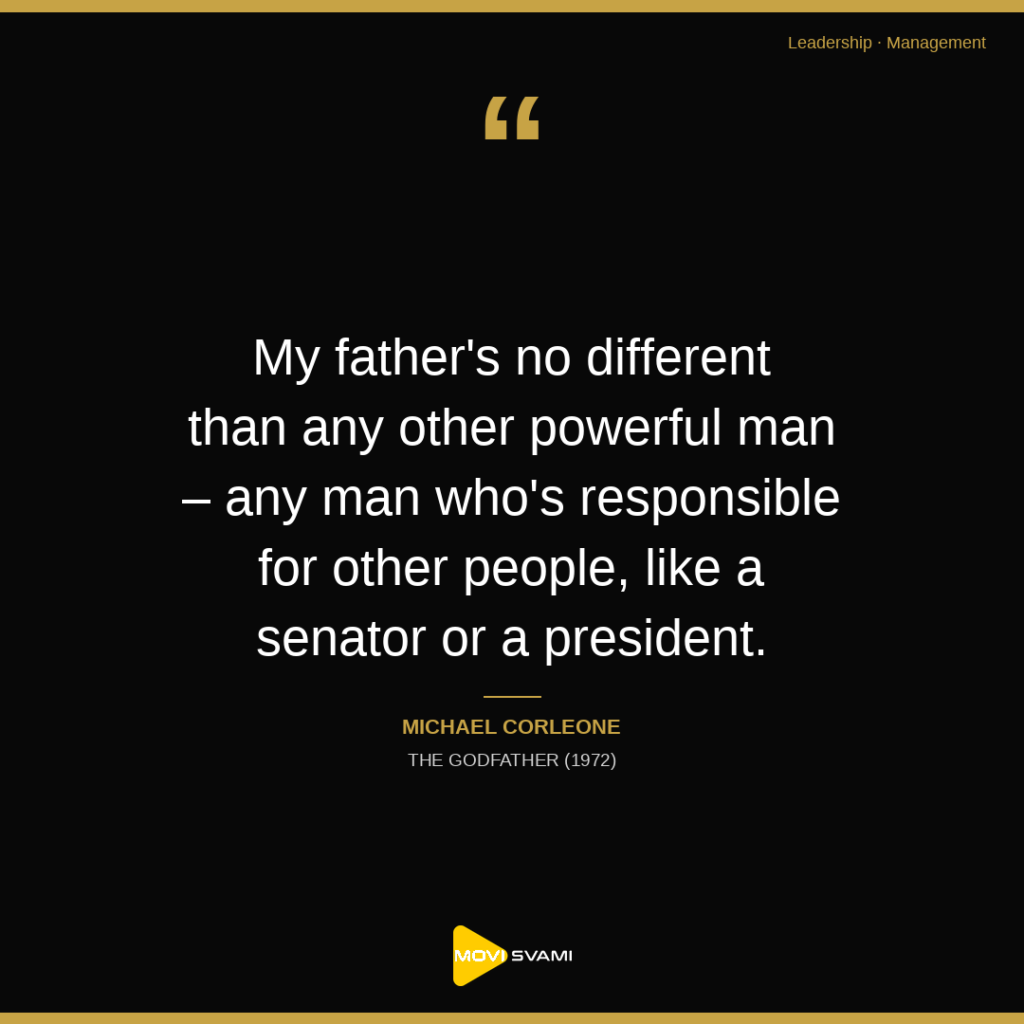
The amber light of the Italian restaurant in 1942 catches the edge of Michael Corleone’s uniform. He is still the war hero, the college graduate, the son who promised Kay Adams he was different from his family. But in this quiet moment, between bites of food that neither character will remember tasting, Michael utters a sentence that functions as both defense and confession: “My father’s no different than any other powerful man – any man who’s responsible for other people, like a senator or a president.”
Francis Ford Coppola frames this scene with intimate proximity. We are eavesdropping on a private conversation, yet the stakes are public and constitutional. Kay represents the legitimate world—WASP, educated, democratic. Michael is translating between codes, attempting to make comprehensible what is, by any legal standard, criminal enterprise. But the true revelation isn’t in his defense of Don Vito. It is in the architecture of justification he constructs, foreshadowing his own inevitable metamorphosis from reluctant successor to calculating sovereign.
**The Linguistic Architecture of Inherited Power**
Michael’s statement performs a critical maneuver that every successor must eventually master: the transmutation of personal authority into institutional legitimacy. Don Vito Corleone built his empire through violence, patronage, and the raw calculus of fear. This is power acquired, not bestowed. Yet Michael does not defend the acquisition. Instead, he reframes the exercise—positioning his father as a burdened steward, a man “responsible for other people,” whose authority is functional rather than predatory.
This is the legitimacy gambit. Inherited power—whether in crime families, family businesses, or publicly traded corporations—suffers from a credibility deficit. It arrives without the mandate of meritocracy. The successor did not build the kingdom; they received it. To consolidate authority, they must perform what political scientist James C. Scott terms “the public transcript”—a narrative that masks the private reality of domination with the vocabulary of service.
Michael’s rhetorical move is particularly sophisticated. By invoking “senator” and “president,” he smuggles democratic virtue into autocratic structures. These titles carry the legitimacy of consent, of institutional process, of responsibility to a public good. By placing Don Vito in this lineage, Michael performs an act of linguistic laundering. The family business ceases to be a criminal conspiracy and becomes a shadow state, complete with constituents, protection rackets reinterpreted as social services, and violence rebranded as enforcement. The genius lies not in the comparison’s accuracy, but in its utility: it allows the successor to occupy the throne while wearing the mask of the civil servant.
**From the Screening Room to the Boardroom**
The pattern Michael identifies transcends the criminal underworld. In executive suites and family offices, successors repeatedly deploy this reframing strategy to bridge the gap between how power was acquired and how it must be exercised.
**The Family Business Metamorphosis**
Consider the second-generation CEO inheriting a manufacturing empire built by a charismatic founder whose methods were brilliant but idiosyncratic, perhaps even brutal. The successor faces an immediate legitimacy crisis: they possess authority by blood, not by battle. To consolidate control, they must reframe the founder’s empire as an institution. “My father’s company” becomes “our legacy of stakeholder service.” The founder’s territorial control transforms into “corporate governance.” The successor doesn’t dismantle the power structure; they intellectualize it, installing boards and processes that mask the continuity of concentrated authority with the rituals of professional management. Like Michael, they legitimate the inheritance by claiming it as a burden for the greater good of employees and community.
**The Turnaround Artist’s Alibi**
In corporate acquisitions, private equity principals and turnaround CEOs frequently inherit organizations through transactions that prioritize financial extraction over operational continuity. The legitimacy deficit here is acute: they are outsiders with no organic connection to the firm’s history or culture. To execute restructuring—closing plants, liquidating assets, severing legacy obligations—they must deploy Michael’s rhetorical strategy. Asset stripping becomes “portfolio optimization.” Mass layoffs transform into “rightsizing for competitive sustainability.” The successor reframes their role not as a destroyer of value for distant shareholders, but as a responsible steward making “difficult decisions” to ensure the organization’s survival. The violence is still done, but it is wrapped in the language of fiduciary duty.
**Institutional Translation**
Even in non-commercial contexts, the gambit applies. University presidents inheriting troubled institutions, NGO directors taking over founder-led charities, or political appointees assuming agency leadership all face the same imperative. They must translate idiosyncratic, personal, or controversial authority into the bland, legitimate language of “stewardship,” “sustainability,” and “stakeholder alignment.” The inherited mandate is reframed as a temporary trusteeship for an abstract public good, allowing the successor to exercise power while disclaiming personal ambition.
**The Mirror of Rationalization**
Michael Corleone’s tragedy is that he comes to believe his own reframing. By the film’s end, he no longer distinguishes between the senator and the don; in his mind, they have become functionally identical, equally ruthless, equally legitimate. This is the occupational hazard of the legitimacy gambit. When successors successfully reframe power as responsibility, they risk internalizing the fiction. The mask becomes the face.
The critical question for any successor is not whether they can construct the narrative—Michael proves that anyone with intelligence and will can perform this translation. The question is whether they can maintain the distinction between the rhetoric of service and the reality of control. Legitimacy is necessary for authority to function, but when the legitimation becomes total, when the successor truly believes that their inherited power is identical to democratic mandate, they cross from pragmatist into something more dangerous: the tyrant who believes he is merely a president.
**Reflection Question:** In your current leadership role, what portion of your authority requires rhetorical reframing to feel legitimate to your stakeholders—and how do you ensure you don’t mistake the mask for your own face?