
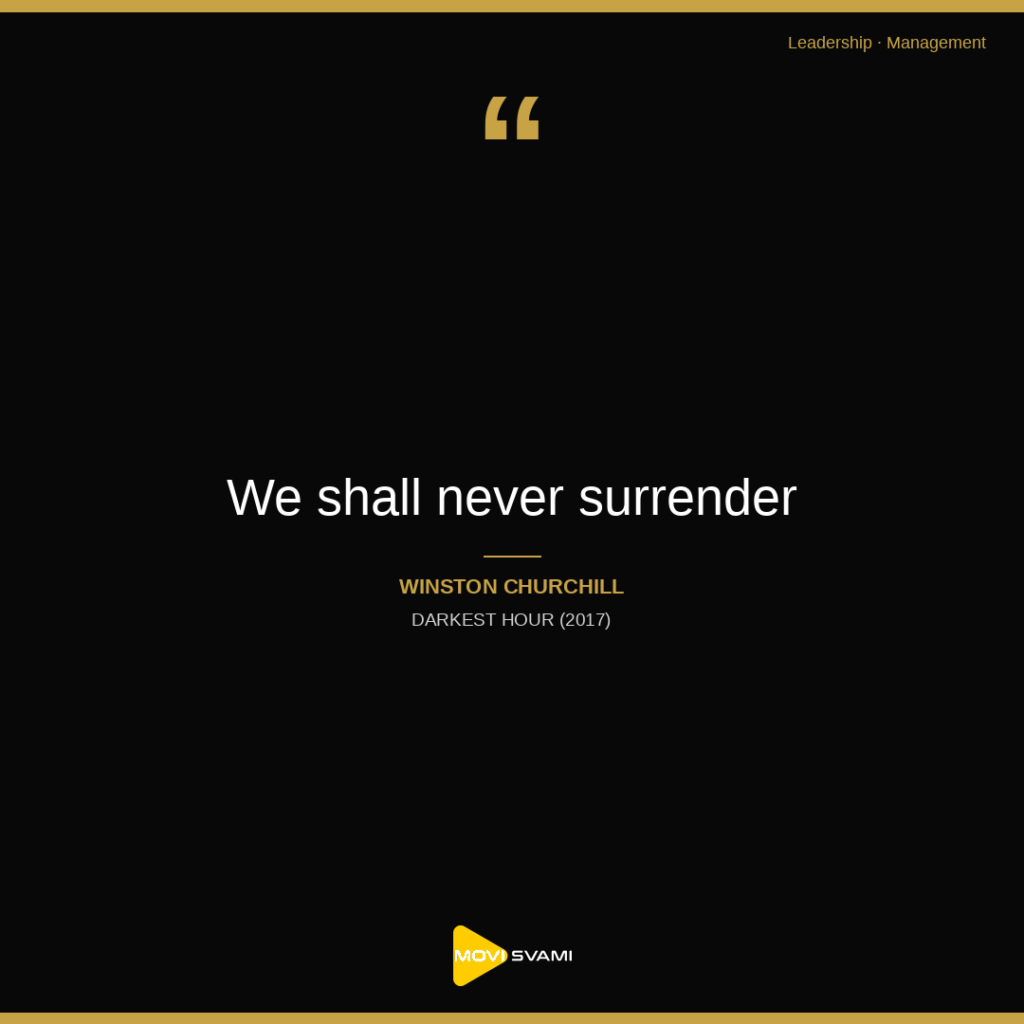
In the cramped confines of the Underground War Rooms, May 1940, the weight of empire pressed against concrete walls. Lord Halifax, Foreign Secretary and architect of appeasement, pushed for negotiated peace with Hitler—a “pragmatic” surrender that would preserve Britain’s fleet while sacrificing its soul. The war cabinet, divided and terrified, saw the Wehrmacht sweeping across France and recognized the mathematical certainty of defeat. Winston Churchill, barely days into his premiership, faced the ultimate test of nascent leadership: capitulate to consensus, or stake everything on an unyielding vision of resistance.
This was not merely diplomatic resistance. It was institutional warfare.
When Churchill thundered “We shall never surrender,” he was not delivering a motivational slogan. He was articulating the non-negotiable foundation upon which his leadership would either stand or collapse. The stakes extended far beyond military strategy; they encompassed civilizational continuity, institutional identity, and the psychological survival of a nation. The war cabinet saw realism; Churchill saw capitulation disguised as prudence. He understood what crisis succession research now confirms: when organizations face existential collapse, survival depends not on compromise but on conviction that reshapes reality itself.
Crisis succession operates counterintuitively to conventional wisdom about leadership appointments. We assume that moments of institutional peril demand conciliators—diplomatic figures who can bridge factions and manage stakeholder anxiety. The historical record suggests the opposite. When the British Conservative Party elevated Churchill over Halifax, they were not selecting a peacemaker. They were selecting an immune response—a leader whose stubborn clarity could navigate absolute chaos when every diplomatic cable suggested surrender.
The “Darkest Hour” principle emerges from this dynamic: Existential threats don’t require leaders who survey the room for agreement; they require leaders who possess the fortitude to fundamentally remake the room’s understanding of what is possible. This explains why corporate boards, when facing genuine catastrophe, consistently pivot toward unyielding visionaries rather than consensus-building administrators.
Consider Lou Gerstner’s arrival at IBM in 1993. The technology giant, hemorrhaging market share and capital, faced institutional dismantlement. The board and activist investors pushed to fracture IBM into autonomous units—a “pragmatic” acknowledgment that the integrated computing model had died. Gerstner refused. Against intense pressure to break the company apart, he staked his leadership on the counterintuitive vision that IBM’s future lay not in fragmentation but in integration—services, hardware, and software operating as a unified ecosystem. His stubbornness seemed irrational to markets accustomed to quarterly rationalization. Yet his refusal to capitulate to the “realistic” dismantlement strategy preserved the institutional knowledge and client relationships that would eventually generate $100 billion in market value. Like Churchill facing Halifax, Gerstner recognized that survival required rejecting the false choice between dignity and existence.
Alan Mulally’s tenure at Ford Motor Company during the 2008 financial crisis demonstrates the same principle. While General Motors and Chrysler accepted government bailout bankruptcy—a “reasonable” capitulation to market forces—Mulally staked Ford’s survival on manufacturing integrity and the “One Ford” vision. The board faced immense pressure to follow competitors into managed bankruptcy, which would have allowed Ford to shed pension obligations and restructure debt. Mulally’s refusal represented institutional stubbornness in the face of overwhelming consensus. He understood that the brand’s existential threat wasn’t merely financial insolvency but the dissolution of manufacturing capability that bankruptcy would entail. By refusing to surrender Ford’s operational sovereignty, even when capitulation appeared mathematically prudent, he preserved the institutional identity that allowed post-crisis recovery.
More recently, Lisa Su’s elevation at AMD in 2014 illustrates how crisis succession favors architectural vision over incremental optimization. The semiconductor company faced existential competition from Intel and NVIDIA, with analysts unanimously recommending the company abandon high-performance CPU manufacturing—a “realistic” retreat to niche markets. Su’s unwavering commitment to the Zen architecture, despite years of negative cash flow and board skepticism, represented the same Churchill-esque refusal to capitulate to “reasonable” defeat. The result: AMD’s resurrection as a competitive threat to Intel’s decades-long dominance.
These cases reveal a governance pattern often misunderstood by succession committees. We teach that leadership requires flexibility, emotional intelligence, and consensus-building—the soft skills of diplomacy. Yet when institutions face genuine extinction, these qualities become liabilities. The leader who reads the room accurately in May 1940 concludes that Britain must negotiate with Hitler. The leader who remakes the room recognizes that survival requires rejecting the premise of negotiation entirely.
For contemporary boards, the implications are uncomfortable. Crisis succession requires identifying leaders who possess not merely strategic vision but ontological stubbornness—the capacity to articulate an unyielding future when present data suggests impossibility. It requires elevating figures who will resist the war cabinet’s pressure for “pragmatic” surrender, who will refuse to break the company into pieces when dismantlement seems inevitable, who will bet the institution on manufacturing integrity when markets demand financial capitulation.
The question is not whether your organization can find such leaders. The question is whether your board possesses the courage to appoint them when the alternative—surrender dressed as realism—feels infinitely safer.
**When your institution faces its darkest hour, will you choose the leader who articulates the consensus of the room, or the one willing to remake the room entirely?**