
In Mike Judge’s *Office Space*, the protagonist Peter Gibbons undergoes a transformation not through ambition, but through strategic apathy. After his occupational hypnotherapist suffers a fatal heart attack mid-session, Peter emerges from the trance with a peculiar form of clarity: he has simply stopped caring about the professional anxieties that once governed his existence. He no longer fears the Lumberghs of the world, dreads the TPS reports, or worries about the impending layoffs quietly circulating through Initech’s cubicle farm. This dissociation from corporate fear should render him a useless employee, yet paradoxically, it catalyzes his most honest and productive period. The scene serves as a sly revelation that much of what we call “demotivation” is not a lack of drive, but an overabundance of obstruction.
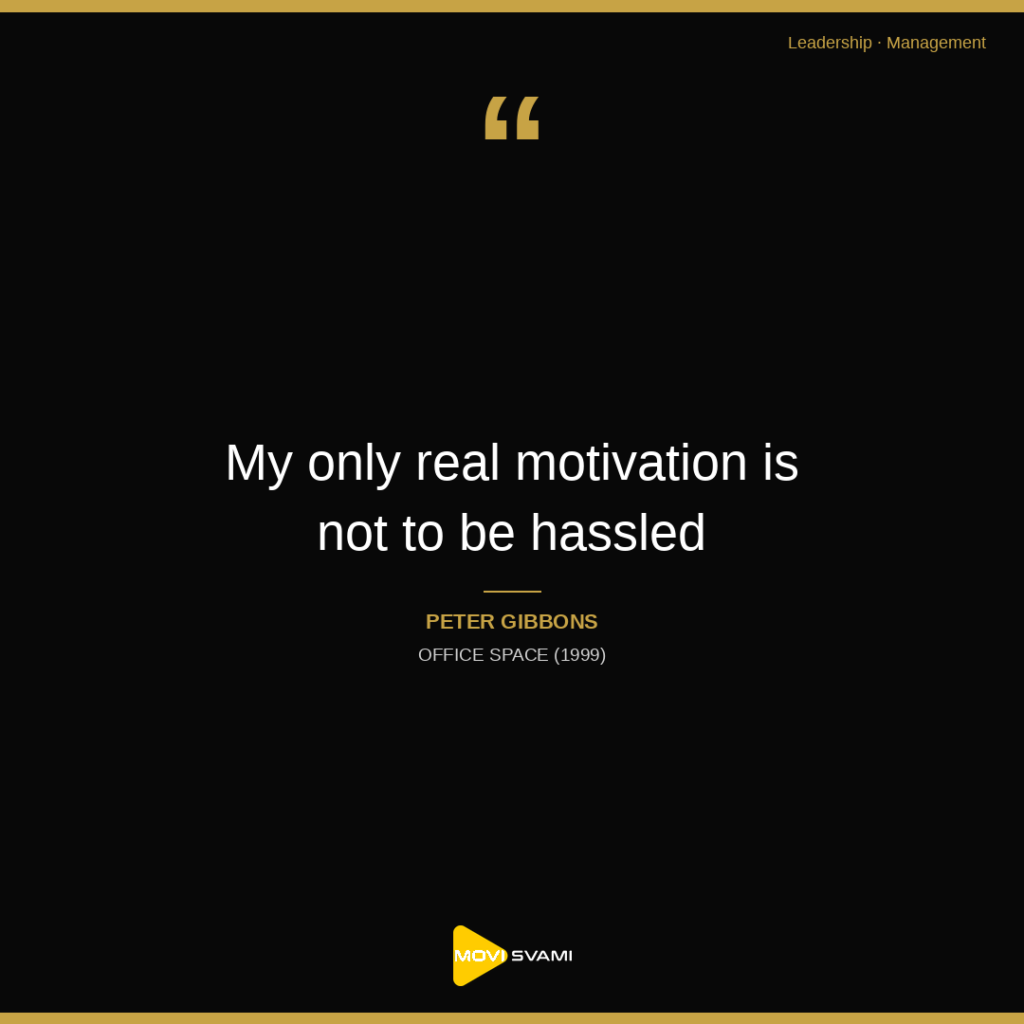
When Peter’s neighbor Joanna asks him what he would do with a million dollars, he confesses he would do “nothing.” Then comes the crucial admission: “My only real motivation is not to be hassled.” On the surface, this reads as nihilism or burnout, yet it contains a sophisticated critique of workplace architecture. Peter is not revealing that he hates work; he is revealing that he hates the artificial work of navigating organizational friction. His previous “motivation” was actually defensive anxiety—the desperate energy required to avoid appearing inadequate, to manage impressions, to check the right boxes for middle managers who checked boxes for other middle managers. When he removes the need to perform diligence, he discovers that he actually possesses ample capacity for genuine contribution. The epiphany is not that incentive no longer matters, but that incentive was never the missing variable. The variable was the absence of fear.
This reframes our fundamental understanding of organizational behavior. Management theory has long operated on an additive model: motivation is a depleting resource that requires constant replenishment through bonuses, gamification, recognition programs, or competitive pressure. Yet Peter’s hypnosis suggests a subtractive model. Humans are naturally inclined toward competence and engagement; the managerial task is not to pour more fuel into the tank, but to release the emergency brake. The “hassle” Peter describes is not merely irritating—it is expensive. It manifests as the cognitive overhead of surveillance, the bureaucratic drag of unnecessary approvals, and the emotional labor of managing up. When leaders add incentive structures without first auditing these friction points, they are essentially trying to accelerate a vehicle that is still anchored to the post. The cost of this friction is not just disengagement; it is the systematic suppression of intrinsic motivation that already existed, buried under layers of administrative precaution.
Many organizations have deployed monitoring software, keystroke trackers, and algorithmic productivity scores in an attempt to capture “efficiency.” Yet these tools introduce precisely the kind of hassle Peter rejects: the cognitive load of performing busyness, the psychological tax of being watched, the micro-anxieties of proving one’s dedication. Employees who were once capable of deep focus now allocate mental bandwidth to demonstrating activity, resulting in the paradox where fifteen minutes of actual work requires eight hours of theatrical availability. The removal of surveillance—trusting output over optics—often yields higher quality work than any performance bonus could purchase.
Many companies have constructed elaborate sign-off hierarchies for decisions that objectively require none. The frontline employee with a $500 budget authority must nonetheless submit to three layers of justification, spreadsheet formatting, and committee review. This creates a chilling effect where the cost of proposing an improvement outweighs the potential benefit. When Peter stops submitting to these rituals, he acts with unencumbered agency—not because he has been incentivized, but because the friction cost has dropped to zero. Smart leaders recognize that the best ideas often die in the waiting room between conception and permission. By subtracting approvers rather than adding champions, they preserve the momentum that already exists.
The modern knowledge worker’s schedule resembles a shattered windshield, with meetings, stand-ups, and check-ins occupying the interstitial spaces between actual work. Each context switch carries a cognitive toll; the “hassle” of preparing for, attending, and recovering from a status update often exceeds the value of the information exchanged. When Peter admits he does only fifteen minutes of real work, he is exaggerating for effect, but the underlying truth resonates: deep work requires contiguous blocks of unharassed time. Leaders who protect their teams’ calendars—who subtract meetings rather than add motivation seminars—are practicing a form of subtraction that yields multiplication.
The most underrated skill in management is not the ability to inspire through charisma or to incentivize through compensation architecture. It is the discipline of removing obstacles. Like a sculptor who reveals form by taking away stone, the effective leader looks for the TPS reports to eliminate, the redundant approvals to dissolve, and the surveillance mechanisms to dismantle. Peter Gibbons’s hypnosis scene is funny because it is recognizable: we have all felt the exhaustion of working under the burden of unnecessary hassle. The tragedy is that we have mistaken this exhaustion for laziness, when it is often just the friction of poor design. True leadership begins not with what we add to the experience of work, but with what we have the courage to subtract.