
Timing the Big Bet: When Leaders Must Make Audacious Moves
In the opening reels of *Ocean’s Eleven* (2001), Danny Ocean assembles a crew not for a simple smash-and-grab, but for an operation requiring almost absurd precision: simultaneous robbery of the Bellagio, Mirage, and MGM Grand vaults, guarded by technology that rivals most government facilities. The logistics are staggering—decoy vans, practiced timing to the second, duplicated security codes, and interpersonal choreography complex enough to rival a space launch. Yet for all the meticulous preparation, Ocean knows the plan is not merely about avoiding detection. It is about recognizing the precise moment when preparation must give way to irrevocable commitment, when the collective nerve of the team must harden into action or dissolve into retreat. The heist is impossible until the moment it isn’t, and that transition happens not in the planning room, but in the gambler’s recognition that the odds have temporarily flipped.
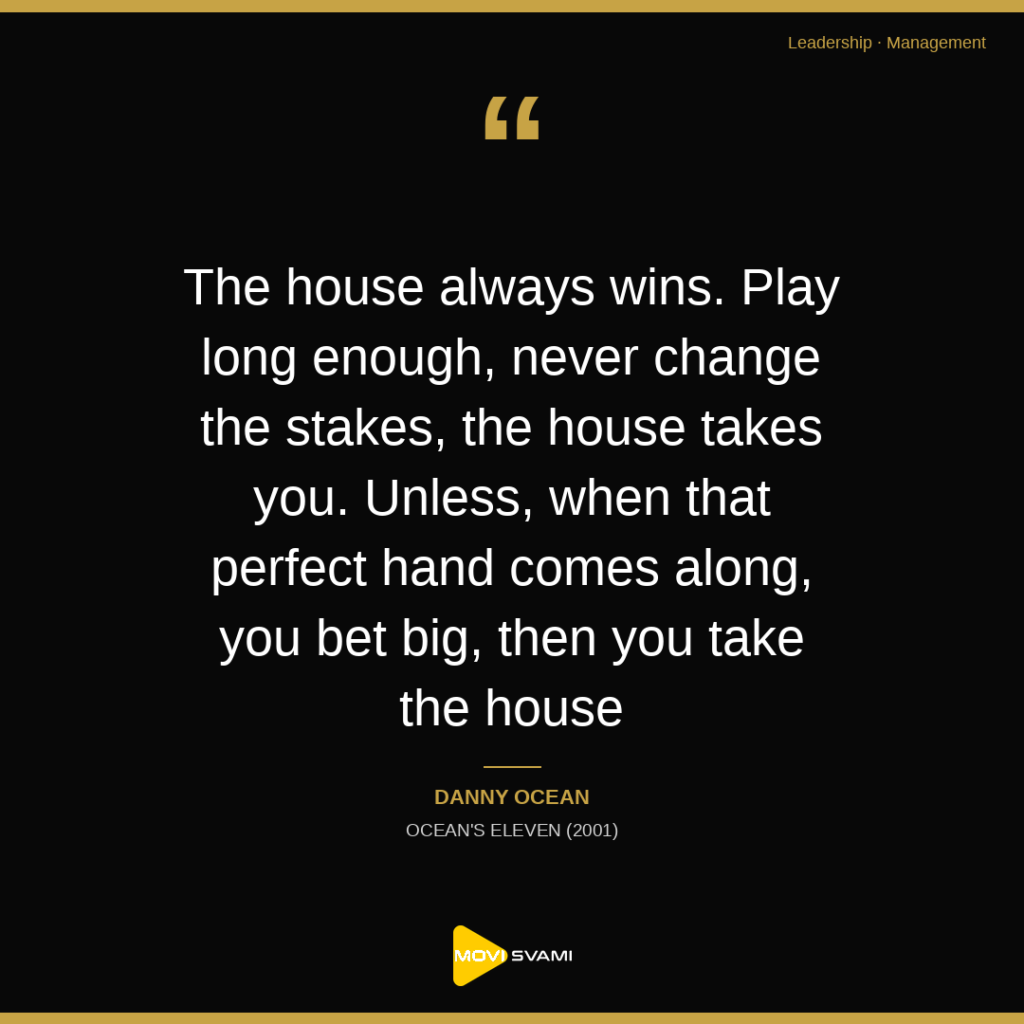
“The house always wins,” Ocean tells Rusty Ryan early in the film, explaining the economic reality that grinding, incremental play inevitably favors the established system. “Play long enough, never change the stakes, the house takes you.” He is describing institutional entropy—the slow bleed of resources, morale, and position that afflicts any competitor playing the incumbent’s game on the incumbent’s timeline. But then comes the pivot: “Unless, when that perfect hand comes along, you bet big, then you take the house.” Ocean is not advocating reckless gambling; he is articulating asymmetric risk theory. The “perfect hand” is the rare convergence of market timing, operational readiness, and competitor vulnerability. It is the strategic inflection point where the cost of caution exceeds the cost of failure. To recognize it requires data, certainly, but also the judgment to distinguish between mere opportunity and decisive advantage—the difference between a hand you can play and a hand that changes the game.
Strategic project planning operates on similar mathematics. Organizations routinely fall into the trap of perpetual preparation, mistaking motion for progress while the competitive window narrows. The danger is not miscalculation; it is the slow attrition of “optimization”—the endless refinement of plans while rivals consolidate market position. Leadership here requires temporal acuity: the capacity to sense when incremental improvements yield diminishing returns and when acceleration becomes the only rational strategy. This is not the false urgency of quarterly pressure, but the disciplined recognition that some strategic moments possess expiration dates. The leader’s obligation is to calibrate the organization’s risk tolerance against the cost of missed timing, understanding that capital deployed too conservatively becomes as wasted as capital deployed too soon.
Consider the dynamics of product launch windows. Markets rarely offer endless patience for perfect iteration; they offer temporary vacuums where consumer attention and competitive response align. The technology sector is littered with cautionary tales of firms that engineered superior products only to find the market had closed—victims of the house’s grinding advantage. Conversely, successful launches often hinge not on feature completeness but on temporal courage: the willingness to ship when the product is “good enough” and the moment is optimal. This is Ocean’s logic applied to product strategy. The “bet” is the commitment to manufacturing scale, marketing spend, and organizational reputation before validation is certain. The leader must ask: Are we preparing to enter the market, or are we preparing to miss it?
Resource concentration decisions reveal the same pattern in competitive warfare. In stable markets, diversification protects against volatility; in contested ones, dispersion guarantees defeat. There comes a point in competitive dynamics where distributed investment becomes strategic dilution, where holding reserves for “future opportunities” actually cedes the current opportunity to more committed rivals. This is particularly acute in capital-intensive industries or platform economies where network effects create winner-take-most dynamics. The executive must recognize when the physics of competition shifts from attrition to decisive battle, when the marginal return of an additional dollar spent in research or market expansion exceeds the option value of keeping it in reserve. It is the difference between managing a portfolio and capturing a market—between playing the house’s game and owning the casino.
Finally, there is the question of organizational transformation. Digital initiatives, restructuring programs, and cultural change efforts often fail not from lack of vision but from half-measures—continuous pilot programs and “phased approaches” that signal organizational hesitation. Yet true strategic inflection requires what military strategists call “the culminating point of attack”: the moment when resources must shift from preliminary maneuvers to main effort. Going all-in on a strategic initiative means irrevocably aligning talent, capital, and executive attention behind a single thesis, accepting that retreat will be costly and partial commitment fatal. It is the corporate equivalent of Ocean’s crew entering the vault elevator: the door closes, the descent begins, and contingency plans evaporate. The organization is no longer experimenting; it is executing.
As you review your current strategic posture, consider this: Are you managing risk in preparation for the perfect hand, or have you mistaken indefinite preparation for risk management itself? What would it take to recognize the moment when the odds shift, and do you have the institutional courage to bet accordingly?