
The afternoon light filtering through the Red Keep’s godswood carries the amber weight of autumn and ending. Ned Stark, Hand of the King, believes he holds the winning card—knowledge of Cersei Lannister’s treason, her children’s illegitimacy, a secret that could topple a dynasty. He offers mercy disguised as justice: exile, silence, survival for her and her brood if she flees quietly into the night. It is, by the codes of honor he understands, a generous gift, a statesman’s solution that preserves life while achieving the transition of power.
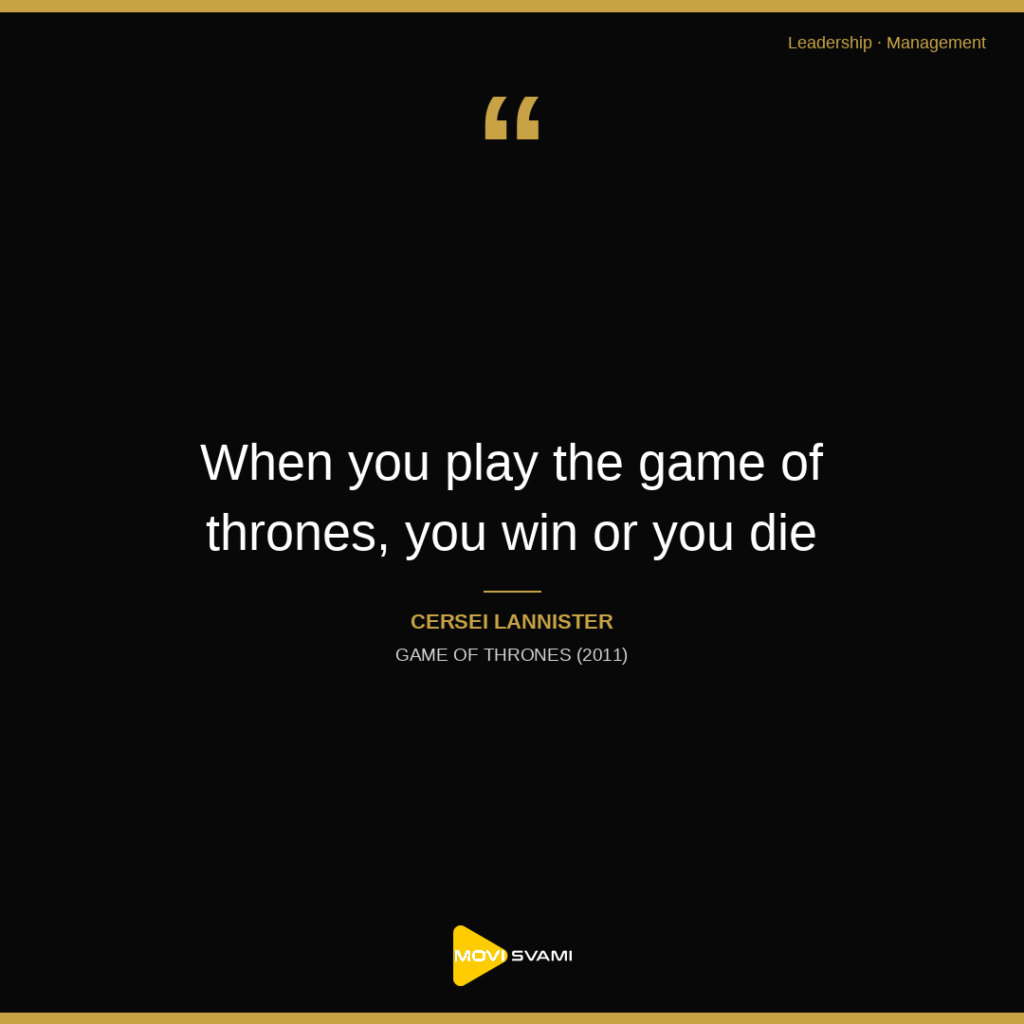
Cersei looks at him not with gratitude but with the detached clarity of a physicist observing a falling object. “When you play the game of thrones, you win or you die,” she tells him. “There is no middle ground.” Her voice is level, ice-eyed, deliberate, absolute. She is not threatening him; she is explaining the thermodynamics of power to a man who mistakes the rules of honor for the rules of the game. In this moment, she articulates the zero-sum structure that Ned’s romanticism refuses to see: the throne is a fixed asset, sovereignty is non-fungible, and in such contests, neutrality is a logical impossibility. You are either seated on the throne or you are dead; there is no standing room, no observers’ gallery, no benign spectatorship in existential competition.
The scene’s brutality lies not in its violence but in its accuracy. Cersei diagnoses the illusion of compromise—the belief that in existential competition, one can hedge, delay, or find a cooperative third way. Ned’s offer of exile is read correctly not as mercy but as weakness, a failure to recognize that the contest for the Iron Throne operates on binary outcomes. Half-measures here do not mitigate risk; they compound it, creating the precise hesitation that allows opponents to consolidate power while you deliberate. The middle ground, she implies, is not safe harbor but the shoal where commitment runs aground.
For executives operating in high-stakes environments, Cersei’s calculus offers an uncomfortable calibration tool. Modern management theory lionizes integrative bargaining, “win-win” scenarios, and cooperative game theory. These frameworks optimize for value creation in positive-sum contexts—markets with expanding pies, complementary goods, and network externalities that benefit multiple participants simultaneously. Business schools teach that compromise preserves relationships and creates sustainable advantage. But leaders must develop the discernment to recognize when they have left that territory and entered Cersei’s landscape: winner-take-all platform competitions, zero-sum regulatory licensing contests where only one firm secures the permit, or existential M&A battles where only one combined entity can survive the debt load. In these environments, binary thinking becomes not a cognitive bias to be corrected through “and/both” leadership, but a survival mechanism to be honed.
The danger lies in strategic ambiguity—the seductive idea that “optionality” preserves freedom of action. In cooperative games, preserving options is rational; flexibility allows pivoting toward emergent value. In zero-sum, existential contests, optionality is lethal precisely because the window for decisive action is finite and the resource requirements for winning are absolute. Consider the acquiring CEO who seeks to preserve “target company culture” as a compromise to talent retention, resulting in dual power structures, confused reporting lines, and the worst of both organizations rather than the best. The binary reality is that acquisition requires subsumption or failure. The middle path creates organizational antibodies that reject the host, consuming the very value the deal was meant to capture while competitors who integrated fully capture market share.
Similarly, examine technology firms entering heavily regulated markets—healthcare, finance, defense—through “regulatory arbitrage.” The illusion of compromise suggests one can disrupt incrementally, remaining “sort of compliant” while scaling, hoping to outrun enforcement. This misunderstands the binary nature of regulatory permission: either one possesses the compliance infrastructure to survive scrutiny, or one does not. The middle ground draws capital and talent into a trap where sudden enforcement triggers immediate collapse, whereas total commitment to compliance (or decisive market exit) preserves strategic coherence and stakeholder trust.
Perhaps most critically, Cersei’s wisdom illuminates the pathology of the corporate turnaround. When Blockbuster Corporation flirted with digital streaming while simultaneously protecting its DVD rental revenue, it committed to neither paradigm. The binary choice—pivot entirely to digital infrastructure or double down on physical optimization—was obscured by the comfort of “strategic optionality” and “phased transitions.” The result was resource dispersion insufficient to win either contest, burning the cash necessary for full transformation while Netflix committed absolutely to the streaming model. In crisis, leaders must recognize whether they face a binary restructuring requiring total commitment to the new model, or managed decline. Half-pivots consume the runway necessary for survival, ensuring the death Cersei names while pretending to choose life.
The discomfort of this analysis is not its cruelty but its specificity. Not all leadership requires binary thinking; indeed, its overapplication destroys collaborative innovation and alienates talent. But when the game is thrones—when markets converge to monopoly, when regulatory windows slam shut, when acquisition targets must be fully digested or discarded—pretending the game is cooperative theater guarantees the outcome Cersei predicts. The reflection for executives is not whether you play to win, but whether you have accurately diagnosed if you are playing at all, or merely waiting to die in the middle ground.