
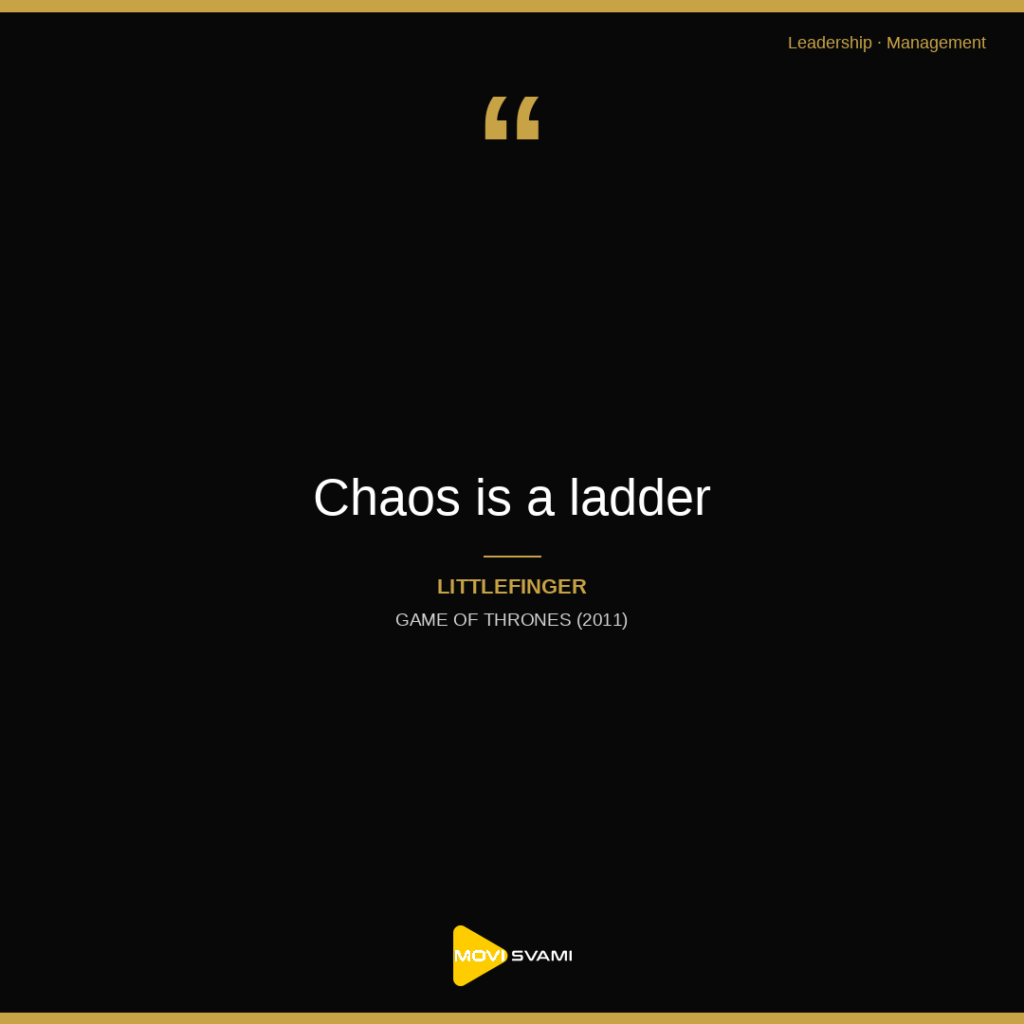
The throne room of the Red Keep is silent except for the whisper of silk and secrets. Petyr Baelish, the Master of Coin, stands before the Iron Throne—not to claim it, but to explain why he doesn’t need to. In this moment from HBO’s Game of Thrones, Littlefinger delivers a masterclass in strategic philosophy to his rival Varys. “Chaos isn’t a pit,” he says, his voice measured, almost gentle. “Chaos is a ladder.”
This isn’t a boast about causing destruction; it’s a dissertation on structural opportunity. Baelish has spent years building invisible networks—whisperers in brothels, ledgers in councils, debts both financial and political. When the War of the Five Kings shatters the established order, he doesn’t scramble for safety like the highborn lords. He ascends. The scene reveals a leader who understands that systemic breakdown doesn’t eliminate hierarchy—it merely re-sorts it according to new criteria: information flow, adaptive capacity, and the patience to wait for the optimal moment of leverage.
For executives, the “ladder” metaphor reframes organizational turbulence not as a threat to be survived, but as a transfer mechanism to be navigated. Traditional management theory often treats stability as the default state and change as temporary deviation. Baelish’s worldview inverts this: change is the constant, and the ability to convert instability into positional advantage is the defining executive skill. This requires what we might call “strategic liquidity”—the capacity to move capital, relationships, and attention across organizational boundaries while competitors remain anchored to collapsing structures.
However, this isn’t mere opportunism. The ladder only exists for those who have previously invested in network infrastructure. Baelish can climb because he spent years placing rungs—cultivating sources, understanding incentive structures, maintaining optionality. The rigid leader treats organizational charts as static maps; the adaptive leader treats them as weather patterns—temporary configurations indicating where pressure is building and where vacuum awaits filling. The leader who attempts to exploit chaos without this preparatory architecture doesn’t climb; they fall.
When two organizations combine, the resulting ambiguity around reporting structures and resource allocation creates a temporary market for influence. Executives who spend the integration period defending their pre-merger territories often find themselves sidelined in the new entity. Conversely, those who treat the integration as an information arbitrage opportunity—mapping the informal power networks of the acquired firm, identifying underutilized talent invisible to due diligence, repositioning their functions at the intersection of previously separate value chains—can convert organizational trauma into accelerated authority. This requires emotional detachment from the previous regime. The executive who mourns the old structure cannot see the new geometry forming in its place. The ladder here isn’t the org chart; it’s the adjacency matrix of who actually makes decisions when the manual is being rewritten.
Legacy institutions undergoing digital disruption often experience a collapse of traditional authority structures. The seniority that guaranteed influence in an analog environment becomes irrelevant when technical literacy determines strategic capability. Leaders who recognize this shift early don’t resist the devaluation of their traditional credentials; they leverage the transition period to acquire new forms of capital—data fluency, ecosystem partnerships, platform governance expertise. Like Baelish, they understand that when the old gods fail, the new priesthood rises. They recognize that during technological transitions, authority becomes temporarily liquid, flowing to those who can translate between legacy systems and emerging protocols. The executive who treats digital chaos as a credentialing opportunity rather than a threat to their expertise builds the ladder’s upper rungs while competitors cling to rotting foundations.
Economic downturns or PR catastrophes create what economists call “creative destruction”—not just of assets, but of brand relationships and customer loyalty. Organizations that retreat into defensive posturing during these moments cede narrative space to competitors. The executive who maintains “strategic liquidity” in crisis—holding reserve communication capacity, maintaining relationships with non-traditional stakeholders, preserving optionality in supply chains—can reposition their brand as the stable alternative in a shaken market. This isn’t exploitation of suffering; it’s recognition that turbulence reveals which institutions have built genuine resilience versus those maintained by market inertia. The ladder here is constructed from trust asymmetries—when competitors falter, the prepared leader steps into the credibility vacuum.
Baelish’s philosophy is morally neutral but mechanically precise. The ladder exists whether we climb it or not. The question for modern executives isn’t whether to acknowledge the existence of organizational chaos—market volatility, technological disruption, and geopolitical instability ensure its permanence. The question is whether you’ve invested in the network infrastructure, the information systems, and the adaptive patience to ascend when the structure beneath you begins to shake. The choice, as always, remains yours: prepare the climb, or prepare the fall. Which are you choosing?