
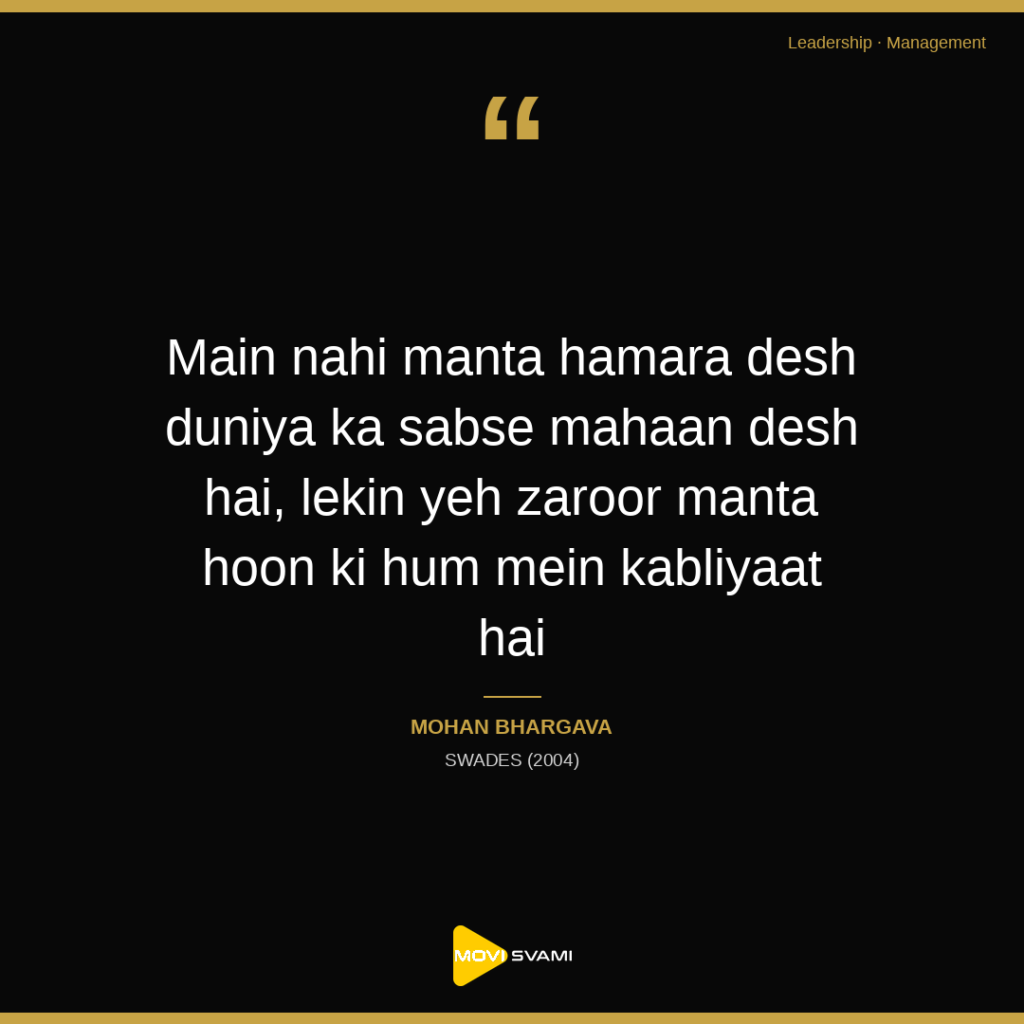
When Shah Rukh Khan’s Mohan Bhargava stands before the villagers of Charanpur and utters words that would make a jingoist cringe, he offers something far more valuable than patriotic platitudes: honest hope that can actually deliver change.
‘Main nahi manta hamara desh duniya ka sabse mahaan desh hai,’ he admits, refusing to participate in the comfortable delusion of supremacy that requires no action, no improvement, and no risk. ‘Lekin yeh zaroor manta hoon ki hum mein kabliyaat hai.’ But we have capability. This is not cynicism dressed in criticism; it is the foundation stone of authentic leadership, the only kind that survives contact with reality.
In an era where leadership often devolves into performance art—where managers shout about exceptionalism while ignoring the leaking roof and broken systems—Bhargava’s approach feels revolutionary in its simplicity. The NASA scientist who returns to rural India doesn’t arrive with lectures about historical glory; he arrives with eyes wide open to present failures. He sees the power cuts that plunge villages into darkness, the educational gaps that trap children in poverty, the caste divisions that fracture community, and the resigned acceptance of ‘fate’ that has replaced agency. He sees the things that break the heart.
But crucially, and this is what distinguishes the leader from the critic, he sees something else that others have missed: latent potential waiting for ignition. He sees the intelligence in the schoolteacher’s eyes despite the lack of resources. He sees the work ethic in the farmers despite the drought conditions. He sees the capability that has been suppressed by circumstance but not extinguished.
This is the leadership lesson we desperately need in boardrooms and communities alike. Authentic leadership acknowledges current reality while betting on latent potential. It refuses the false choice between toxic positivity (‘everything is amazing!’) and resigned cynicism (‘nothing can change’). Instead, it occupies the difficult middle ground of critical optimism: seeing clearly what is broken while maintaining unwavering belief in the capacity to fix it.
Consider the alternative approaches that dominate modern management. The leader who insists everything is fine despite evidence to the contrary loses credibility the moment the team encounters an obstacle they can’t perform their way through. The facade crumbles, and with it, trust. Conversely, the leader who sees only problems without believing in solutions creates learned helplessness, a culture of complaint without construction. Bhargava offers a third way, the narrow path of honest builders. He validates the struggle—’Yes, the electricity fails; yes, the system is unjust; yes, we are not yet great’—then pivots immediately to agency: ‘But look at what we could build if we trusted our capability.’
There is a crucial distinction between Bhargava’s honesty and mere complaining. The critic identifies flaws to dismiss; the leader identifies flaws to repair. When Bhargava admits India is not the greatest, he isn’t wallowing in shame or accepting inferiority. He is establishing a baseline from which genuine improvement can be measured. This is the difference between diagnostic honesty and destructive criticism. The leader uses truth as a foundation for construction, not as a reason for demolition.
In organizational contexts, this translates to the courage to conduct honest post-mortems without blame, to acknowledge market share losses without spiraling into despair, and to admit skill gaps without shame. The modern leader must become an archaeologist of capability, excavating the hidden competencies of their team that have been buried under years of bureaucratic sediment and negative self-talk.
Bhargava’s investment in the village isn’t primarily financial, though he brings resources; it is psychic and spiritual. He bets on their capability before they believe in it themselves. This is the essence of leadership: seeing the possible in people who have stopped seeing it in themselves. When he convinces the villagers to generate their own electricity, he isn’t just solving an infrastructure problem. He is proving that the capability he named is real, tangible, and accessible.
The resistance he faces isn’t from the British Empire or external enemies, but from internalized limitations and colonial mindsets. ‘This is how things are,’ the villagers insist. ‘This is our fate.’ Bhargava’s leadership is the radical refusal to accept that stasis. He understands that before you can change material conditions, you must change the narrative about what’s possible. You must convince people that they are capable of change before they can attempt it.
For today’s leaders navigating volatile markets and skeptical workforces, the application is clear. Stop claiming your company is ‘world-class’ when the servers keep crashing and the culture is toxic. Stop insisting your team is ‘the best’ when turnover suggests otherwise. Instead, follow Bhargava’s lead: acknowledge the gap between current reality and potential with clarity and compassion, then invest relentlessly in closing that gap through capability development. The most patriotic thing a leader can do—whether to their country or their company—is love it enough to tell it the truth, then work to make that truth better.
True leadership doesn’t rest on laurels or past achievements. It doesn’t require the suspension of disbelief or the denial of present pain. It rests on the uncomfortable, courageous work of seeing things exactly as they are while working tirelessly toward what they could become. That is the capability Mohan Bhargava bet on—and it’s the only bet worth making for any leader who wants to create lasting change rather than temporary comfort.