
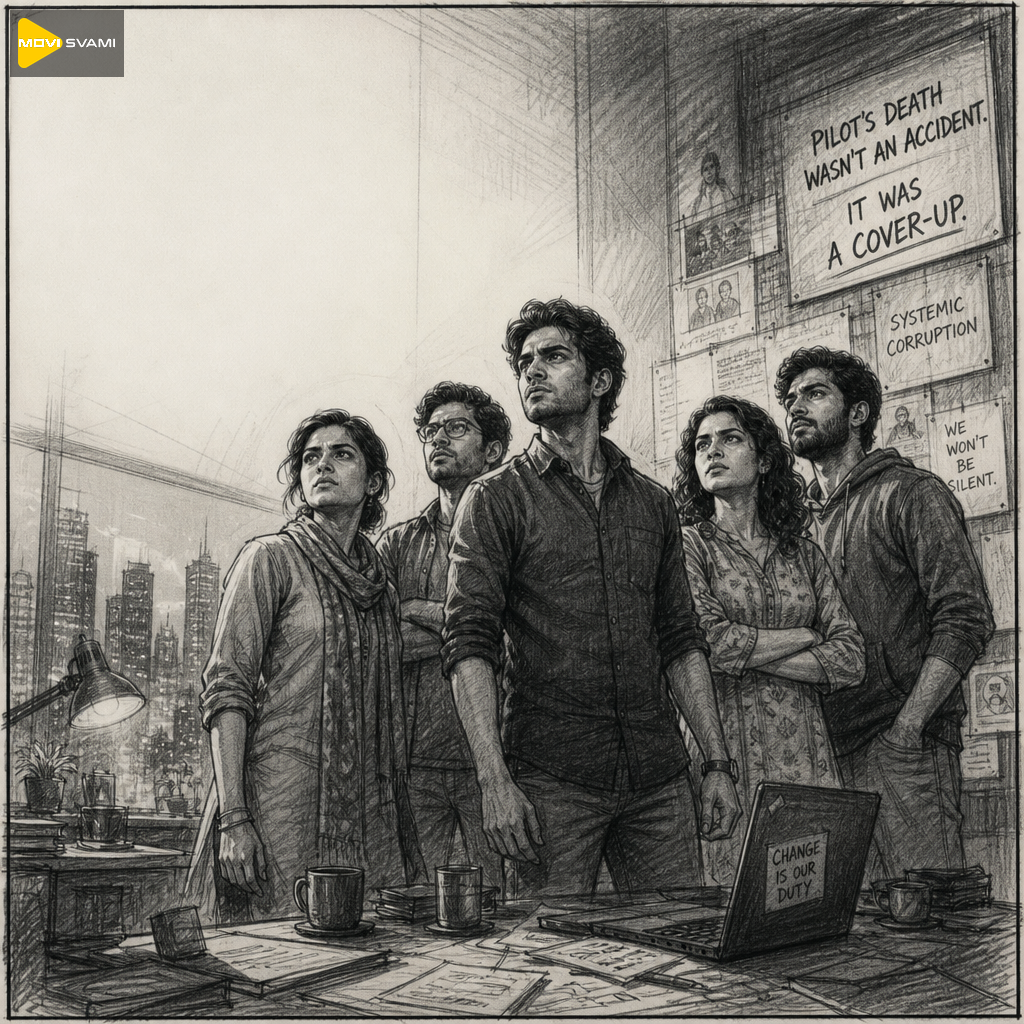
They begin as typical urban millennials—cynical, comfortable, and carefully apolitical. DJ, Karan, Aslam, Sukhi, and Sonia have mastered the art of ironic detachment, mocking the system while benefiting from it, aware of injustice but resigned to its permanence. They are not villains; they are bystanders. And then Flight Lieutenant Ajay Rathod dies, not in combat, but because of corruption in the defense procurement system. The comfortable distance collapses. The question becomes unavoidable: Will they continue to tolerate, or will they take responsibility for change?
‘Zindagi jeene ke do hi tareeke hote hain,’ Sukhi explains, translating their new understanding into action. ‘Ek jo ho raha hai hone do, bardaasht karte jao, ya phir zimmedari uthao use badalne ki.’ There are only two ways to live: either tolerate what is happening, or take responsibility to change it. This declaration marks the birth of collective leadership—the transformation of passive compliance into active ownership of systemic change and moral responsibility.
The genius of Rang De Basanti is that it doesn’t offer a single charismatic hero. DJ is magnetic, but he cannot act alone. The leadership is distributed, emerging from the group’s collective refusal to accept the official narrative that their friend’s death was an accident. It is the ensemble nature of their awakening that makes it powerful. They don’t designate a leader; they become leaders together, each bringing different strengths to the revolutionary act.
This is the leadership model neglected by traditional hierarchies. We train individual executives to lead from the top while ignoring the power of collective leadership that emerges when a group simultaneously shifts from ‘someone should do something’ to ‘we must do something.’ The friends in RDB don’t form a committee or elect a spokesperson. They form a conspiracy of care, bound by shared grief and shared responsibility. Their leadership is not positional but moral.
The film draws explicit parallels to the revolutionaries Bhagat Singh, Rajguru, Sukhdev, and Chandrashekhar Azad, suggesting that collective leadership is not a modern invention but a recurring necessity. In every era, systems calcify, corruption spreads, and individuals face the choice the film articulates: tolerate or transform. The revolutionary leaders of the past didn’t wait for permission or perfect conditions; they accepted responsibility and acted with imperfect information and imperfect tools.
For modern organizations, this lesson is urgent. How many toxic cultures persist because everyone assumes ‘that’s just how things are here’? How many ethical violations continue because everyone is waiting for someone else to speak first? Collective leadership emerges when individuals stop calculating personal risk and start accepting collective responsibility. It is the shift from ‘not my job’ to ‘if not me, then who?’
Individual leadership can be co-opted or isolated. A single whistleblower can be fired; a single reformer can be transferred. But collective leadership distributes risk while concentrating moral force. When the group moves together, retaliation becomes more difficult, and the message becomes impossible to ignore. This is why authoritarian systems fear collective action more than individual dissent. The friends in RDB understand that their power lies not in any individual virtue, but in their unbreakable solidarity.
The friends’ transformation is not instant. There is hesitation, debate, and fear. Karan, the privileged son of a minister, represents the internal conflict of complicity. His eventual participation symbolizes the crossing of class boundaries that collective leadership requires. True systemic change cannot be led only by the victims; it requires the participation of those who benefit from the system. When Karan turns against his own father’s corruption, he models the difficult leadership of rejecting inherited privilege for moral accountability.
Their methods become increasingly radical not because they love violence, but because the system proves itself immune to gentler persuasion. This is the tragic reality of collective leadership confronting entrenched power: polite requests often fail where disruption succeeds. The film is controversial in its conclusion, but unambiguous in its message: when institutional channels for change are blocked, collective action becomes moral necessity.
The leadership here is not about individual glory. The friends know they will likely not survive their act. They are not building careers or reputations. They are exercising the ultimate leadership: sacrificing for the collective good without expectation of reward. This is leadership as service, stripped of ego and ambition.
For contemporary professionals, the application is less dramatic but no less important. When you witness harassment and stay silent, you choose tolerance. When you see inefficiency and shrug, you choose tolerance. When you accept ‘the way things are’ because fighting is inconvenient, you choose tolerance. Collective leadership asks more of us. It asks us to risk comfort for principle, to speak when silence is safer, to organize when individual complaint is easier.
The ending is heartbreaking because it suggests that systemic change often requires the ultimate sacrifice. But the film’s enduring popularity suggests that audiences recognize the truth of Sukhi’s declaration. We know, intuitively, that there are only two ways to live. The question Rang De Basanti leaves with every viewer is simple, terrifying, and essential: Which way are you choosing?