
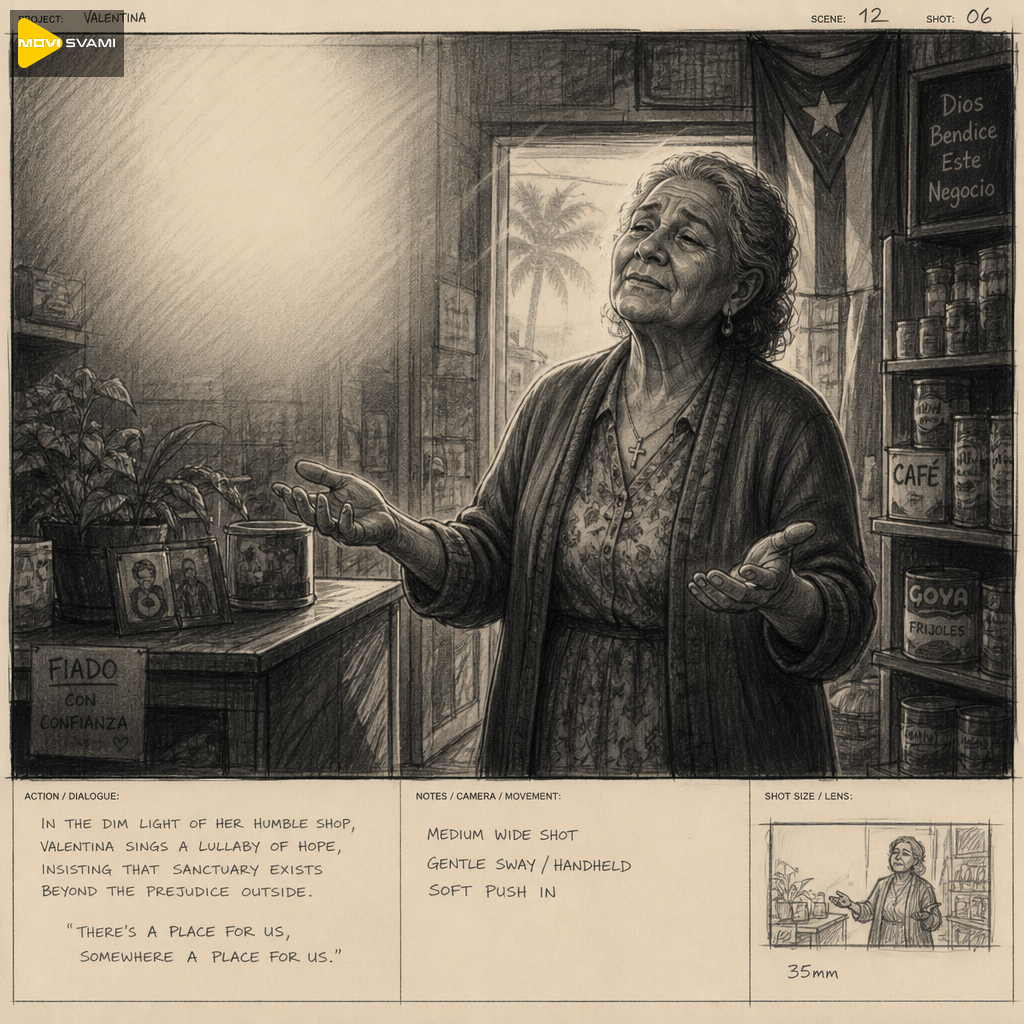
In the amber glow of a cramped corner store that has witnessed decades of territorial violence, Rita Moreno’s Valentina does something that transcends mere performance. She sings. Not for an audience, not for spectacle, but as an act of cartography. When she intones “There’s a place for us, somewhere a place for us” in Steven Spielberg’s *West Side Story*, she is not simply delivering a lullaby to young lovers. She is sketching coordinates for a sanctuary that does not yet exist on any map of the Upper West Side, insisting that belonging is a destination leaders must learn to draw before their teams can arrive there. In a film obsessed with borders—turf lines, ethnic boundaries, the edges of acceptable love—her quiet, steady voice offers a counter-geography. The act matters because it reframes leadership not as the management of existing territory, but as the stubborn, imaginative work of claiming space for those whom systems have rendered placeless.
Valentina occupies a unique position in the film’s architecture of power. As the widow of Doc and the inheritor of his store, she stands at the intersection of the neighborhood’s warring tribes, neither Shark nor Jet but witness to both. When Tony and Maria seek refuge in her shop, they arrive not merely as forbidden lovers but as evidence of a failure—the failure of the streets to accommodate human connection. Valentina’s singing is not naive optimism. She has watched the cycles of prejudice harden into violence; she understands the razor’s edge of the rumble awaiting outside her door. Yet she chooses, in that dim light, to articulate a future where the “sometime” and “somewhere” collapse into a present possibility. The stakes could not be higher. The song is a lifeline thrown across a chasm of systemic exclusion, a refusal to let the brutality outside define the limits of the imaginable. She is not promising easy arrival, but she is insisting that the destination is real.
This scene illuminates a critical dimension of resilient leadership: the obligation to render belonging so vividly that it sustains momentum through periods of active exclusion. Vision, in this framework, is not a motivational poster or a quarterly slide deck. It is a detailed architectural plan drafted under duress. Valentina does not wait for the neighborhood to become welcoming before she asserts the existence of sanctuary. She constructs it in real time, using voice and conviction as building materials. For leaders operating within hostile environments—whether defined by market volatility, political backlash, or organizational toxicity—this is the essential task. Resilience is not merely the capacity to endure damage; it is the discipline of maintaining a clear, navigable image of “somewhere” while standing in the “nowhere” of systemic rejection. The leader’s role becomes that of a cartographer who must sketch the map while the ground is still shifting, providing reference points that prevent disorientation from becoming surrender.
The necessity of this leadership capacity becomes starkly visible across contemporary organizational landscapes. Consider the technology startup navigating a downturn. When capital contracts and hiring freezes transform talent from “culture carriers” into “cost centers,” the default leadership response often involves retrenchment—pulling back on community, silencing the rhetoric of belonging in favor of survival. But the resilient leader recognizes that precarity is precisely when the map matters most. By articulating a “somewhere” that transcends current constraints—a shared project, a standard of craft, a community of purpose that will outlast the economic cycle—leaders prevent the diaspora of their most valuable human capital. The vision must be specific enough to feel tangible: not “we are a family” (which rings hollow during layoffs), but “we are building the infrastructure that will define the next decade, and your specific expertise is the load-bearing wall.”
Similarly, executives steering diversity, equity, and inclusion initiatives through periods of political headwinds face the Valentina test. When external legislation or internal resistance attempts to erase the legitimacy of certain identities in the workplace, the resilient leader cannot rely on defensive compliance or hedged language. They must paint the belonging so vividly that it becomes structural. This means moving beyond policy defense to narrative construction—describing with granular specificity what the organization becomes when it fully accommodates difference, how decision-making improves when marginalized voices hold equal weight, and what innovations emerge when psychological safety is non-negotiable. Like Valentina, they sing knowing the violence outside continues, but they refuse to let that violence dictate the acoustic properties of the room. The same principle applies to distributed and remote teams, where physical dispersion threatens to fragment culture into isolated silos. Leaders must become intentional cartographers, creating rituals and reference points that make the “somewhere” tangible across time zones and screens, ensuring that digital space feels as consecrated as the corner store.
In moments of acquisition or merger, when two organizational cultures collide with the force of rival gangs, the absence of a clearly drawn “somewhere” results in existential displacement. Employees do not resist change itself; they resist the vertigo of not knowing where they stand. The leader’s task is to sketch the new territory before the anxiety calcifies into departure, articulating not just what is changing but what is being preserved and what is being built. This requires the same courage Valentina displays: the willingness to name a destination while surrounded by evidence of fragmentation, to offer a melody when the prevailing noise is discord.
For leaders operating today, Valentina’s lesson is uncompromising. You do not wait for the world to become welcoming before you build the room. You do not pause the architecture of belonging until the hostility outside subsides. You sing the coordinates into existence, knowing that your team is listening not for promises of ease, but for evidence that somewhere remains navigable. The resilient leader accepts that exclusion is often the condition, not the exception, and responds by drawing the map so clearly that others can follow it home, even through the dark.