
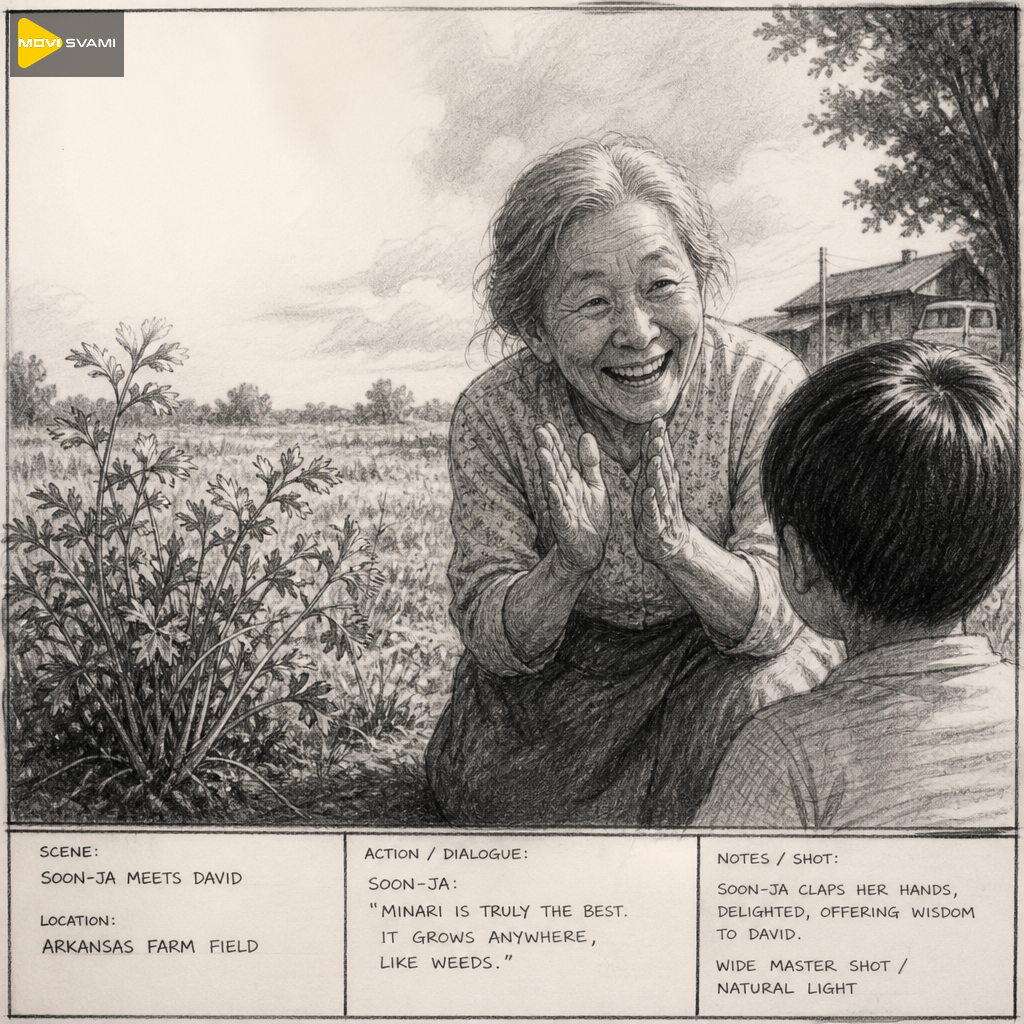
When Soon-ja steps off the plane in rural Arkansas, she does not arrive as the dignified matriarch her daughter Monica has spent years trying to explain to her American-born children. Instead, she shuffles through the terminal with a bag of spices and anchovies, complaining about her swollen feet, and immediately establishes herself as a disruptive variable in the family’s precarious immigrant equation. She cannot cook American food. She refuses to pray the way her son-in-law prefers. She calls her grandson David “not-sweet” to his face. Yet within hours of her arrival, she has identified what the rest of the family has missed: that their survival in this unforgiving soil depends not on assimilation, but on a weed-like persistence they have been trained to despise.
The film’s emotional anchor arrives not in a moment of crisis, but in a quiet walk to a dried creek bed where Soon-ja plants minari seeds she has carried from Korea. When David asks what she is doing, she offers him the observation that becomes the film’s thesis: “Minari is truly the best. It grows anywhere, like weeds.” The statement functions on multiple registers. Botanically, she is describing a herb that thrives in marginal conditions, requiring neither cultivation nor permission. Interpersonally, she is reframing her own presence—unwanted by the ambitious Jacob, confusing to the children, initially disappointing to Monica who hoped for a traditional caretaker. Strategically, she is identifying the only sustainable strategy for cultural survival in a context designed to erode it. The humor in comparing a cherished Korean staple to an invasive nuisance is deliberate; it allows the truth to bypass the defenses of a family exhausted by the performance of success.
This moment reframes eldership away from the ceremonial authority organizations typically associate with seniority. Soon-ja offers no five-year plan, no curriculum vitae, no credentials that would satisfy a hiring committee. Her value lies precisely in what cannot be credentialed: the capacity to recognize viable systems in discarded materials, to maintain coherence without control, and to deliver strategic insight wrapped in apparent triviality. In organizational terms, she represents a form of tacit knowledge that resists codification—the wisdom of having survived multiple economic collapses, migrations, and the specific humiliations of being permanently out of place. Her humor is not a personality quirk but a pedagogical tool, lowering the emotional cost of accepting advice that contradicts dominant logic. When she tells David that minari is better than wealth because “you can eat it,” she is articulating a theory of value that prioritizes regenerative capacity over accumulation, a distinction that eludes Jacob until his well fails and his crops burn.
Organizations frequently misunderstand this form of leadership. Reverse mentoring initiatives, for instance, often fail because they operate on the assumption that knowledge flows in one direction—from digital natives to institutional veterans—while treating older employees as repositories of obsolete tradition rather than adaptive intelligence. The error lies in assuming that technological fluency equals strategic wisdom, while contextual resilience counts as mere survival. A manufacturing firm might pair young data scientists with veteran floor managers to “modernize” operations, only to dismiss the elder’s warnings about supply chain fragility as resistance to change. Soon-ja’s archetype suggests a different approach: reciprocal apprenticeship that recognizes her ability to identify water sources in a drought is as valuable as David’s English fluency. The elder’s role is not to preserve the past but to decode the present through patterns invisible to those who have never faced systemic erasure.
The cost of credential bias becomes visible in how quickly organizations discard employees who lack formal educational markers but possess what Soon-ja embodies—deep familiarity with how systems actually function under stress. A logistics company facing climate disruption might prioritize hiring supply chain analysts with advanced degrees while laying off warehouse veterans who have spent decades navigating the physical realities of inventory under duress. The minari principle suggests that adaptive capacity often resides in those who have never been given permission to thrive, who have learned to extract value from insufficient resources. To honor this wisdom requires structural changes: rotating leadership through operational contexts rather than siloed specializations, rewarding employees who solve problems using unavailable tools, and creating feedback channels that bypass hierarchical reporting structures where junior voices filter what reaches executives.
Building cultures where adaptation is valued means deliberately cultivating cognitive diversity that includes the “unserious.” Soon-ja wins David’s trust not through authority but through transgression—teaching him to cheat at cards, sleeping in, refusing the cuisine of respectability. Organizations can replicate this by protecting spaces where deviation from standard operating procedure is not immediately disciplined, where the employee who notices the creek bed while others focus on the crop yield has authority to redirect resources. This requires executives to tolerate ambiguity, to accept that the most valuable strategic insights may arrive wrapped in anecdotes about weeds, and to recognize that cultural continuity depends less on preserving traditions than on maintaining the capacity to improvise them.
The question for modern organizations is not whether they have senior employees, but whether they have elders—individuals whose authority derives from demonstrated resilience rather than title, who can identify what will survive when the current structures fail. Look at your leadership pipeline. Who in your organization sees the weed and recognizes the dinner.