
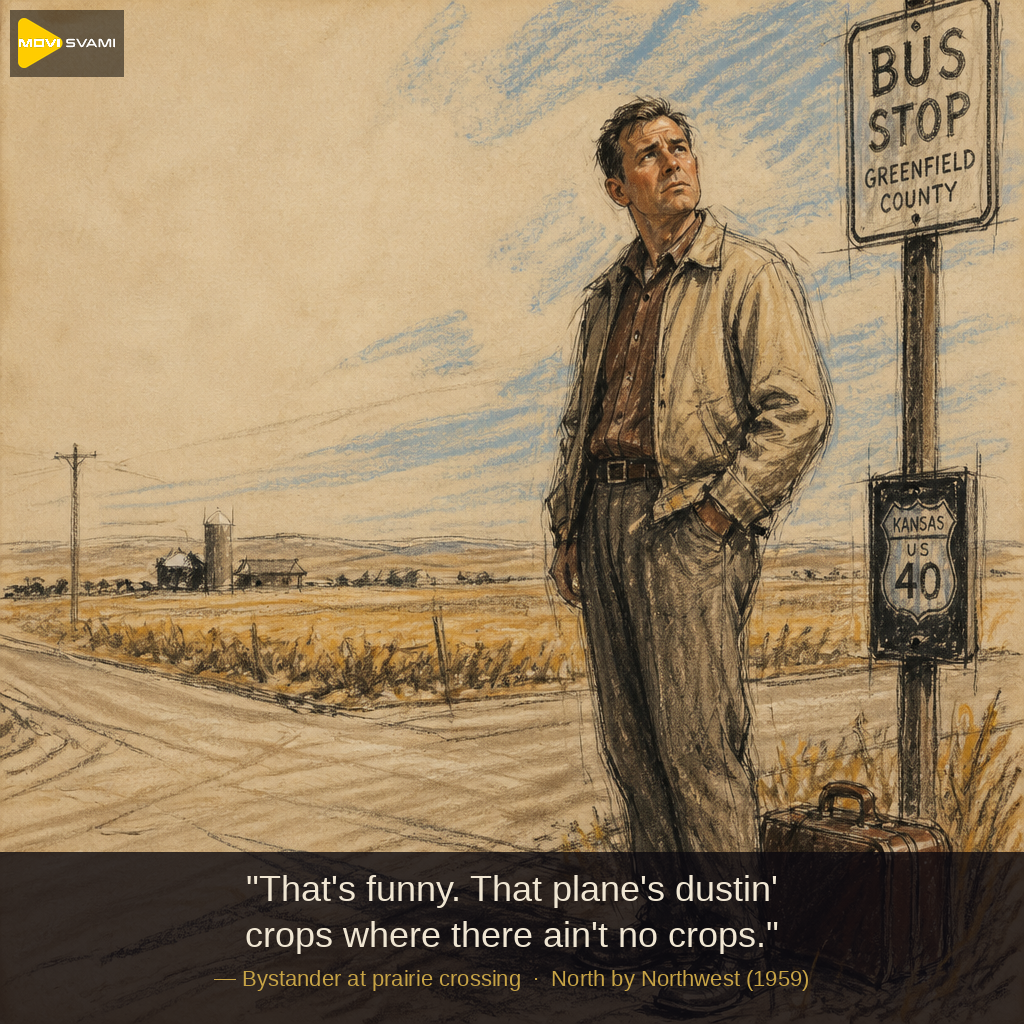
North by Northwest opens with mistaken identity and escalates through increasingly baroque conspiracies until Roger Thornhill finds himself in a wheat field, genuinely stranded, watching a crop-duster circle toward him. The sequence is Hitchcock’s masterwork of visual storytelling and mounting dread. But the crucial moment—the moment that fractures the narrative everyone believes—comes not from Thornhill’s frantic realization, but from a farmer working nearby who makes a simple observation:
“That’s funny. That plane’s dustin’ crops where there ain’t no crops.”
It’s a line delivered with the casual certainty of someone who knows the field, who understands agricultural operations, who sees the misalignment immediately because he is embedded in the actual work, not the story about the work. The farmer is not an expert in espionage. He is not privy to classified information. He is simply observing reality against narrative, and the narrative collapses.
It’s a line that should hang in every executive’s office as a reminder about the nature of organizational truth.
## The Embedded Observer
The farmer’s credibility derives not from rank or credentials, but from proximity to reality. He works in the field. He knows when crops are planted, what the seasons require, what machinery appears and when. He knows the logic of agricultural work because he does that work. When a crop-duster appears over a fallow field, his observational frame immediately flags the contradiction.
By contrast, a visitor from the USDA bureaucracy, reading a memo about “routine dust-crop operation,” would believe the narrative. An executive who approved the flight plan would have no reason to doubt it. Thornhill himself, unfamiliar with farm operations, doesn’t catch the inconsistency. The narrative—the airplane exists to dust crops, therefore crops must be here—maintains its coherence until someone with ground-level knowledge disrupts it.
This is the pattern in every organization. The person closest to the actual work sees misalignment first. Not because they are smarter, but because they are embedded. They see facts, not abstractions. They experience processes, not flowcharts. They notice when systems behave in ways that contradict their stated purpose.
When a production system claims to be optimizing for customer outcomes but actually optimizes for internal convenience, the person running production sees it daily. When a hiring process claims to seek diverse talent but systematically filters for biographical similarity, the recruiter notices. When a product roadmap claims to address user pain points but ships features nobody asked for, the support team knows. The farmer knows there are no crops.
## The Suppression Architecture
Yet most organizations have constructed elaborate systems to prevent such observations from surfacing. Information is compartmentalized—the farmer isn’t meant to have visibility into strategic decisions. Reporting structures are vertical—information flows up and interpretation flows down; the farmer doesn’t communicate directly with executives. And psychological safety is carefully calibrated—speaking up about contradictions is treated as questioning authority, or suggesting incompetence, or “not being a team player.”
The crop-duster can circle indefinitely if the farmer is not allowed to speak.
This manifests in specific ways. The person who says, “I don’t think this process is actually serving its stated goal,” is thanked for their feedback and then nothing changes—which teaches the farmer that observation is performative, not consequential. The employee who finds a workaround because the official system is broken is told to “follow the process,” regardless of whether the workaround is more effective—which teaches them that loyalty to the system matters more than outcomes.
Over time, the farmer learns to stay silent. Not because they stop seeing misalignments, but because speaking up has repeatedly taught them that observation is dangerous, change is resisted, and the system will dutifully continue doing something absurd.
## The Cost of Belief
Here’s what makes the suppression architecture so effective: it works by getting everyone invested in the narrative. Once a process, a strategy, a system has been announced from leadership, invested in, integrated into budgets, made part of the “way we do things,” it becomes costly to question. To admit that the crop-duster is an assassination attempt—not routine agriculture—would be to admit that leadership made an error, that resources were misdirected, that the story was wrong from the beginning.
It’s easier to let the plane circle and trust that the pilots know what they’re doing. It’s easier to cite the official purpose and pretend misalignment doesn’t exist. It’s easier to promote the narrative than to investigate the farmer’s concern.
The cost of this collective denial is that the system continues to operate in service of a purpose it no longer actually pursues. The “crops” that justified the duster have vanished, but the duster flies on, burning fuel, scouring the earth, accomplishing nothing except the maintenance of a narrative.
## Creating Channels for Ground Truth
The organizations that navigate change most successfully are those that have intentionally created structures to surface farmer observations. This isn’t complicated. It requires:
**Flattened information asymmetry** — Decision-makers must be able to hear directly from people who work in the field, without the distortion that comes from hierarchical filtering. This might be regular office hours, skip-level meetings, or anonymous feedback channels. The mechanism is less important than the principle: the farmer’s voice reaches the farmer’s voice reaches decision-makers without being pre-interpreted by the bureaucracy.
**Psychological safety for contradiction** — The person who observes that the narrative doesn’t add up must be able to voice it without fear of retaliation, career damage, or being labeled a poor team player. This requires leadership that visibly rewards such observations, that responds to contradiction with curiosity rather than defensiveness, that treats the farmer not as threatening authority but as extending credibility.
**Coupled observation and action** — The farmer must see that being right about the misalignment produces change, not thanks and continued misalignment. If you surface that a process is broken and nothing shifts, you’ve taught the farmer that observation is performative. If you surface it and the process changes, you’ve created a feedback loop that makes ground truth valuable.
**Structural humility** — Leadership must be willing to acknowledge that proximity to work generates insight that rank does not. The executive who says, “I trust your sense of what’s actually happening because you’re the one doing the work,” has created a context where the farmer becomes a strategic resource, not a problem to be managed.
## The Aftershock
When the farmer makes his observation—”That plane’s dustin’ crops where there ain’t no crops”—the narrative breaks. Thornhill’s understanding of what’s happening shifts. He goes from believing a story (routine agricultural operation) to seeing reality (assassination attempt). The misalignment creates vulnerability; it creates opportunity for adaptation.
In organizations, these moments of narrative collapse are typically treated as failures—evidence of poor planning, insufficient communication, or ground-level misunderstanding. They’re reframed quickly, or suppressed before they spread. But they’re actually opportunities to adapt, to correct course before the crop-duster lands.
The person who can work in a field with no crops and still notice the duster is looking, is observing, is maintaining fidelity to reality over comfortable narrative. They are the organization’s immune system. The question is whether leadership has built the conditions where such people can signal the misalignment before everyone is invested in the fantasy.
The farmer knows there are no crops. The question is whether you’ve created a world where he’s allowed to say it.