
# No Lasting Success Exists Without Absolute Integrity
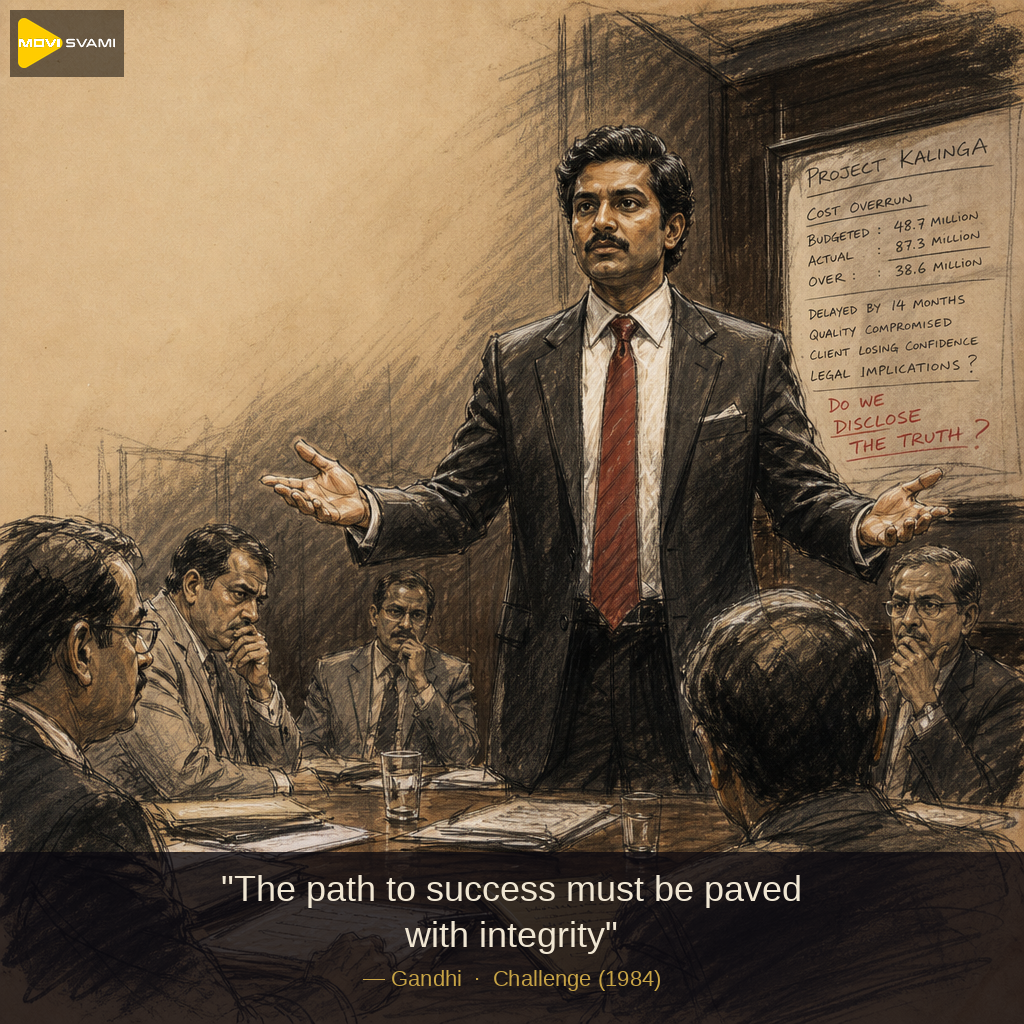
The fluorescent lights of the conference room flickered with the irregular rhythm of a building whose utilities were days from disconnection. Outside, creditors had already begun to circle. Inside, the silence was complete. Gandhi, the founder, sat before a term sheet that represented salvation and arsenic in equal measure. The investor on the other side of the table offered capital sufficient to clear the mounting debt, stabilize the payroll, and arrest the free fall toward bankruptcy. The price, however, was not merely interest or equity. It was complicity. The funds required the deliberate obfuscation of regulatory violations, the quiet acceptance of a partner whose revenue derived from criminal enterprise, and the tacit understanding that the company’s books would become instruments of fiction. It was 3:00 a.m. The team, unaware of the specifics, waited in the cramped main office for word that their jobs, their months of sacrifice, would survive the quarter. Gandhi stood, left the room, and did not sign. He gathered his people in the half-darkness of their exhausted operations floor and told them they would not take the money. He acknowledged that the coming weeks would bring a depth of uncertainty they had not yet faced. Then he redefined their collective mission. They were not building to survive a fiscal cycle. They were building something that would outlast the industry itself. The silence that followed was not relief. It was the heavy, quiet recognition that integrity had just been chosen over immediate survival.
In the 1984 film *Challenge*, Gandhi delivers a line that functions not as a motivational abstraction but as a verdict forged in fire: “The path to success must be paved with integrity.” Within the context of this moment, the statement matters because it acknowledges precisely what is being sacrificed. Immediate solvency. The temporary comfort of employees who would not face immediate termination. The founder’s own need to be perceived as a rescuer. Integrity, in this crucible, costs every transactional advantage that corruption offers. It costs the speed of unregulated growth, the insulation from market discipline, and the silent acquiescence that allows polluted capital to enter a bloodstream and permanently alter its chemistry. What Gandhi sacrifices is the shortcut. What he purchases is the far more expensive prospect of building on ground that will not eventually collapse beneath him.
The mathematics of business often appear to reward the present above all else. Cash flow is oxygen, and without it, philosophy suffocates. Yet leadership at its highest level recognizes that oxygen administered through corruption creates dependency on poison. When an executive accepts a fraudulent bargain to survive a fiscal quarter, they do not preserve the institution. They restructure it around a hidden liability that compounds silently. That liability manifests as legal exposure, cultural cynicism, and the slow dissolution of trust among stakeholders who sense, often before they can articulate, that the foundation has been contaminated. The choice to reject the corrupt investor reframes survival entirely. It is no longer defined by the next payroll cycle but by whether the organization’s skeleton can bear weight five, ten, or twenty years hence. Survival without integrity is merely postponed failure wearing the mask of rescue.
Conversely, integrity functions as a competitive advantage that no amount of capital can directly purchase. In saturated markets, technical differentiation lasts months. Product features are replicated. Pricing models are undercut. What cannot be duplicated with speed or funding is a reputation for unwavering ethical conduct. Clients, partners, and top-tier talent migrate toward entities they do not need to audit for hidden motives. An organization rooted in transparency does not merely weather crises. It emerges from them with strengthened market position because its narrative has never required revision, its contracts have never required secret appendices, and its leadership has never needed to manage the cognitive tax of simultaneous truth and deception. The moat around such an organization is not sanctimony. It is the pragmatic reduction of friction in every negotiation, the deepening of loyalty during downturns, and the insulation from the catastrophic exposure that eventually finds those who cut corners.
This principle manifests across distinct professional landscapes with remarkable consistency. Consider the startup at its scaling inflection point. The mythology of blitzscaling often pressures founders to inflate user metrics, obscure debt structures, or accept capital from sources whose operations fundamentally oppose the startup’s stated mission. The temptation to falsify unit economics to secure a Series B, or to misrepresent capability to force an acquisition, is acute precisely because the alternative feels like standing still while competitors sprint. Yet this is where integrity is most load-tested. Founders who refuse to accelerate through deception build infrastructure that can genuinely bear weight. They attract investors who conduct due diligence without discovering landmines, and they retain early employees who signed on for an authentic mission rather than a fabricated trajectory.
Established companies facing decline confront a different but equally piercing version of this test. Legacy enterprises with shrinking margins possess institutional memory of better quarters, rigid shareholder expectations, and access to complex legal mechanisms that can obscure deterioration. The temptation to manipulate pension obligations, relax safety standards, or greenwash environmentally destructive products to buy eighteen additional months of relevance is rationalized as fiduciary responsibility. Leadership in decline requires the courage to contract with honor rather than expand through fraud. Organizations that face financial winter with transparent balance sheets and honest communication with their workforce often discover unexpected resilience. Employees accept measured sacrifice when they trust that leadership bears an equal portion of the burden. Customers remain loyal to brands that never treated them as collateral damage in a financial shell game.
At the individual level, personal integrity operates as the granular infrastructure upon which all larger organizational ethics depend. The account executive asked to disguise a fee structure. The engineer instructed to bury a safety flaw in a report. The manager encouraged to frame layoffs as voluntary restructuring. Each instance appears isolated, a minor compromise in service of harmony or employment security. Yet these moments are where culture is actually authored. Personal integrity is not a private moral luxury reserved for idealists. It is an operational standard that either elevates or infects the surrounding team. Professionals who document irregularities, ask direct questions, and refuse incremental complicity prevent the normalization of systemic corruption. They become the load-bearing pillars of any enterprise capable of genuine longevity.
Crises are temporal. Markets recover, capital reallocates, and operational models evolve in response to disruption. What persists across these cycles is the trust record an entity accumulates through its darkest hours. Gandhi’s refusal to sign that overnight term sheet did not guarantee his company would see the next sunrise. It guaranteed that if the organization survived, it would not carry a terminal illness at its core. Absolute integrity offers no immunity from hardship. It offers something more durable: the absence of hidden fragility. In an economy addicted to velocity and habituated to convenient deception, the disciplined choice to remain honest is frequently mistaken for naivety. It is not. It is the only architecture capable of supporting weight across decades.