
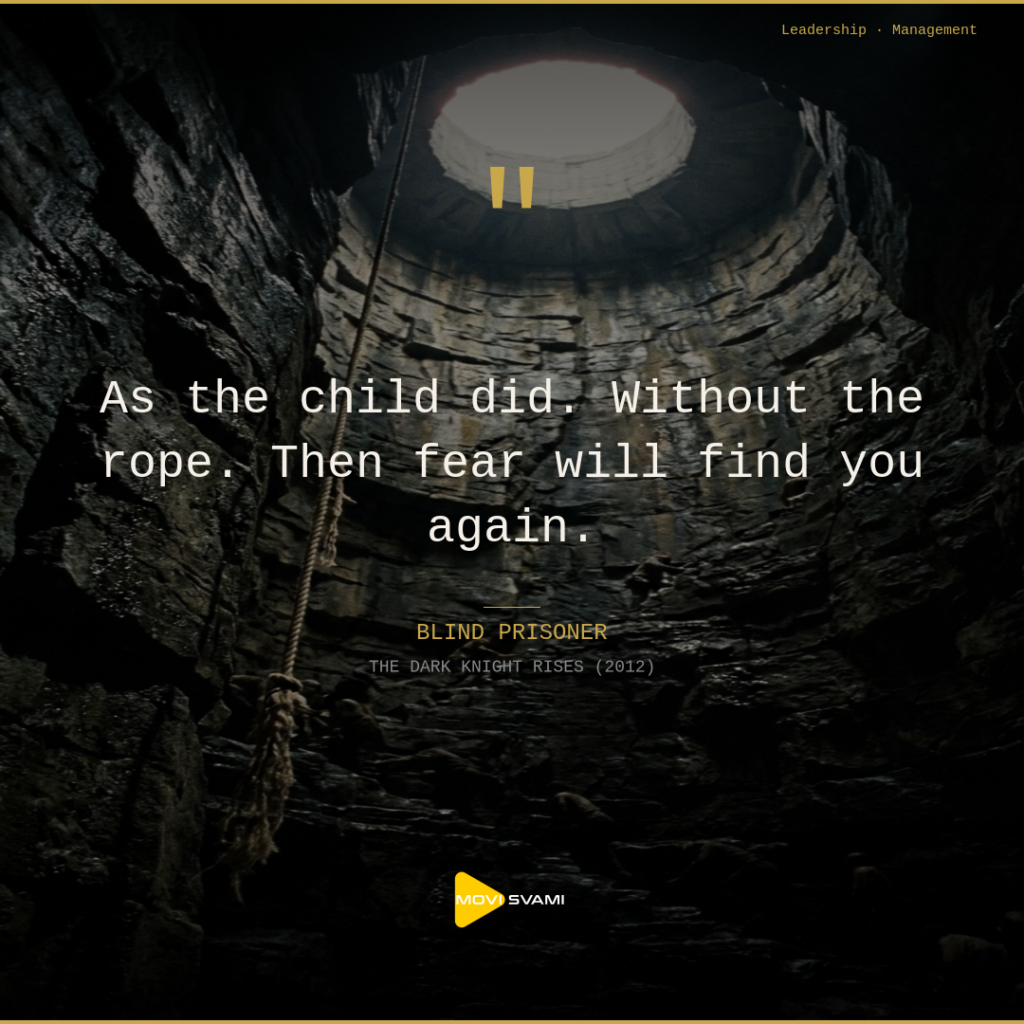
The pit is not merely a prison; it is a psychological crucible. In the ancient well where Bruce Wayne has been left to rot, broken in body and spirit, he watches other inmates attempt the impossible climb to freedom. They ascend the rock walls, tethered to safety ropes that catch them when they fall, until exhaustion or resignation claims them. Wayne tries repeatedly, muscles failing, hope dimming. The rope ensures survival but guarantees failure. It is only when an old, blind prisoner whispers a counterintuitive truth—that the child who escaped did so without the rope—that the scene shifts from physical desperation to existential revelation. The rope, it turns out, is the obstacle.
The Blind Prisoner serves not as a comforting mentor but as a ruthless truth-teller. He observes Wayne’s repeated attempts and identifies the fatal flaw: the rope provides the illusion of progress while preventing the commitment necessary for transcendence. “As the child did,” he advises. “Without the rope. Then fear will find you again.” The child who escaped was not stronger or more skilled; he was simply more desperate. With the rope, climbers make the jump intellectually but not viscerally—they know they cannot die, and therefore they cannot truly live. Wayne must embrace the possibility of death to access the fear that sharpens instinct and overrides hesitation. What is at stake is not merely one man’s freedom but the survival of Gotham itself, held hostage by a ticking clock and a mercenary army. The rope represents the luxury of time and the comfort of contingency, both of which have expired.
In leadership praxis, the rope manifests as the safety net we refuse to cut. We speak of transformation while maintaining legacy revenue streams “just in case.” We announce cultural pivots but keep the old guard in advisory roles, ensuring we can retreat to familiar hierarchies if the new model falters. This is not transformation; it is tourism. True organizational resurrection requires what historians call “burning the boats”—the elimination of return pathways that forces total commitment to the new shore. Safety nets do not merely cushion failure; they prevent the desperate, creative leap that forges genuine rebirth. When leaders have a backstop, they optimize for risk mitigation rather than breakthrough. The rope creates a condition where failure is affordable, and therefore, where mediocrity is sustainable.
Consider the enterprise attempting digital transformation while maintaining its legacy infrastructure as a “fallback.” This is the rope. The organization invests in cloud architecture and agile methodologies but keeps the mainframe running “until the transition stabilizes.” The result is a bifurcated organization that never fully commits to new operational logics because the retreat to the old system remains neurologically and financially available. The fear of total system failure—the fear that would drive genuine innovation—is neutered by the safety line. Until leadership sunsets the legacy systems entirely, forcing the organization to operate without the net, the transformation remains theoretical. The climb continues, but the escape never comes.
In turnaround scenarios, the rope often takes the form of transitional continuity. A new CEO enters a distressed organization and retains the previous executive team “for institutional knowledge,” or maintains legacy compensation structures to “ease the transition.” This is understandable human prudence, but it is fatal strategic error. The old guard represents the gravitational pull of the status quo; their presence signals that the past remains a viable future. The leader who truly resurrects a moribund organization must make the climb without that particular rope—terminating the contracts, eliminating the safety valves, and communicating that the previous era is definitively over. Only when the organization understands that there is no descent back to the familiar does the desperate, creative energy of survival emerge.
Even in innovation culture, we see the rope disguised as “psychological safety.” While creating environments where failure is cheap and experimentation is encouraged has merit, there exists a threshold where safety becomes sedation. When innovation labs are quarantined from the P&L, when “moonshots” are funded by corporate charity rather than existential necessity, the rope is present. The teams know they cannot truly fall, and therefore they do not access the primal fear that produces breakthrough thinking. The most significant innovations in business history have typically emerged not from protected skunkworks but from moments when the organization faced extinction—when the rope was cut by market forces or competitive threat, and survival required the impossible leap.
What is the rope you are currently gripping in your own leadership practice? Is it the undistributed budget that cushions underperformance, the legacy client relationship that justifies outdated service models, or the deferred decision that maintains organizational peace at the cost of strategic relevance? The Blind Prisoner’s wisdom is not comforting, but it is clarifying: you will not ascend until you accept that the fall might kill you. The question is not whether you can afford to climb without the rope, but whether you can afford not to.