
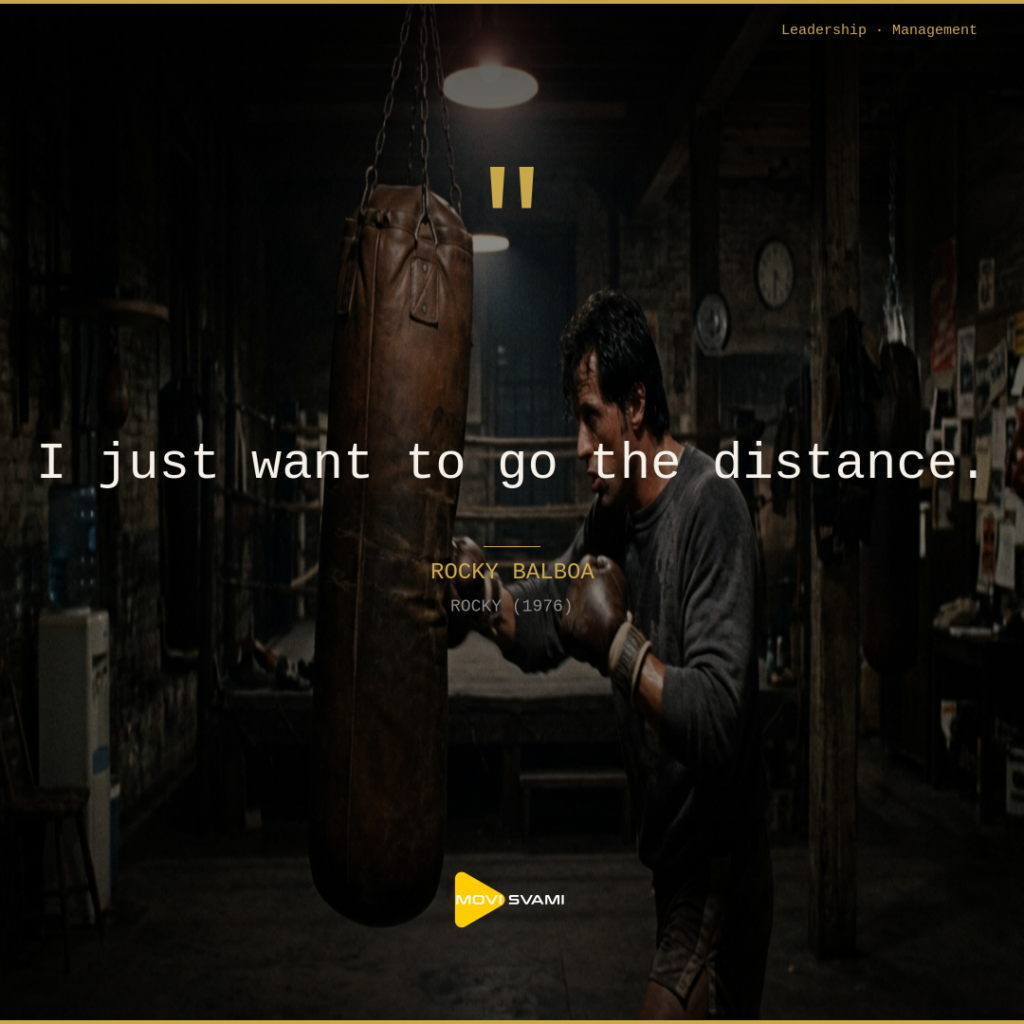
The locker room smells of wintergreen and anxiety. It is 1976 in Philadelphia, and Rocky Balboa—a journeyman club fighter with a 44–20 record—has been chosen to face Apollo Creed, the undefeated heavyweight champion of the world. The bout is a publicity stunt, a Bicentennial joke staged by promoters who expect Rocky to collapse inside three rounds. Everyone assumes this will be a coronation for Creed, a brief violence followed by a count-out. But in a quiet moment before the fight, Rocky confesses to Adrian that his ambition is not to win. “I just want to go the distance,” he says. “Nobody’s ever gone the distance with Creed. And if I can go that distance, seeing that bell ring, and I’m still standing, I’ll know for the first time in my life that I’m not a bum.”
This is not the language of competitive strategy. It is the calculus of endurance. Rocky understands that against superior resources, talent, and market position—embodied by Creed’s speed, power, and polish—the traditional definition of victory (a knockout, a decision, a clear win) is statistically improbable. The real metric of success becomes temporal: can he remain standing when the fifteenth round ends? In boxing, “going the distance” means surviving the full scheduled length of a championship fight. For a 30-year-old “ham-and-egger” who had never fought more than ten rounds, this was considered impossible. The bookmakers gave him 30-to-1 odds not to win, but to last. Rocky reframes the enterprise entirely. He is not trying to defeat the champion; he is trying to defeat the clock.
For executives, this distinction is more than cinematic sentiment. It is a fundamental reorientation of strategic purpose. Modern leadership literature obsesses over “disruption,” “crushing the competition,” and “market domination”—metaphors borrowed from knockout artists. Yet most organizations are not Creed; they are Rocky. They enter markets with entrenched incumbents, finite capital, and talent gaps that no amount of bravado can close overnight. In such contexts, the ability to endure—to remain solvent, coherent, and operationally intact when the final bell sounds—constitutes a more profound victory than a quarterly earnings beat. Endurance is not passive survival; it is active resilience. It requires the discipline to absorb punishment without retaliating wastefully, the pacing to manage energy reserves across fifteen rounds rather than three, and the psychological fortitude to redefine success metrics when the scorecards are predetermined against you.
This principle manifests in three distinct managerial scenarios where “going the distance” separates functional leaders from那些被 spectacle-driven metrics mislead.
**The Turnaround Trajectory.** When a new executive inherits a division bleeding cash and talent, the board often demands immediate “wins”—revenue spikes, cost cuts, or market share gains that signal a knockout punch. But turnarounds are rarely delivered by haymakers. They are won through rounds of incremental stabilization: retaining key clients who were preparing to defect, maintaining morale during hiring freezes, and preserving institutional knowledge while restructuring debt. The leader who keeps the division intact long enough for new capital to arrive or market conditions to shift has gone the distance. They have demonstrated that the organization was not a “bum”—that it possessed underlying structural integrity worth saving, even if the scorecard still shows a loss on the books.
**The Innovation Marathon.** Research and development initiatives, particularly in sectors like biotechnology, advanced manufacturing, or climate technology, operate on timelines that exceed quarterly reporting cycles. A leader funding a seven-year R&D pipeline faces the equivalent of Creed’s jab: skeptical investors, competitor product launches, and internal pressure to pivot to surer bets. The temptation is to swing for early proof-of-concept knockouts—premature product launches that generate buzz but fail to scale. The disciplined leader instead manages for endurance, allocating capital to sustain the team through the full fifteen rounds of clinical trials, regulatory review, and iteration. Victory here is not being first to market, but being the last laboratory still standing when the technology finally matures.
**The Crisis Consortium.** During economic contraction, industry-wide consolidation, or supply chain collapse, the prevailing wisdom advocates aggressive downsizing—”taking a knee” to preserve cash. But there is a difference between strategic retrenchment and forfeiture. The leader who maintains core capabilities, keeps critical talent off the market, and preserves customer relationships through a downturn is going the distance. When competitors have exhausted themselves through panic layoffs or fire-sale divestitures, the organization that endured the full schedule emerges with its gloves still up, ready to compete in the rebound. The market does not always reward the hardest puncher; it rewards the fighter who is still there when the economy’s bell rings.
Leadership, at its core, is the management of endurance against entropy. Rocky Balboa did not defeat Apollo Creed in that first fight; he lost by split decision. But he achieved something more valuable than a belt. He proved that his effort could sustain itself against the best opposition in the world for the full duration of the contest.
As you face your next board meeting, budget cycle, or market entry, consider this: Are you measuring success by the knockout you hope to land in round three, or by the standing position you intend to occupy when the final bell sounds? What would it mean for your strategy, your team, and your own professional identity if you stopped trying to win the fight in the opening rounds, and committed instead to going the distance?