
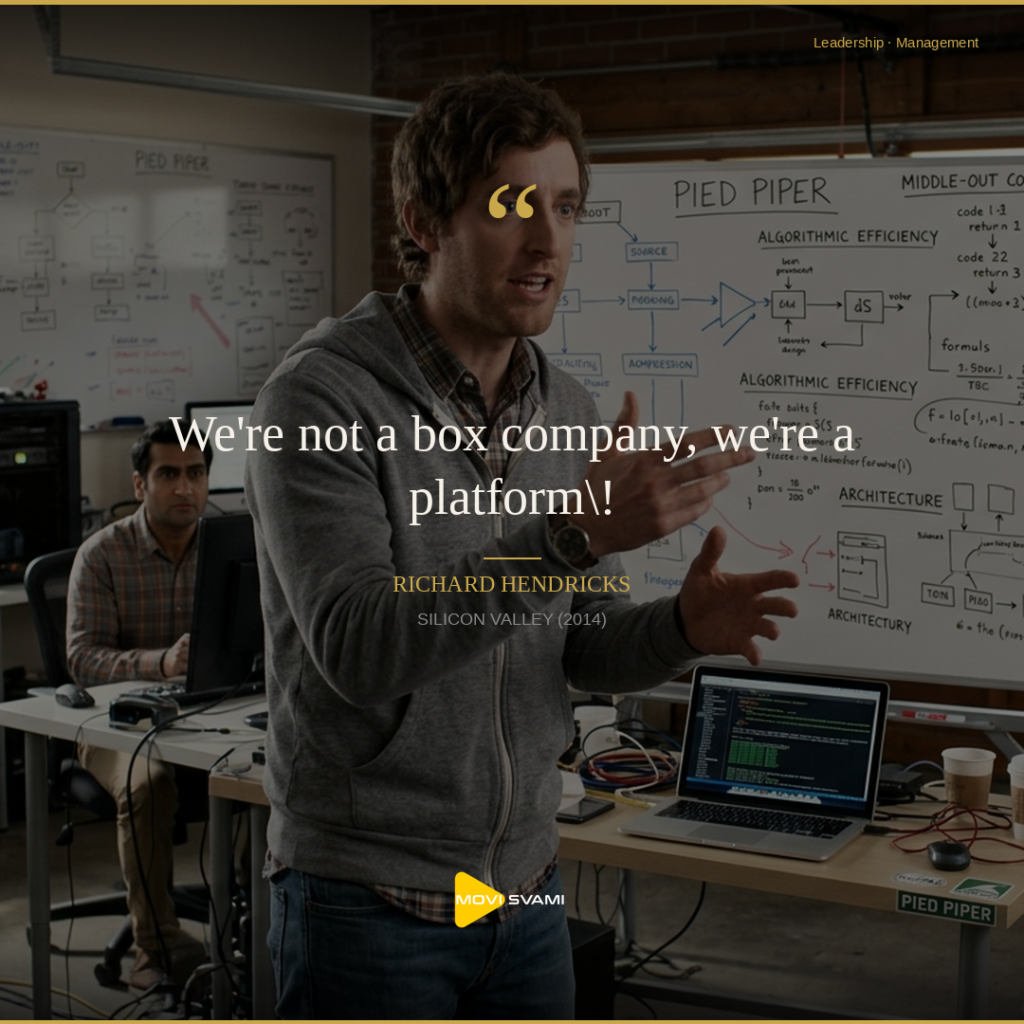
The conference room at Raviga Capital was stifling. Richard Hendricks, sweat darkening the collar of his hoodie, stood before a whiteboard facing a semicircle of investors who had already mentally bankrupted his company. On the table sat the proposition that would have saved Pied Piper from insolvency within ninety days: a proprietary hardware appliance—a “box”—that would monetize their compression algorithm through immediate, high-margin enterprise sales. The path was clear, the revenue model proven, and the exit timeline shortened to please every risk-averse LP in the valley. Richard looked at the schematic drawings, then at the board, and made a declaration that would either cement his company’s unicorn trajectory or accelerate its collapse: “We’re not a box company. We’re a platform.”
For the uninitiated, *Silicon Valley*’s third season found Pied Piper technically brilliant but commercially lost. Their decentralized compression technology was superior, yet user acquisition lagged and cash reserves dwindled. The “box” represented a tactical retreat into hardware—a physical appliance containing their chip that large enterprises would purchase for on-premise data storage. It offered linear economics: sell more units, hire more sales engineers, capture predictable margins. The platform, conversely, required building an ecosystem of developers, APIs, and network effects—capital-intensive, slow to monetize, but capable of exponential scaling and defensible moats. When Richard rejected the box, he wasn’t merely choosing a business model; he was protecting the underlying architecture that made Pied Piper valuable.
This scene distills a fundamental tension in scaling technology companies: the conflict between capital efficiency and architectural leverage. The “box” represents a local maximum—a pivot into revenue models that optimize for present cash flows but sacrifice future optionality. It is the seductive logic of linear scaling, where growth requires proportional increases in headcount, inventory, or operational complexity. When leadership succumbs to the box, they trade exponential curves for predictable increments, transforming potential platforms into service businesses or product companies with capped upside. Richard’s resistance reveals that technical architecture is not merely an engineering concern but a strategic imperative; the codebase and its extensibility determine whether a company can capture increasing returns to scale or remains trapped in diminishing marginal returns.
Maintaining platform fidelity requires a specific form of managerial courage: the ability to resist stakeholder pressure for immediate monetization that violates architectural principles. Investors and boards, optimizing for portfolio theory rather than individual company destiny, often advocate for pivots that reduce variance—converting uncertain platform bets into certain cash flows. But leadership in high-growth environments demands protecting the company’s technical moat from its own organization. This means declining the seven-figure custom deployment that would divert engineering resources, refusing the channel partnership that centralizes control, and rejecting the early monetization mechanics that deter ecosystem adoption. The platform is a commitment to compound growth; the box is a declaration that you’ve stopped believing in network effects.
**The Services Prison**
Consider the SaaS founder facing the classic “professional services” pivot. When enterprise clients demand custom implementations—promising immediate cash in exchange for bespoke development—the box logic whispers acceptance. A fintech infrastructure startup, for instance, might be offered $3 million to build a white-labeled version of their payment stack for a single banking client. The platform leader recognizes that diverting engineering to one-off builds creates technical fragmentation that destroys API consistency and prevents ecosystem growth. Accepting the box revenue funds eighteen months of runway but eliminates the possibility of thousand-fold scaling through standardized infrastructure. The discipline lies in maintaining productized architecture even when custom contracts offer survival.
**The Vertical Integration Trap**
Marketplace and network-effect businesses face their own box temptation when they observe high-value transactions occurring on their rails. A B2B procurement platform, seeing lucrative freight logistics contracts, might pivot to owning trucks and warehouses—the box strategy of capturing margin through physical assets. Similarly, a developer platform might begin competing with its most successful third-party applications. This confuses platform enablement with direct revenue extraction. The architecture that enables ecosystem value creation requires remaining agnostic to specific transactions; the moment you compete with your suppliers, you become a box company with inventory risk and linear scaling constraints, forfeiting the exponential leverage of pure facilitation.
**The Premature Monetization Pivot**
Developer platforms and technical infrastructure companies often face pressure to “prove the model” through early API monetization or restrictive licensing. The box approach charges per transaction, call, or seat from inception, generating predictable ARR but capping adoption curves. A data infrastructure startup, for example, might impose usage fees that deter experimentation, effectively optimizing for revenue per user rather than network density. Platform leadership requires subsidizing ecosystem growth—accepting near-term losses to achieve critical mass where network effects become self-reinforcing. Richard’s platform was valuable not because it generated immediate compression revenue, but because it enabled infinite derivative applications. Monetizing too early creates friction that prevents the architectural density required for defensible market position.
The next time your board pushes for the pivot that “gets us to profitability this quarter,” ask yourself: Are we optimizing for cash flow or for architectural leverage? What is the box they are offering you—and what exponential future does it cost?