
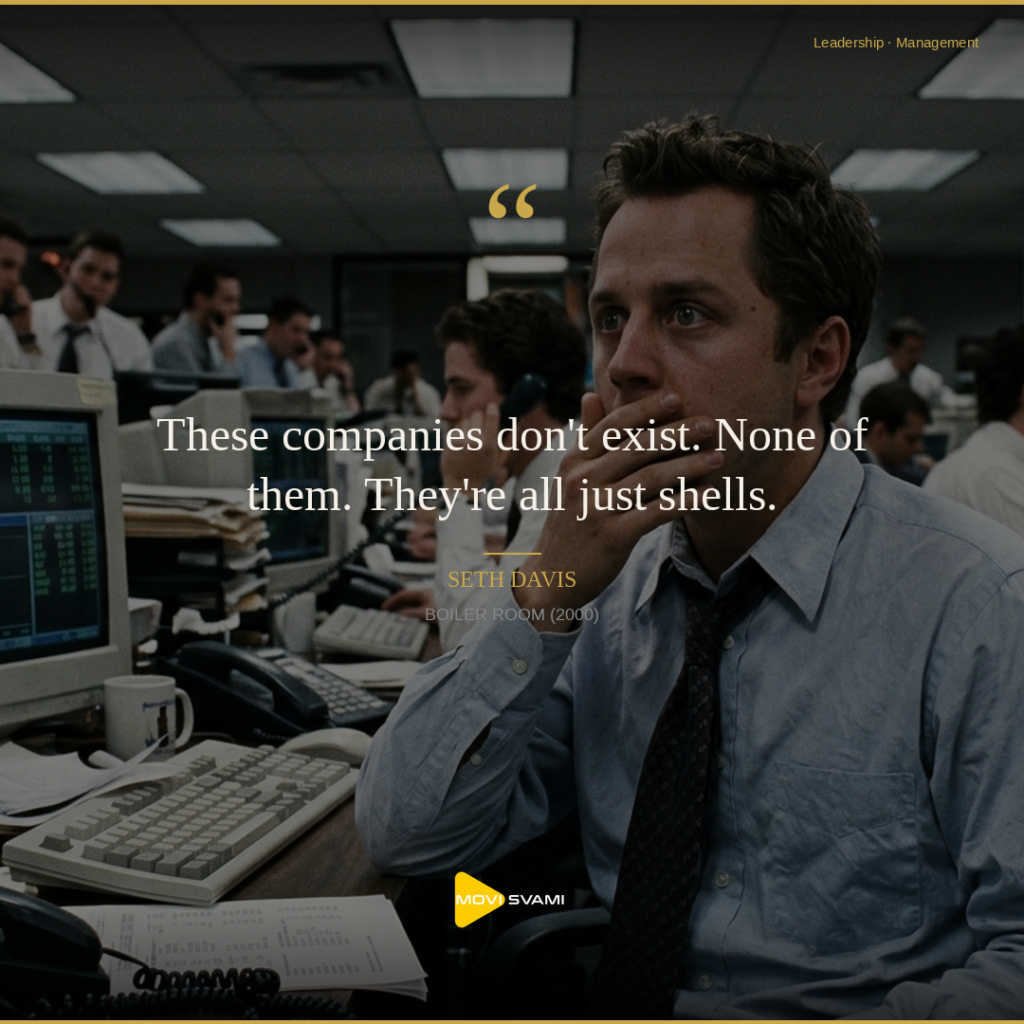
In the dimly lit basement of a Long Island strip mall, surrounded by the adrenalized chaos of cold-calling brokers and the faint smell of stale coffee, Seth Davis stares at a blinking computer screen. The numbers glow with artificial promise—huge positions, soaring market caps, institutional interest. But the revelation hits him not with the force of data, but with the hollow clarity of fraud. The companies they have been hawking to unsuspecting investors are fabrications, elegant shells constructed only to be inflated and abandoned. In that moment, the distance between a ticker symbol and a tangible factory floor, between a revenue line item and actual cash flow, crystallizes into existential horror. “These companies don’t exist,” he whispers. “None of them. They’re all just shells.”
Seth Davis’s realization in *Boiler Room* (2000) serves not as cautionary entertainment but as a brutal diagnostic for financial leadership. The boiler room’s business model—manufacturing paper companies to generate trading commissions—represents an extreme pathology, but the underlying disease infects legitimate enterprises with alarming frequency. It is the disease of appearance over substance, of narrative over verification, of metrics engineered to satisfy analysts rather than reflect economic truth. Davis’s horror derives not from ignorance of fraud, but from the sudden recognition that his entire professional identity rests on a foundation of nothing. The companies do not merely underperform expectations; they possess no operational reality whatsoever. The balance sheets are fiction. The revenue projections are theater. The investor presentations are performances staged for an audience that has not yet realized they are watching a scripted collapse.
For CFOs operating within ostensibly ethical organizations, the lesson is not about avoiding outright securities fraud—that bar is sufficiently clear. The lesson is about the insidious drift toward what might be termed “financial opacity creep”: the incremental erosion of transparency as organizations optimize reporting for stakeholder perception rather than stakeholder insight. This is the CFO who capitalizes software development costs aggressively to manufacture profitability, the finance team that smooths revenue recognition across quarters to eliminate volatility, the executive who structures off-balance-sheet entities to obscure leverage. These are not criminal enterprises. They are sophisticated organizations that have permitted the distance between reported financials and economic reality to widen until the gap becomes material. The numbers still comply with GAAP. The auditors still sign off. But the financial statements no longer provide an honest picture of the business’s operational health, and stakeholders—investors, employees, creditors—make decisions based on a curated fiction rather than verifiable fact.
The mandate for contemporary financial leadership is brutally simple: every asset on the balance sheet must correspond to tangible economic substance, and every revenue figure must represent completed, verifiable transactions with genuine customers. This is not an aspiration. It is the irreducible floor of fiduciary responsibility. Yet the practical implementation demands constant vigilance across three critical domains where the temptation to prioritize appearance over reality is greatest.
First, consider revenue recognition in subscription or software-as-a-service businesses. A SaaS company signs a three-year enterprise contract for $3 million. Under ASC 606, the CFO can recognize revenue ratably over the contract term, creating predictable quarterly growth. But what if the customer’s payment terms allow 90-day cycles with no upfront commitment, and churn data suggests that 40% of enterprise deals fail to renew past year one? The contract exists on paper, but the economic substance—the probability-weighted cash flow—is materially lower than the booked revenue. A CFO committed to transparency would build reserve models that reflect actual renewal probabilities, creating a more conservative but vastly more honest representation of future cash generation. A CFO optimizing for quarterly optics would book the full contract value and defer the reckoning until the churn becomes undeniable. The difference is the distance between Seth Davis’s nightmare and stakeholder trust.
Second, examine asset valuation in technology or IP-heavy organizations. A biotech company holds 15 patents related to a novel therapeutic mechanism. The patents were acquired for $50 million and are carried on the balance sheet at historical cost, net of amortization. But clinical trials have stalled, competitor therapies have advanced, and internal projections now show negligible probability of commercial viability. The patents still exist legally, but their economic value has evaporated. A rigorous CFO would write down the asset to reflect fair value, triggering an impairment charge that devastates EBITDA and invites uncomfortable board questions. A CFO prioritizing narrative continuity would defer the write-down, citing “strategic optionality” or “ongoing evaluation,” allowing the balance sheet to carry a $50 million fiction until the quarterly results force the issue. The patents are shells. The only question is when the CFO admits it.
Finally, assess the treatment of related-party transactions and off-balance-sheet structures. A holding company extends vendor financing to a struggling distribution partner that also happens to be majority-owned by the holding company’s founder. The distributor books inventory purchases from the holding company, creating revenue and receivables for the parent entity, but the distributor lacks independent cash flow and depends entirely on ongoing financing from the same parent. The accounting is technically correct—revenue is recognized upon shipment, receivables are booked at face value—but the economic reality is circular. The “customer” is not an independent third party; it is a financing vehicle that transforms equity injections into revenue recognition. The substance is capital deployment dressed as operational performance. A transparent CFO would consolidate these entities and eliminate intercompany transactions, presenting stakeholders with the genuine cash-generating capacity of the business. A CFO focused on growth optics would maintain the separation, manufacturing top-line growth from internal capital recycling until the financing runs dry.
The ultimate distinction between the boiler room and the boardroom is not the presence or absence of fraud—it is the organizational commitment to ensuring that financial reporting reflects economic truth rather than convenient illusion. Seth Davis’s horror was not that the companies failed to meet projections; it was that they possessed no operational substance whatsoever. The question for every CFO is how far the gap has widened in their own organization between what the financials claim and what the business actually does. Because in the long run, shells collapse. The only variable is whether you recognize it in time to rebuild on solid ground—or whether you wait until stakeholders make the discovery for you.