
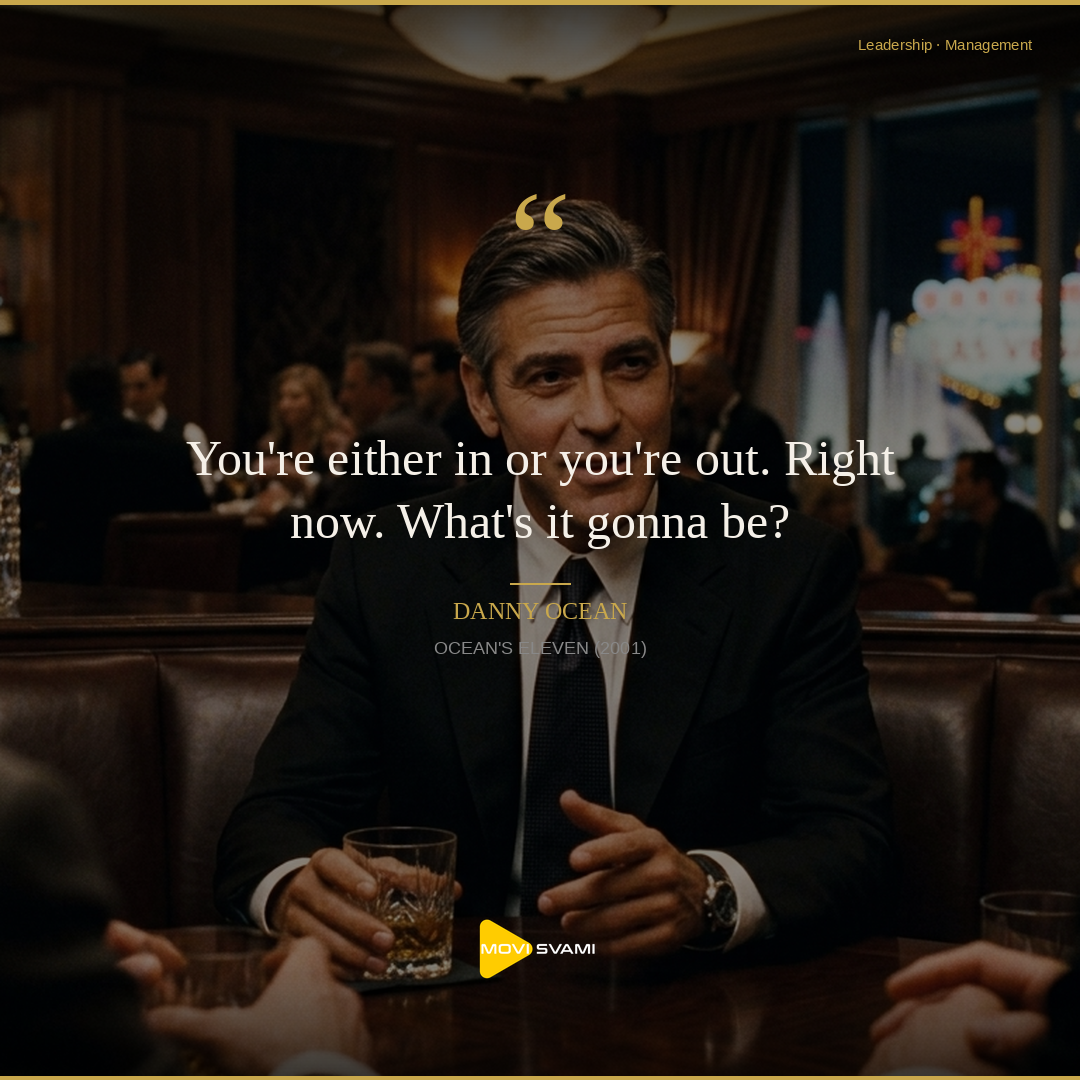
The rain against the loft windows provided little relief from the tension inside. Daniel Ocean stood before a chalkboard scrawled with the architectural blueprints of the Bellagio, the Mirage, and the MGM Grand—three vaults, three casinos, one impossible night. Around him sat a pickpocket, an explosives expert, a financier, a contortionist, and a handful of others whose skills existed at the margins of legality and genius. They had listened to the outline of a heist that would require simultaneous, millimeter-precision coordination. Now came the moment of irrevocable commitment. Ocean did not ask for a show of hands. He looked at each of them in turn and delivered the ultimatum that would define their alliance: “You’re either in or you’re out. Right now. What’s it gonna be?”
The question was not merely rhetorical; it was diagnostic. Ocean understood that the complexity of robbing Terry Benedict’s vaults made hesitation more dangerous than incompetence. Benedict’s reputation for violence was matched only by the Nevada Gaming Commission’s forensic scrutiny. A half-committed team member did not represent a manageable risk; they represented a systemic failure point. By forcing a binary decision, Ocean was filtering for psychological ownership. Those who remained were not simply agreeing to a job—they were consenting to an architecture of mutual dependency where the acrobat’s flexibility mattered as much as the electrician’s soldering precision, and where the absence of either would collapse the entire structure.
This scene crystallizes a leadership principle rarely articulated in management literature: the strategic curation of specialists over the assembly of generalists. Ocean’s methodology rejects the comfortable myth of the “well-rounded” team member in favor of cognitive and technical extremity. He does not seek criminals who are “good enough” at surveillance, explosives, and sleight of hand; he recruits individuals who are singularly obsessive about one domain. The leader’s role, in this model, shifts from taskmaster to systems architect. Ocean’s value lies not in being the best at any specific function—Rusty is the better strategist, Yen the better contortionist—but in his ability to visualize how discrete competences interface. He designs the compartments of the operation such that the pickpocket never needs to understand thermodynamics, while the pyrotechnician need not master misdirection. The resulting ecosystem exhibits what organizational theorists call “complementarity without redundancy”: a sum greater than its parts precisely because the parts are irreplaceable rather than interchangeable.
**Complex Systems Implementation**
Consider the enterprise attempting a cloud migration or ERP overhaul. The default tendency is to staff such initiatives with “versatile” IT generalists who understand the broad strokes of legacy systems and modern architecture. The result is typically mediocrity expressed through delay. The Ocean model suggests a different approach: recruiting the specific COBOL archaeologist who understands the 1970s bookkeeping code, the Kubernetes specialist who thinks in container orchestration, the cybersecurity auditor with nation-state incident response experience, and the change management expert who maps political networks. The project manager’s job becomes not micromanaging these experts—Ocean never hovers over Basher’s explosives—but ensuring their interfaces are watertight. When the COBOL expert hands off data formats to the cloud architect, that translation must be frictionless, requiring the leader to establish common protocols without demanding common expertise.
**Post-Merger Integration**
In the volatile months following a corporate acquisition, leadership faces a coordination challenge analogous to the heist. Two legacy organizations, distinct cultures, and conflicting ERP systems must converge without alerting the market or hemorrhaging talent. The instinct to appoint integration leads who are “good with people” and understand “the big picture” often results in surface-level harmony masking operational dysfunction. Instead, the Ocean methodology prescribes assembling a shadow cabinet of deep specialists: the forensic accountant who can reconcile divergent revenue recognition standards, the employment lawyer versed in union jurisdictional battles, the supply-chain logician who models inventory mesh points, and the cultural anthropologist who decodes informal power structures. The CEO acts as the fence between these domains, forcing the same binary commitment Ocean demanded—are you committed to the integration’s success, or are you protecting your legacy fiefdom?—while trusting each specialist to own their silo’s complexity.
**Breakthrough Innovation**
R&D departments and innovation labs frequently err by staffing interdisciplinary teams where everyone possesses a superficial literacy in adjacent fields. True innovation, however, often emerges from the productive friction between alien epistemologies. When developing a novel medical device, for instance, the leader should recruit not “product people” but the specific cardiologist who understands ventricular flow dynamics, the materials scientist specializing in biocompatible nitinol, the regulatory strategist who navigated FDA Class III approvals in 2019, and the behavioral economist who models patient adherence. The tension between the cardiologist’s physiological constraints and the materials scientist’s manufacturing limitations is not a problem to be smoothed away by a generalist project manager; it is the generative engine of the solution. The leader’s function is to sustain that tension without allowing it to fracture the coalition, much as Ocean sustained the friction between the volatile Basher and the meticulous Livingston.
As you review your current organizational chart, ask yourself: Do you have a team of generalists averaging toward competence, or a constellation of extremities whose edges touch to form a complete picture? Are you managing interchangeable parts, or have you curated irreplaceable competencies? And most critically, when you look at your next impossible objective, do you know exactly which specialist holds the key to each specific lock—or are you hoping that someone in the room will figure it out along the way?
Leave a Reply