
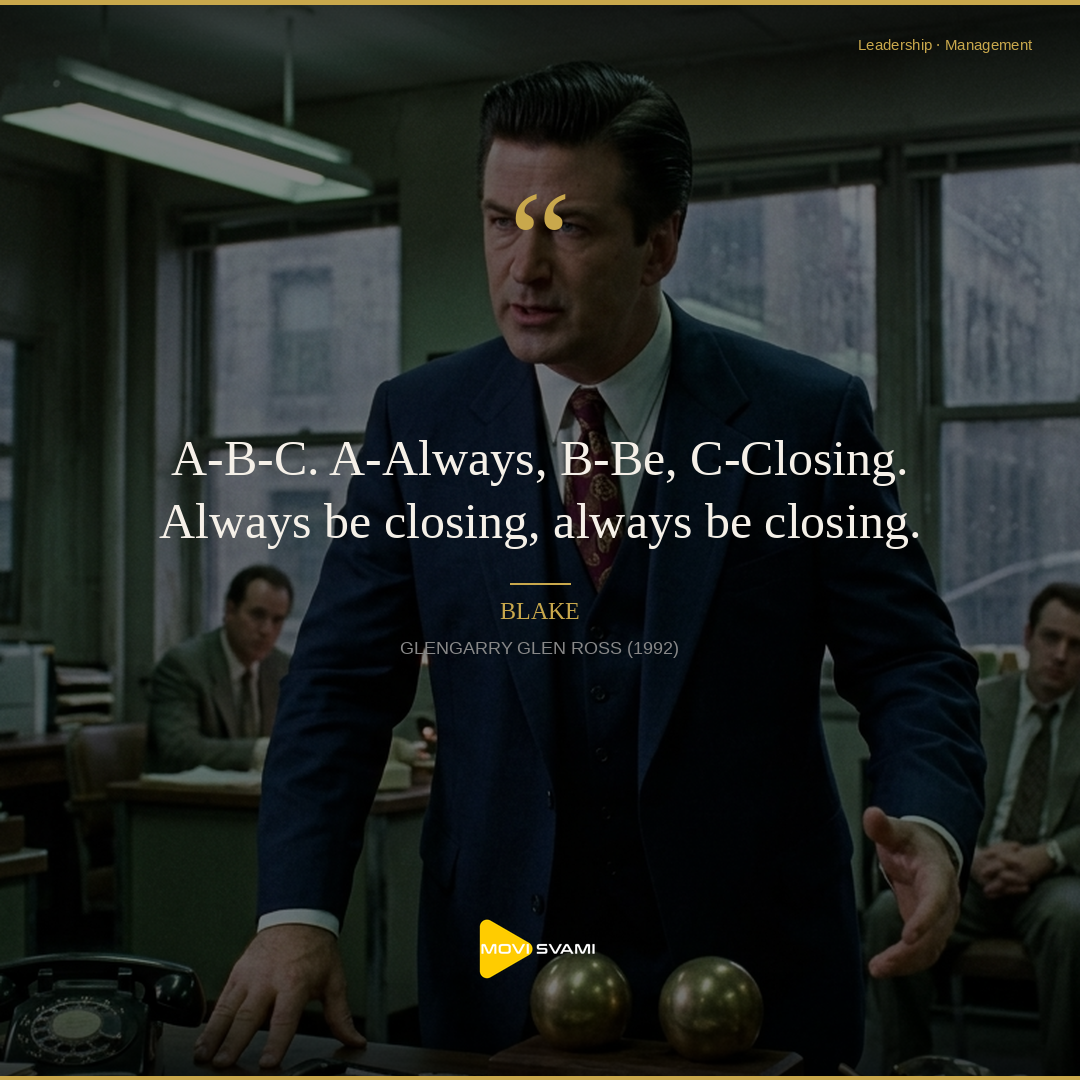
The scene opens on a rain-soaked night in Chicago, where the fluorescent hum of a down-market real estate office is shattered by the arrival of a man in an impeccably tailored suit. Blake, sent by the elusive powers downtown, doesn’t knock. He enters like a corporate executioner, carrying a pair of brass balls that he places on the desk with deliberate menace. Before the exhausted salesmen—Shelley, Dave, George, and the rest—can process his presence, he launches into a tirade that has since become the most quoted seven minutes in cinema history. The room shrinks. Coffee cups tremble. This is not a pep talk. It is an autopsy of failure, delivered with the gentleness of a sledgehammer.
Blake is not there to mentor. He is there from Mitch and Murray to administer a sales contest with Darwinian stakes: first prize is a Cadillac El Dorado, second prize is a set of steak knives, third prize is you’re fired. These are not middle managers having a bad quarter; they are desperate men drowning in bad leads, economic desperation, and obsolescence. When Blake sneers the now-legendary acronym—”A-B-C. A-Always, B-Be, C-Closing”—he is weaponizing language itself. The words land not as strategy but as indictment. For these salesmen, “Always Be Closing” is not motivation; it is the narrowing of existence to a single, binary metric: did you bring in revenue today, or did you not? The brilliance of the scene lies in its honesty. It strips away every euphemism about “synergy” or “culture” and exposes the raw economics of commercial survival.
Beneath the venom and profanity lies a leadership principle that modern executives often sanitize into meaninglessness: accountability requires clarity, and clarity is often uncomfortable. Blake’s method is abusive, toxic, and ultimately self-defeating—studies consistently show that fear-based management destroys creativity and retention. Yet the inverse failure—leadership without metrics—is equally destructive. When Blake insists on ABC, he is demanding that every activity map to an outcome. There is no ambiguity about success. You closed, or you failed. This radical transparency, stripped of its cruelty, represents a standard that many contemporary organizations fail to meet. Too often, performance reviews become narrative exercises where “effort” substitutes for “impact,” and accountability dissolves into vague discussions about “alignment.”
The architecture of Blake’s contest reveals a mechanical truth about performance management: consequences must be real, proximate, and correlate directly to behavior. The salesmen know exactly where they stand because the scoreboard is unforgiving. When leadership fails, it is often not because of insufficient kindness, but because of insufficient definition. Goals drift into platitudes; deadlines become suggestions; underperformance is managed through incremental “check-ins” that delay the inevitable. Blake’s brutality is unacceptable, but his precision is instructive. He understands that accountability without stakes is merely advice, and advice is free.
**When Pressure Works**
High-stakes clarity functions effectively in environments with unambiguous metrics and short feedback loops. Turnaround scenarios, crisis management, or sales organizations with commoditized products often require the kind of relentless focus Blake embodies—minus the psychological abuse. When a company faces existential threat, niceties become liabilities. The key distinction is structural rather than emotional: pressure works when it is coupled with autonomy within constraints. Blake’s ABC framework succeeds when organizations define the “what” with absolute rigor (close deals) while allowing flexibility on the “how” (the specific tactics). In military operations, emergency medicine, and certain transactional sales environments, this binary clarity saves lives and revenues. The leader’s job becomes ensuring that the pressure channelizes toward the target rather than crushing the operator.
**When It Backfires**
The Blake methodology collapses catastrophically in complex, knowledge-based economies where innovation requires psychological safety. When organizations importAlways Be Closing” cultures into engineering, design, research, or strategic consulting, they trigger defensive behaviors that prioritize short-term optics over long-term value. Employees hoard information to protect themselves. Ethical corners get cut to hit numbers. Retention hemorrhages as top talent flees to environments that don’t treat human beings as interchangeable ledger entries. The destruction is often invisible until it is irreversible: a culture where “closing” becomes more important than the quality of the deal inevitably produces toxic assets and damaged client relationships. The steak knives become symbols not of incentive, but of institutional contempt.
**Finding the Balance**
Effective modern leadership requires extracting Blake’s structural precision while exorcising his sadism. This is the discipline of being hard on results and soft on people. It means establishing non-negotiable metrics with the same clarity as the Cadillac contest, but coupling those standards with development resources, coaching, and the humanity to recognize that performance gaps often reflect systemic failures rather than character flaws. The contemporary leader must ask: Have I made the definition of success so clear that there is no room for interpretation? Have I removed the ambiguity that allows mediocrity to hide? Accountability is not cruelty; it is respect for the shared mission. When a team member fails in such a system, the conversation mirrors Blake’s clarity but replaces his contempt with curiosity: What blocked the close? What resource was missing? How do we ensure success next week?
The brass balls on Blake’s desk were vulgar props, but they symbolized something executives too often forget: leadership requires the courage to define reality without flinching. The question is not whether you can replicate Blake’s brutality—you can, and your best people will leave. The question is whether you have the discipline to maintain his standards without sacrificing your humanity.
Look at your current team. Are your performance expectations as clear as a Cadillac or a set of steak knives, or have you allowed ambiguity to become the opiate of your underperformers?
Leave a Reply