
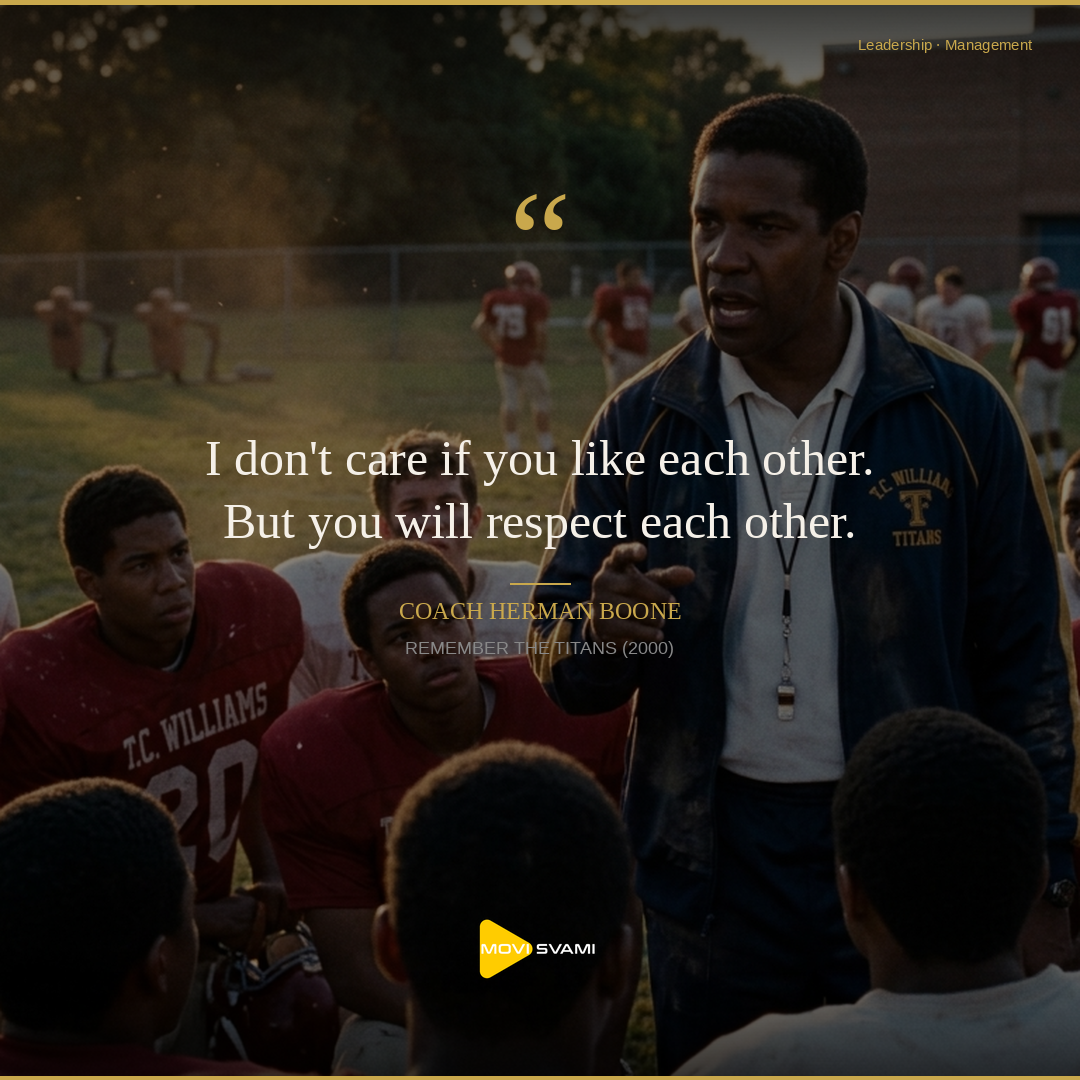
The Virginia heat hangs heavy over Gettysburg in 1971. Two buses carrying the newly integrated T.C. Williams High School football team idle near the cemetery where America once nearly tore itself apart. The players are divided by race, by position, by socioeconomic status. They hate each other. Their season hasn’t started, but their conflict threatens to destroy the program before the first snap. Coach Herman Boone, a black man appointed head coach over a local white favorite, stands before exhausted athletes who refuse to integrate. He understands that talent without cohesion is merely potential energy, and that potential, left unmanaged, explodes rather than executes.
Boone’s philosophy crystallizes during the grueling two-week camp where he engineers integration through shared suffering. He pairs black and white roommates arbitrarily. He forces the team to run through the night to the battlefield where Union and Confederate soldiers died, explaining that if they don’t come together, they too will be destroyed by infighting. When the team returns to Alexandria, the tension hasn’t dissolved into friendship—it has transformed into something more durable. “I don’t care if you like each other,” Boone tells them, his voice carrying the authority of someone who has faced real violence. “But you will respect each other.”
The distinction matters. Boone isn’t demanding affection, which cannot be mandated. He is demanding professional regard grounded in shared stakes. The “each other” refers specifically to the interdependence of their positions: the quarterback cannot succeed without the lineman, regardless of race. The stakes extend beyond winning games; they represent the fragile possibility of integration succeeding in a community prepared for failure. Boone demonstrates that chemistry is not discovered but engineered through structured vulnerability.
Traditional team-building assumes that shared goals naturally produce collaboration, but forced chemistry recognizes that trust requires shared experience before it produces voluntary cooperation. The “merit-based selection” angle emerges in Boone’s refusal to trade talent for comfort—he keeps the best players regardless of race, forcing the community to confront its biases while simultaneously demanding that those players abandon their own prejudices for collective survival. This approach transforms individual talent into a unified force through structured interdependence.
When performance metrics depend on collaboration rather than individual heroics, social categories become less salient than functional roles. The leadership insight is brutal but necessary: cohesion sometimes requires removing the option of exclusion. Boone doesn’t wait for natural affinity to develop; he creates conditions where survival depends on mutual reliance, knowing that respect often follows dependency even when affection lags.
**Implement cross-functional “camp” protocols.** Like Boone’s Gettysburg retreat, organizations should create intensive, time-bound projects that force collaboration across demographic or functional lines. A product team cannot retreat into silos if their quarterly bonus depends on joint deliverables with operations. Structure temporary assignments where “enemies” must solve concrete problems together before returning to permanent teams. The shared context creates reference points and mutual dependencies that survive the return to normal operations, establishing respect as a functional requirement rather than a social preference.
**Establish non-negotiable respect protocols.** Boone’s rule about respect operated as a behavioral floor, not a ceiling. Translate this into explicit team charters that define disrespect not as personality conflict but as failure to engage with ideas or withhold effort. When a team member dismisses a colleague’s contribution based on role, tenure, or background rather than content, intervention must be immediate and standardized. Respect becomes a performance metric, not a matter of personal preference, enforceable through the same mechanisms as missed deadlines or budget overruns.
**Tie individual evaluation to group outcomes.** The Titans succeeded when Boone ensured that defensive players celebrated offensive touchdowns as their own victories. In corporate settings, this means structuring compensation and recognition so that “star” performers cannot optimize their personal metrics while depleting team resources. When the quarterback’s promotion depends on the offensive line’s development, hierarchy flattens and expertise becomes distributed rather than concentrated. Meritocracy requires mutual investment, not individual extraction.
The Titans didn’t win the championship because they became best friends. They won because they became reliable colleagues who understood that disrespect carried a cost higher than interpersonal comfort. In high-stakes environments, leaders must sometimes choose between harmony and performance—not by selecting one, but by recognizing that enforced respect precedes earned trust. Your team doesn’t need to like each other to change the game. They need to need each other.
Leave a Reply