
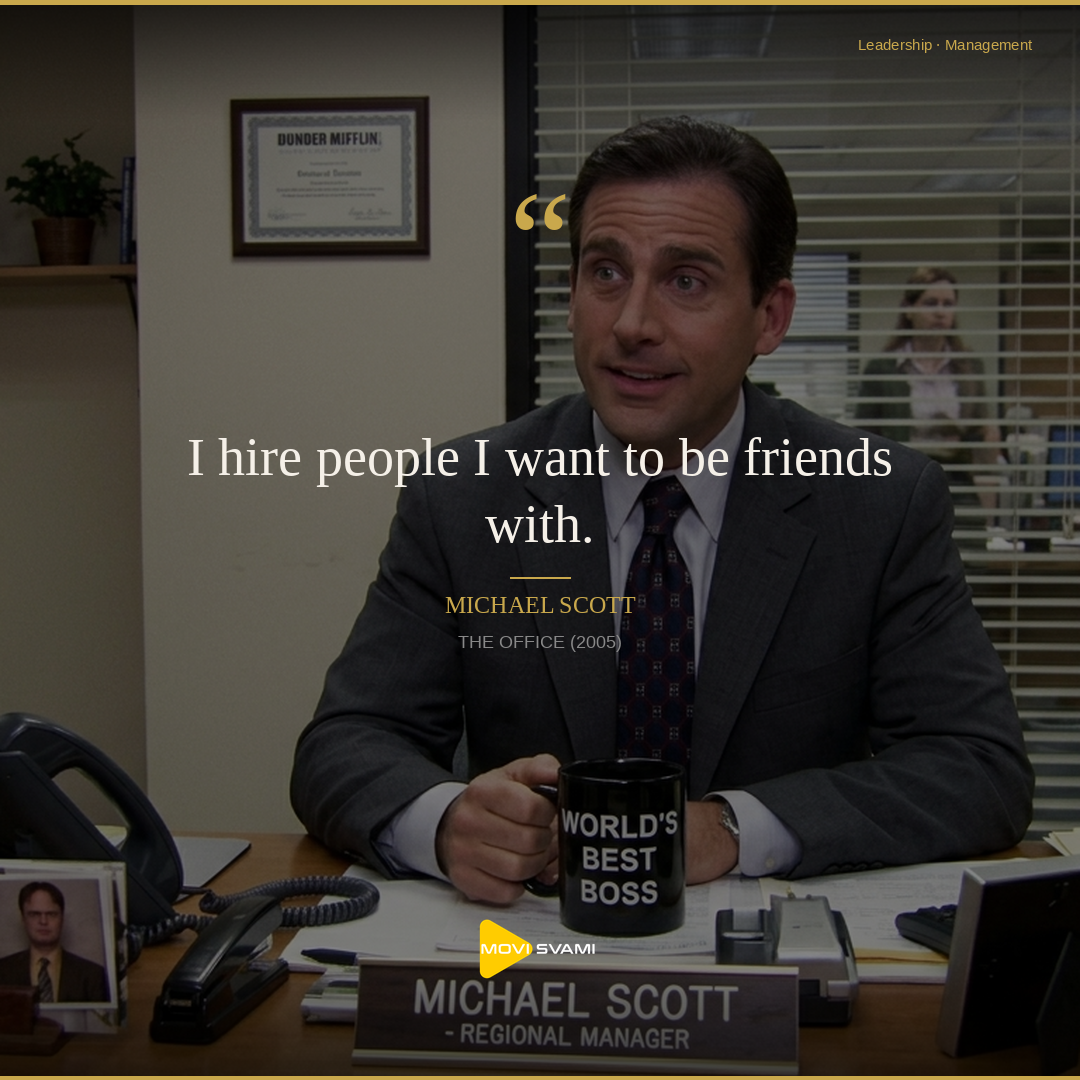
The Dunder Mifflin Scranton branch should not function. Its regional manager, Michael Scott, violates every tenet of modern HR protocol: he mixes personal and professional boundaries, ignores skills-based hiring matrices, and selects employees based on gut feelings that often confuse “competent” with “entertaining at happy hour.” And yet, the branch persists as the company’s most profitable outpost while flashier, more “professional” locations close. When Michael explains his hiring philosophy—”I hire people I want to be friends with”—corporate America winces. Yet buried within this apparent capriciousness lies an uncomfortable truth about team cohesion that competency-models often miss: technical skills depreciate while relational architecture endures.
Michael’s statement appears during discussions of his inexplicable loyalty to underperforming employees and his resistance to corporate-mandated terminations. While often interpreted as weakness or narcissism—hiring mirrors rather than talent—the philosophy contains a sophisticated observation about organizational durability. When Michael selects Holly Flax as HR representative or defends Dwight Schrute’s eccentricities, he prioritizes interpersonal rhythm over resume optimization. He recognizes, intuitively, that paper distribution is a commodity business where client relationships and crisis retention determine success more than operational efficiency.
“Friends” in Michael’s framework means people with compatible emotional intelligence, shared values, and the psychological safety to be vulnerable. The chaos of Dunder Mifflin requires employees who will answer phones at midnight, cover shifts during personal emergencies, and absorb managerial eccentricities without mutiny. These behaviors emerge not from job descriptions but from social contracts built on genuine affection and loyalty. Michael understands that skills can be taught, but the willingness to go above and beyond—the discretionary effort that separates adequate from exceptional—derives from emotional investment in colleagues.
Michael’s approach, however crudely executed, distinguishes between skills and culture in ways that formal hiring processes often conflate. Technical capabilities—Excel proficiency, sales technique, industry knowledge—follow learning curves that respond to training. Interpersonal architecture—the ability to navigate conflict, demonstrate empathy, and contribute to collective morale—operates as fixed personality traits resistant to corporate education. By prioritizing the latter, Michael ensures that skills gaps become solvable problems while chemistry gaps become permanent organizational drag.
This doesn’t validate incompetence; rather, it recognizes that in service-based or creative industries, the marginal utility of a pleasant colleague exceeds the marginal utility of a technically perfect misanthrope. The “vibe” Michael seeks represents psychological safety, the foundation of team learning and innovation. When employees feel friendship toward leadership, they disclose errors faster, collaborate more freely, and withstand pressure without burnout. The credential barrier that rejects candidates for skills gaps but ignores culture fit creates expensive turnover; Michael’s approach inverts this calculus.
**Separate technical screening from values alignment.** Structure interviews so that functional skills are assessed through work samples or technical tests administered by specialists, while cultural contribution is evaluated through team-based scenarios. Michael’s “friend” criterion translates to “Would this person enhance or deplete our collective emotional energy?” Use behavioral interviews probing conflict resolution and collaboration, not just individual achievement. Assess whether candidates demonstrate curiosity about others rather than mere self-promotion.
**Calculate training costs versus replacement costs.** Michael understands that teaching Dwight Schrute social norms, while exhausting, costs less than recruiting replacements who lack Dwight’s loyalty and work ethic. Audit your onboarding budgets: if you cannot afford six months of skills training, you cannot afford to hire for personality alone. Conversely, if you cannot survive one toxic high-performer who destroys team cohesion, you cannot afford to ignore chemistry. Build financial models that quantify the cost of cultural damage versus the cost of technical training.
**Implement team-veto powers.** Michael rarely hired against the will of his senior staff. Allow high-performing team members to meet finalists in low-stakes social contexts—team lunches rather than formal panels. If the “vibe” reading detects narcissism, aggression, or disinterest, trust it. Skills can be taught; the desire to belong and contribute cannot. This democratic approach to culture-setting prevents the “bad hire” who meets individual metrics while destroying collective capacity.
Michael Scott was wrong about nearly every management theory in the textbook. But he understood that workplaces are human systems before they are economic engines. When building your next team, consider whether you are hiring for the spreadsheet or for the crisis—the moment when technical competence fails and character sustains. You can teach someone to sell paper or code software. You cannot teach them to care about your people when the deadline looms and the client demands miracles. Hire for the friendship; train for the function. The branch that likes each other outlasts the branch that merely respects each other’s credentials.
Leave a Reply