
In the dimly lit back corridors of *Runway* magazine, where the hum of industrial clothing racks replaces elevator music and the air smells of steamed fabric and impending deadlines, Andrea Sachs is unraveling. She has just survived another impossible directive from Miranda Priestly—perhaps sourcing an unpublished Harry Potter manuscript in three hours, or navigating a hurricane of ego during Paris Fashion Week. Her personal life lies in ruins. Her boyfriend has stopped returning calls. Her friends have become strangers. She is, by any conventional measure, failing at being human. Yet as she staggers through the chaos, Art Director Nigel Kneale observes her not with pity, but with recognition. He sees something that Miranda Priestly has already detected: the precise moment when pressure transmutes into capability.
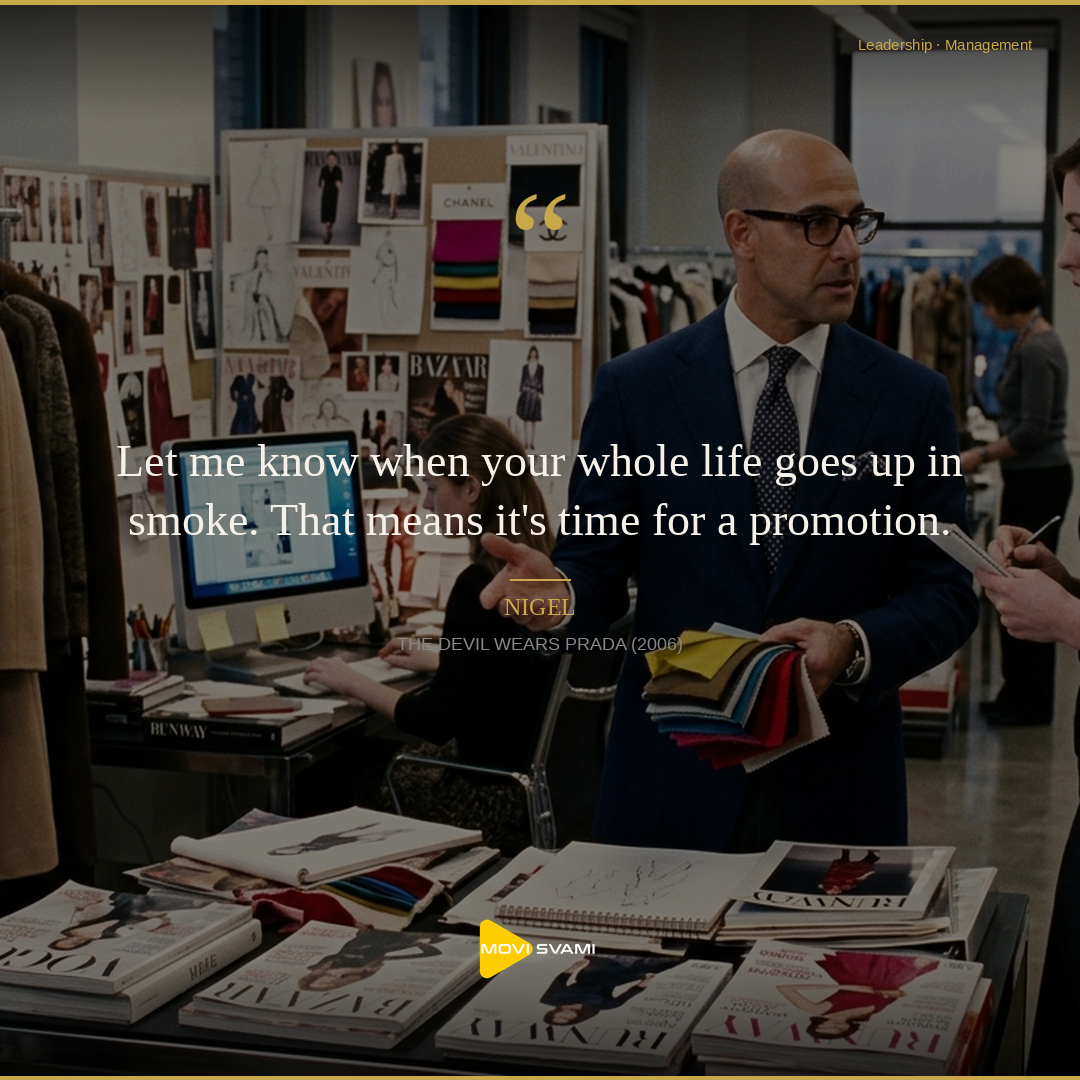
It is here that Nigel delivers the film’s most devastatingly pragmatic line: “Let me know when your whole life goes up in smoke. That means it’s time for a promotion.” The remark lands with the weight of institutional truth. Spoken not by the tyrannical editor-in-chief but by her most trusted lieutenant, the line reveals the perverse meritocracy of Runway’s culture. Nigel, who has weathered decades of Miranda’s whims, understands that survival is not merely about endurance. It is about demonstrating that your operational capacity expands precisely as your personal stability contracts. The promotion is not a reward for suffering; it is validation that the candidate has proven capable of functioning at the altitude where oxygen is thin and the margin for error is nonexistent.
What Miranda Priestly intuits—and what most hiring managers overlook—is the distinction between competence and resilience. Technical proficiency can be trained; adaptive capacity must be stress-tested. Miranda does not select assistants for their existing knowledge of fashion, nor does she prioritize candidates with pristine work-life balance metrics. She selects for elasticity of capability, screening for individuals who reorganize their priorities not as a concession to burnout, but as evidence of strategic triage. In organizational behavior terms, she is hiring for “post-traumatic growth” potential—the ability to metabolize crisis into expanded bandwidth. The smoke rising from a candidate’s personal life becomes, in Miranda’s calculus, smoke signaling: proof that the individual can operate with degraded resources while maintaining executive function.
This approach challenges conventional talent acquisition models that prioritize cultural fit and current skill alignment. Instead, it suggests that high-stakes hiring should focus on cognitive flexibility under duress. When a manager observes a team member navigating systemic failure—missed deadlines, resource shortages, interpersonal volatility—without reverting to learned helplessness, they are witnessing the precise alchemy that Nigel identifies. The candidate is revealing that their professional identity has decoupled from their circumstances; they can execute regardless of environmental stability.
Consider the biotechnology firm selecting a project lead for a regulatory submission facing accelerated FDA timelines. The traditional approach favors the candidate with the flawless track record, the one who has managed compliant documentation in stable environments. The Miranda Priestly approach, however, scrutinizes the résumé for evidence of organizational scar tissue. It favors the candidate who shepherded a drug through approval during a facility closure, or who rebuilt a quality assurance team after a mass resignation. The hire is predicated not on the absence of failure, but on the demonstrated ability to maintain strategic coherence while the operational ground shifts.
In turnaround scenarios, this principle becomes existential. A private equity firm installing new leadership at a distressed portfolio company cannot afford executives who require established protocols to function. Here, the hiring manager must look for the equivalent of Andy Sachs sourcing that unpublished manuscript: evidence that the candidate has previously operated within ambiguous authority structures, extracted deliverables from broken supply chains, and maintained decision velocity while stakeholder confidence collapses. The right candidate does not flinch when the corporate equivalent of their “whole life” goes up in smoke; they recognize the smoke as the signal flare of transformative opportunity.
Even in less dramatic contexts, such as scaling customer success teams at high-growth SaaS companies, the standard applies. When platform outages trigger enterprise client exodus, the difference between a competent manager and a resilient one emerges in the first fifteen minutes of crisis. The former follows the escalation playbook; the latter improvises retention strategies while engineering races to patch the system. Hiring for this role requires looking past certifications and Net Promoter Scores to identify candidates who have previously absorbed professional blame for systemic failures not of their making, and who converted that liability into client loyalty.
The implications for talent strategy are uncomfortable. It requires abandoning the safety of hiring for “potential” as defined by pedigree and polish, and instead seeking evidence of survival under resource constraint. It means valuing the career narrative that includes professional immolation followed by reconstruction, rather than the seamless trajectory.
As you assemble your next critical hire, consider what you are actually testing for in your interview process. Are you screening for the ability to thrive in abundance, or the capacity to function in scarcity? When you review final-round candidates, ask yourself: whose track record contains the moment when their professional world went up in smoke, and who emerged from the ashes not merely intact, but elevated?
Leave a Reply