
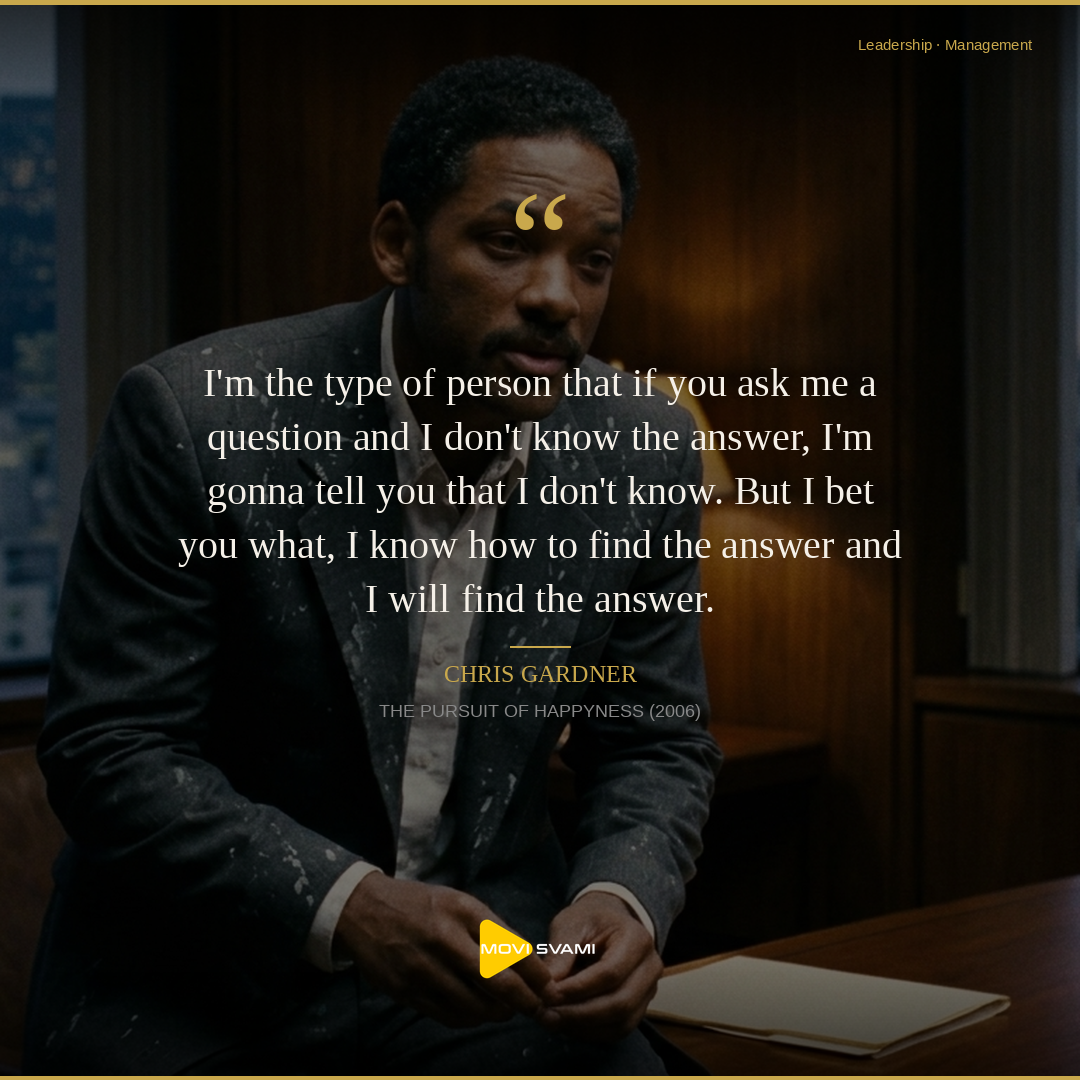
The Dean Witter Reynolds brokerage office in 1981 represents the pinnacle of corporate exclusion: marble floors, oak-paneled walls, and an unspoken dress code that requires both money and lineage to decode. Chris Gardner arrives for his internship interview wearing paint-splattered clothes, having spent the previous night in a San Francisco jail for unpaid parking tickets. He carries no MBA, no resume, no connections. The six hiring managers facing him represent the gatekeepers of financial services, an industry that traditionally hires for polish, pedigree, and the confidence that comes from never having been hungry. Gardner has none of these. He has something rarer and more difficult to certify: the demonstrated ability to solve problems without resources.
The interview begins disastrously by conventional standards. Gardner is honest about his circumstances in a way that violates every coaching manual about “spin” and “positioning.” When asked a question he cannot answer, he doesn’t bluff. “I’m the type of person that if you ask me a question and I don’t know the answer, I’m gonna tell you that I don’t know,” he states, establishing intellectual honesty as his baseline. Then he pivots to the critical differentiator: “But I bet you what, I know how to find the answer and I will find the answer.” This isn’t false confidence; it’s metacognition—the awareness of one’s own learning capability.
In a room filled with candidates who memorized financial models, Gardner demonstrates the only skill that matters in volatile markets: the ability to navigate uncertainty. The Rubik’s cube he solved earlier serves as physical proof of his pattern-recognition abilities, but the quote reveals his operational framework. He treats ignorance as a temporary state rather than a fixed condition, a mindset that converts unknowns into actionable research agendas rather than stopping points.
Gardner’s interview redefines “qualified” from a static inventory of existing knowledge to a dynamic capacity for resource acquisition. The traditional hiring model treats unknowns as liabilities; Gardner treats them as solvable constraints. This represents a shift from credential-based selection to velocity-based selection—hiring for learning speed rather than learned information. In environments where problems are novel and solutions are perishable, determination and resourcefulness outperform polish because polish represents optimization for past conditions.
Gardner’s determination isn’t merely persistence; it’s the demonstrated ability to function under resource constraints, a scenario that mimics startup and turnaround environments more accurately than case-study interviews ever could. His homelessness and single parenthood weren’t obstacles to his candidacy; they were the training ground that proved his operational resilience. The interview reveals that qualification is not what a candidate has done, but how rapidly they can do what hasn’t been done before.
**Design problem-solving auditions.** Replace “Tell me about your experience with X” with “Here is a problem we haven’t solved. How would you begin?” The response reveals research methodology, humility, and strategic thinking. Candidates who immediately construct learning plans—identifying who to ask, what to read, how to prototype—demonstrate Gardner’s capability. Those who claim pre-existing expertise for novel challenges reveal dangerous overconfidence. Structure interviews to probe epistemic process rather than resume verification.
**Create resource scarcity simulations.** During final-round interviews, present candidates with constraints: limited budget, no access to preferred tools, or ambiguous stakeholder requirements. Observe whether they freeze, negotiate, or iterate. Gardner’s survival depended on converting limitations into focusing constraints. High-potential hires treat scarcity as a design parameter, not a stopping condition. Their ability to articulate workaround strategies reveals the resourcefulness that Gardner demonstrated under extreme duress.
**Value intellectual honesty signaling.** Train interviewers to distinguish between “I don’t know” as a confession of inadequacy versus “I don’t know yet” as a statement of epistemic clarity. The former requires rescue; the latter invites collaboration. Candidates who admit gaps while proposing investigation protocols possess the security required for high-learning roles. Insecure talent hides ignorance; secure talent schedules its resolution. Gardner’s candor about his knowledge gaps signaled confidence, not weakness.
Gardner secured the internship not despite his circumstances, but because they had forged the precise capabilities Dean Witter needed: relentless resourcefulness under uncertainty. When hiring, ask whether your process filters out the polished and predictable, or whether it can recognize the determination that comes from having everything to lose. The best candidate might be the one who admits they haven’t done it before—and can articulate exactly how they’ll learn faster than anyone else.
Leave a Reply