
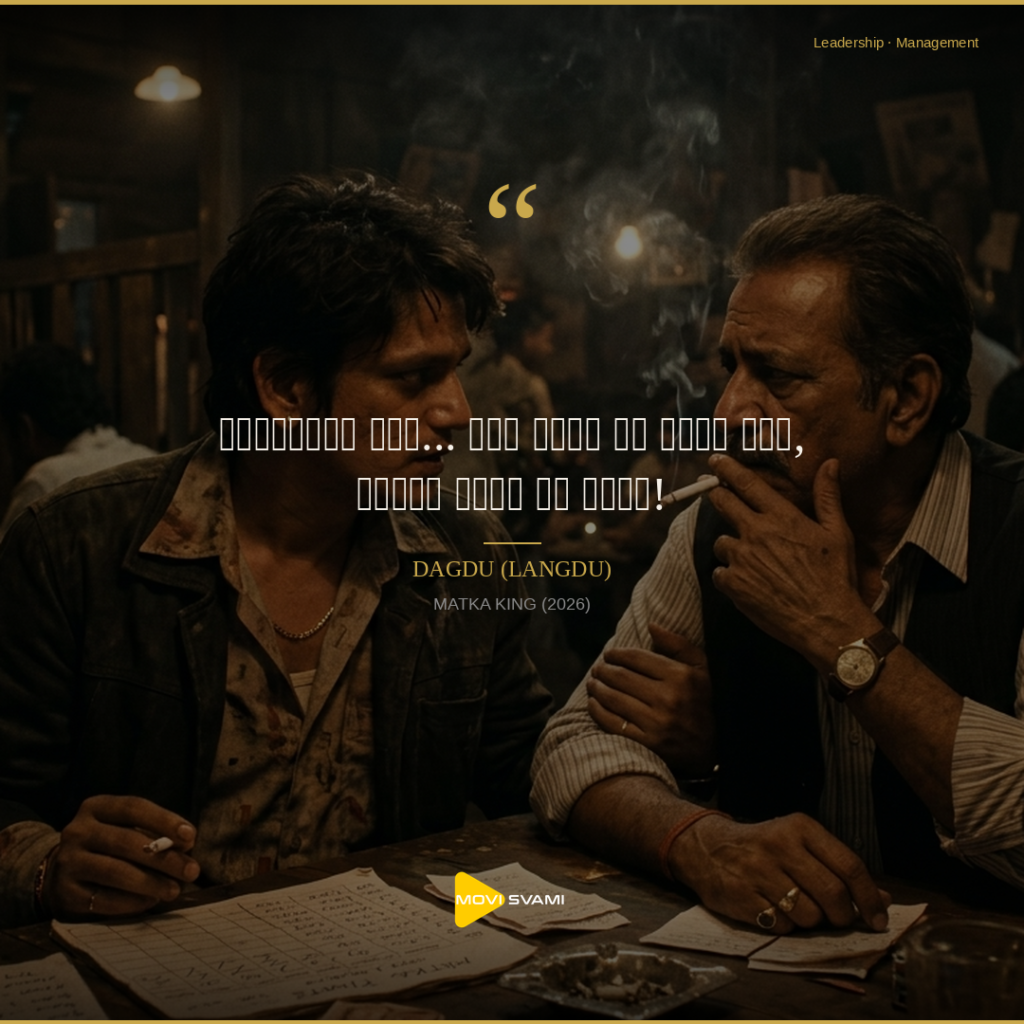
The scene unfolds in the dimly lit backroom of a Mumbai matka den, circa 1985. Smoke hangs heavy between men who count cash not in rupees but in survival. Brij Bhatti (Vijay Varma), the calculating kingpin of this shadow economy, has just entrusted a critical operation to Dagdu—known among the ranks as Langdu, the limping one, a man whose physical vulnerability mirrors his precarious station in the city’s underbelly. When the job concludes not in betrayal but success, Dagdu doesn’t reach for his cut. Instead, he looks at his employer and delivers a line that fractures the hardened silence: “Shukriya Seth… kaam dene ke liye nahi, bharosa rakhne ke liye.” Thank you, boss—not for giving me work, but for trusting me.
In the ecosystem of matka gambling—a hierarchical structure built on exploitation, surveillance, and disposable labor—Dagdu’s gratitude reveals a profound inversion of power dynamics. Work is abundant in poverty; it is never scarce. What remains genuinely rare is the wager of credibility across steep power gradients. By thanking Brij not for the economic transaction but for the psychological risk of faith, Dagdu acknowledges that his value has been elevated from replaceable labor to entrusted agent. This moment captures the essence of loyalty formation: it is triggered not by compensation, which satisfies contracts, but by trust, which satisfies identity.
Organizational behavior research consistently demonstrates that hierarchical systems tend toward transactional defaults—exchanges of labor for capital governed by surveillance and compliance. Yet in exploitative or high-risk environments, this transactionality breeds minimal viable effort and maximum viable extraction. The alternative is the Dagdu Principle: the recognition that in asymmetrical power relationships, trust operates as a scarcer and more valuable currency than money. When leaders extend belief downward—delegating not just tasks but discretion, not just responsibility but judgment—they activate what sociologists term “normative commitment” as distinct from “calculative commitment.” The employee ceases to ask “What is the minimum required to retain this position?” and begins asking “What is required to honor this faith placed in me?”
Consider first the delegation of high-stakes judgment. In corporate environments, managers often delegate execution while retaining decision rights, creating “empty delegation” that signals distrust. The Dagdu scenario suggests the opposite: entrusting subordinates with consequential choices in ambiguous conditions. When a director allows a junior strategist to own the final recommendation for a client pitch—not merely the slide deck but the strategic call—they replicate Brij’s wager. The subordinate’s response is rarely calculative (demanding higher pay) but normative (investing deeper cognitive and emotional resources into justifying that trust).
Second, examine crisis navigation through the lens of trust reserves. During organizational restructuring or market contractions, the transactional contract frays—compensation stagnates, security evaporates, and the rational response is disengagement. Yet leaders who have previously invested in trust currency find that loyalty persists beyond the transactional break. Like Dagdu, who remains bound to Brij even when the economic logic suggests opportunism, employees in downsizing firms often protect process knowledge and institutional memory specifically because they have been treated as trustees rather than variables. The leader’s prior vulnerability becomes the organization’s insurance policy.
Third, observe cross-hierarchical mentorship and knowledge transfer. In rigid hierarchies, information flows upward through filtering mechanisms designed to protect those at the apex from error. When senior leaders instead share vulnerabilities—uncertainties about market shifts, past failures, or strategic ambiguities—with subordinates, they perform the same act of faith as Brij entrusting Dagdu with operational secrets. This disclosure signals that the subordinate possesses not just labor capacity but judgment maturity. The result is not mere compliance but protective stewardship: the mentee begins guarding the leader’s interests with the same ferocity they would protect their own reputation.
The matka dens of mid-century Mumbai were brutal meritocracies where hierarchy was enforced through violence. Yet they produced this timeless insight: that the most durable power is not coercive but fiduciary. As managers navigate contemporary organizations—less violent but equally stratified—they must ask whether their relationships with subordinates resemble transactional extraction or trust-based investment. The question is not what work you have given your team, but what belief you have risked upon them. In that risk lies the only loyalty that transcends the paycheck.