
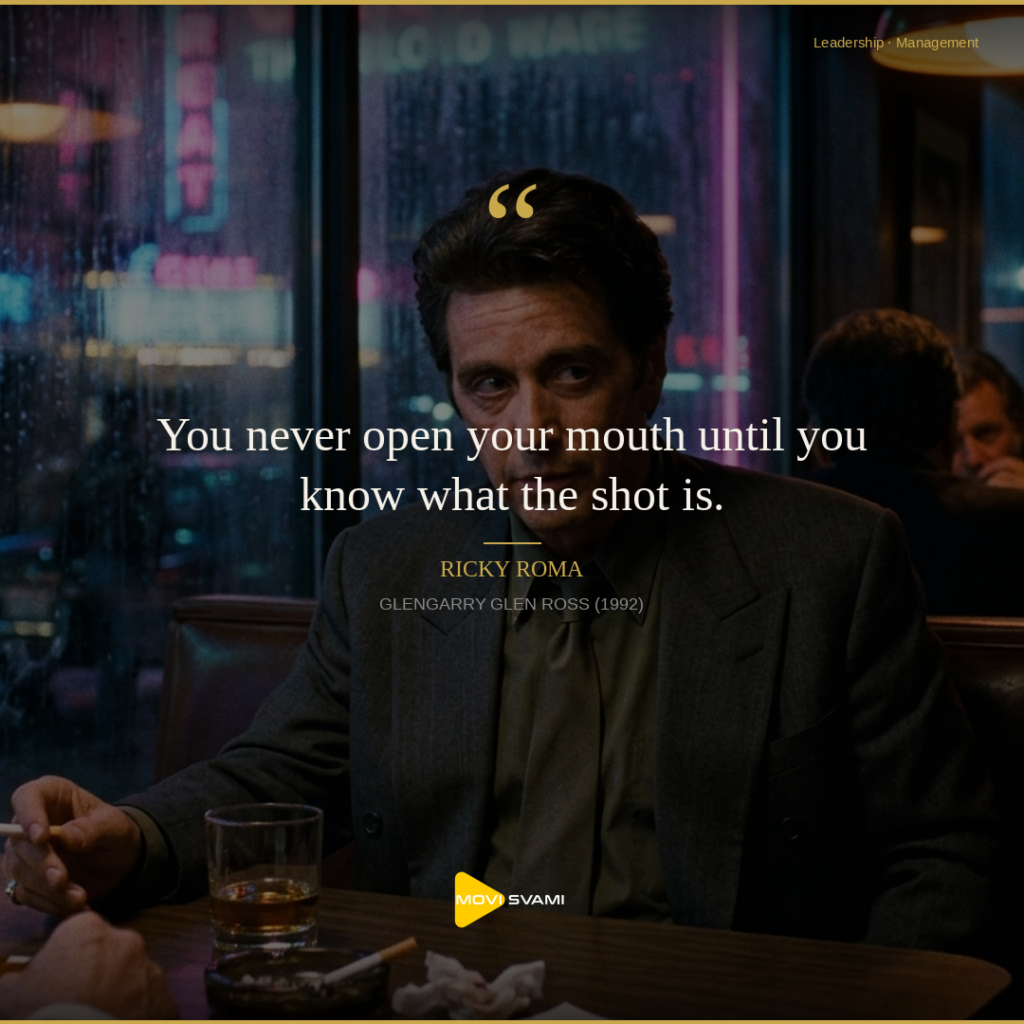
The neon glow of the Chinese restaurant cuts through the rain-soaked Chicago night, a refuge from the desperation permeating the Premiere Properties office. Inside, Ricky Roma—played with predatory charm by Al Pacino—sits not with sales brochures or contracts, but with James Lingk, a vulnerable mark reeling from marital collapse. The audience knows Roma is selling. Lingk does not. Yet for nearly ten minutes of screen time, Roma never opens his briefcase. He listens. He probes. He waits. The tension is excruciating because we understand that in this world of “Glengarry leads” and cutthroat competition, silence is not emptiness—it is the most sophisticated weapon in the arsenal.
“You never open your mouth until you know what the shot is.” Roma delivers this line not as a manipulator’s confession, but as a strategist’s credo. In the context of the film, the “shot” is not merely the sales angle; it is the precise psychological coordinates of the prospect’s pain, desire, and desperation. Roma understands that Lingk doesn’t need land in Florida; he needs to feel like a man who still possesses agency in a life spiraling toward obsolescence. The stakes are existential—for Lingk, who fears oblivion, and for Roma, who understands that botching the “shot” means wasting a premium lead in a zero-sum game where Shelley Levene’s breakdown in the phone booth serves as a constant reminder of failure’s cost.
This dynamic reveals a fundamental leadership principle often obscured by sales methodologies obsessed with objection handling and closing techniques: the primacy of diagnostic listening over prescriptive pitching. Roma’s approach is essentially clinical. He conducts an examination before writing the prescription. Modern sales literature emphasizes “solution selling” and “consultative approaches,” yet too often these devolve into scripts disguised as conversations, where the seller waits impatiently for the prospect to finish speaking so they can deploy their PowerPoint deck. Roma’s discipline—his refusal to speak until he has mapped the territory—represents a more austere and effective model: alignment before proposition. You cannot solve a problem you have not accurately diagnosed, and you cannot diagnose without the strategic patience to let the prospect reveal the architecture of their constraints.
Consider the enterprise software sales cycle, where initial conversations often determine whether a deal progresses to technical validation or dies in procurement purgatory. The error is leading with capability statements—”Our platform reduces TCO by 30%”—before understanding whether TCO is the prospect’s metric of pain. The Roma approach demands mapping the prospect’s operating reality first: Who owns the budget? What failed last quarter? What is the internal politics of the status quo? The “shot” in this context is the specific workflow bottleneck that, if unresolved, threatens the prospect’s departmental credibility. Only after this diagnostic can the seller propose a solution that aligns with the prospect’s internal narrative of success.
In high-stakes partnership discussions—whether joint ventures, licensing agreements, or channel partnerships—the temptation is to anchor early with aggressive terms, believing that anchoring theory favors the first mover. Yet this ignores the information asymmetry that exists in every negotiation. The “shot” is understanding the counterparty’s constraints that are invisible in their opening position: Are they facing board pressure to show growth? Do they have a quarterly window that creates urgency? Are they constrained by existing exclusivity agreements? Strategic listening in this context means diagnosing their zone of possible agreement before submitting proposals. The power lies not in speaking first, but in understanding the structural forces acting upon the other side’s flexibility.
The principle extends beyond external sales to internal leadership, particularly when driving organizational change initiatives. Leaders often mistake buy-in for understanding, launching transformation programs with compelling visions before diagnosing the organization’s readiness to absorb change. The “shot” here is the specific resistance psychology of the team: Is the hesitation rooted in capability anxiety, resource scarcity, or loss of status? Diagnostic listening in leadership means conducting the ethnography of your own organization—understanding the micro-cultures, the informal power networks, the unspoken fears—before proposing strategic shifts. Alignment must precede action, or the initiative meets the silent sabotage of the unconsulted.
The enduring power of Roma’s philosophy lies in its inversion of the sales myth that velocity equals value. In a business culture obsessed with hustle metrics—calls made, demos booked, pipelines stuffed—the discipline of strategic silence appears almost subversive. Yet the mathematics of conversion favors the diagnostician over the broadcaster. The question for the contemporary executive is not whether you are speaking enough, but whether you are listening with sufficient strategic intent to know what the shot is before you take it. When was the last conversation you entered where you remained deliberately silent until you understood the exact architecture of the other party’s need—and how did that change the outcome of the negotiation?