
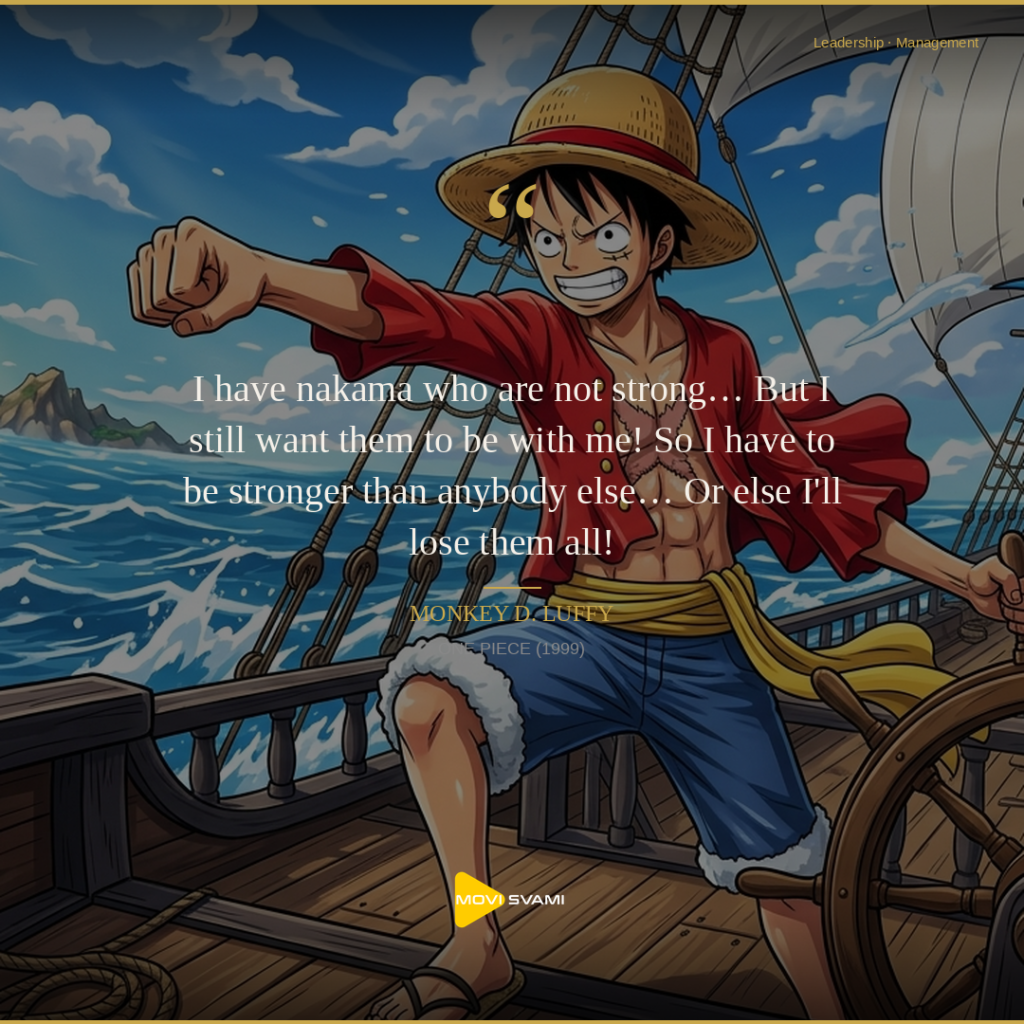
The aftermath of Marineford leaves Monkey D. Luffy physically shattered, but the psychological devastation cuts deeper. In Eiichiro Oda’s epic *One Piece*, the Straw Hat captain confronts a terrifying asymmetry: his ambition has outpaced his capacity to shield his diverse crew—the “nakama” whose heterogeneity defines their collective strength. Unlike conventional leaders who seek homogeneous excellence, Luffy has deliberately curated a team of specialists—musicians, archaeologists, cooks, navigators—whose vulnerabilities vary dramatically. Some possess combat prowess; others would collapse under direct assault. This variance creates a leadership burden distinct from command: the necessity of becoming, as Luffy realizes, “stronger than anybody else” not to dominate, but to preserve diversity through asymmetric protection.
Following the tragedy at Marineford where he nearly loses his brother and recognizes his crew’s exposure, Luffy articulates the paradox of protective leadership: “I have nakama who are not strong… But I still want them to be with me! So I have to be stronger than anybody else… Or else I’ll lose them all!” The statement rejects the easy solution of demanding universal combat readiness or culling the vulnerable to reduce risk exposure. Instead, Luffy accepts the mathematical reality that heterogeneous teams contain variance in defensive capability, and that leadership strength must function as a counterweight—a statistical hedge against the differential risks inherent in diversity. The quote frames captaincy not as status elevation but as load-bearing responsibility, where the leader’s development trajectory must steepen proportionally to the team’s vulnerability gaps.
Modern organizational design increasingly recognizes that homogeneity—while operationally convenient—produces brittleness and blind spots. Diverse teams, by definition, contain asymmetric profiles of experience, resilience, political capital, and technical capability. The entry-level innovator possesses demographic insight that the C-suite lacks; the veteran administrator navigates institutional memory that recent hires cannot access; the neurodivergent analyst perceives pattern anomalies invisible to normative cognition. Yet these asymmetries create protection gaps. When market volatility, organizational politics, or technological disruption strike, the most vulnerable nodes of the heterogeneous team face existential threat first.
Effective leadership therefore operates as organizational shock absorption—capacity held in reserve specifically to neutralize threats that would otherwise selectively eliminate the team’s most distinctive (and often most vulnerable) contributors. This requires leaders to develop “protective surplus”—technical credibility, political insulation, and resource control—sufficient to intercept challenges before they reach those lacking equivalent defensive infrastructure.
Startup founders frequently recruit junior talent with non-traditional backgrounds—career switchers, bootcamp graduates, or international hires—who bring cognitive diversity but lack professional networks or immigration stability. During funding crunches or restructuring, these individuals face disproportionate precarity. Sophisticated founders preemptively build “protection capacity” by establishing relationships with multiple investors, maintaining emergency cash reserves, or creating cross-functional mentorship pods that insulate vulnerable hires from layoff cascades. The leader’s strength—relationship capital, financial security, reputational credibility—is deployed specifically to preserve heterogeneity that would otherwise be homogenized by market pressures.
Military special operations units increasingly incorporate technical specialists—linguists, cyber operators, cultural experts—whose combat capabilities differ from direct-action operators. Unit commanders must architect mission profiles where their personal tactical proficiency and decision-making velocity absorb risk that would otherwise expose vulnerable specialists. This “asymmetric protection” ensures that the team’s diversity (essential for complex, ambiguous missions) isn’t sacrificed to the uniformity demanded by high-threat environments. The leader becomes the primary defensive system, allowing specialists to contribute distinct value without requiring universal combat mastery.
Healthcare administration presents acute versions of this dynamic as physicians face escalating administrative burdens and burnout. Nurse practitioners, residents, and medical assistants often possess patient-connection capabilities that exceed their institutional political power. Effective medical directors must develop bureaucratic and political “strength”—buffering clinical staff from administrative violence, absorbing compliance complexity, and intercepting resource conflicts—to preserve the care diversity that improves outcomes. When leaders fail to scale their protective capacity, homogenization occurs: the most vulnerable (often the most empathetic) clinicians burn out first, leaving only the institutionally armored but potentially less patient-centered providers.
Luffy’s vow ultimately recognizes that diversity is not a dividend of strength but a demand upon it. Leaders who assemble heterogeneous teams inherit an obligation to scale their protective capacity proportionally to the vulnerability variance they have invited into their mission. The alternative—demanding that all nakama become equally strong—destroys the very heterogeneity that warranted their inclusion. True leadership strength manifests not in the ability to dominate, but in the capacity to preserve.