
# Breaking the Surface: How Leaders Build Trust Across Difference
The Pennsylvania humidity hangs heavy over Gettysburg, suffocating the 1971 football squad of T.C. Williams High School. Coach Herman Boone has driven his black and white players to a college campus scarred by Civil War history, forcing them to bunk in artificial proximity—black athletes with white roommates, compressed into dormitory heat that amplifies every micro-aggression. Three-a-day practices in the cemetery, among the gravestones of dead soldiers, serve less as physical conditioning than as psychological pressure testing. The players arrive not as teammates but as representatives of incompatible social orders, each collision carrying the kinetic potential for violence. Boone does not moderate the intensity; he accelerates it, eliminating escape routes until the team must either fracture completely or forge new structural integrity. The first week is not about football. It is about civil restraint under conditions of manufactured stress.
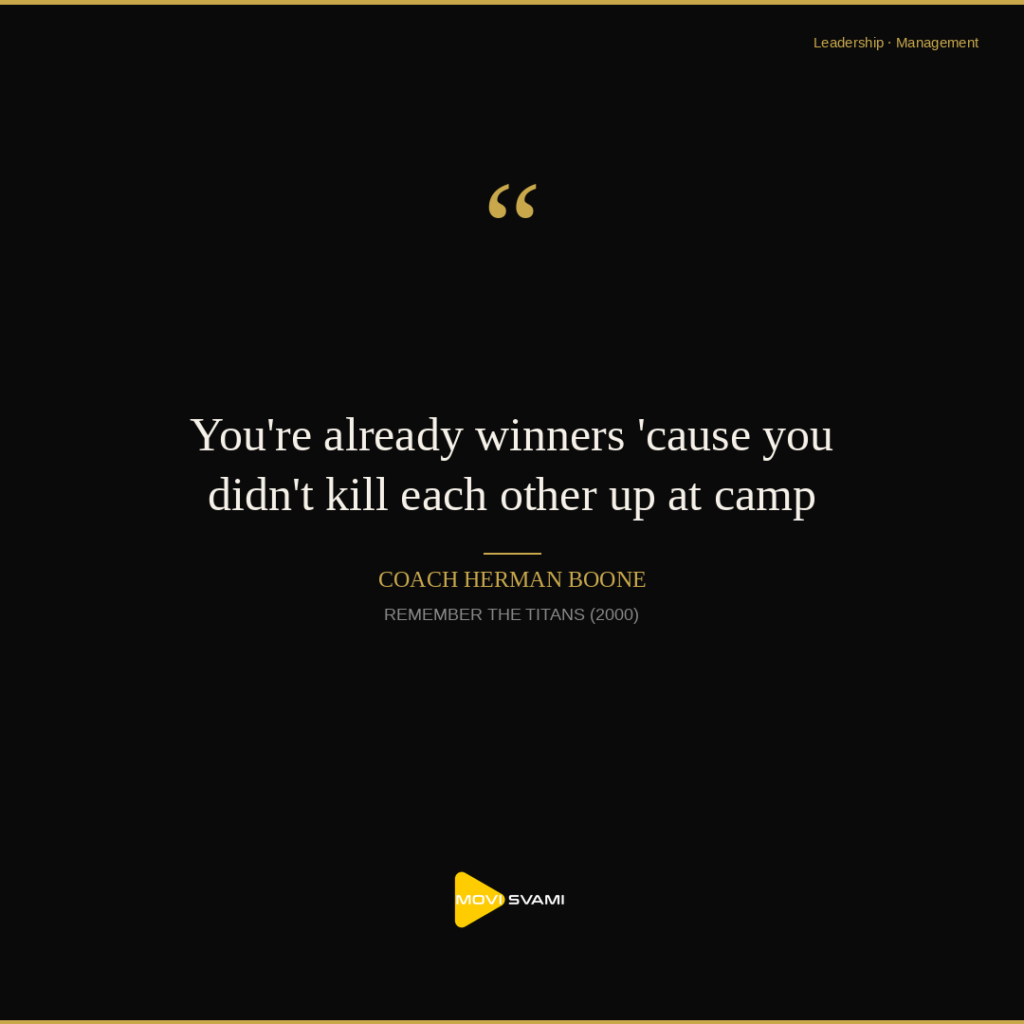
Days into this crucible, after the fistfights have been broken up and the racial epithets have echoed off brick walls, Boone gathers the exhausted men in the half-light of evening. They have not yet won a game. They have not yet mastered the perfect option play. But Boone identifies a victory that conventional leadership metrics would miss: “You’re already winners ’cause you didn’t kill each other up at camp.” The statement lands not as sentimental encouragement, but as diagnostic truth. The goalposts have shifted from championship rings to basic survival. In acknowledging this lowered threshold as genuine achievement, Boone signals that he understands the structural weight of what he is asking—coexistence across a fault line that runs deeper than sports.
Most leaders launching diverse initiatives commit a sequencing error that guarantees suboptimal outcomes. They assume that shared objectives—quarterly targets, patient outcomes, product launches—will override the primal circuitry of in-group preference. The amygdala does not recognize OKRs. When individuals from historically antagonistic or simply unfamiliar groups are compressed into high-stakes environments, the body metabolizes difference as threat, expending cognitive resources on vigilance rather than collaboration. As Harvard organizational scholar Amy Edmondson’s research demonstrates, psychological safety—the shared belief that interpersonal risk-taking will not result in humiliation or exclusion—functions as a prerequisite for learning and excellence, not a byproduct of it. Performance cannot precede safety; it requires the basal conditions of mutual non-destruction.
Boone’s insight lies in recognizing that diverse teams generate inherent “coordination costs”—friction that must be metabolized before momentum can build. This is not an argument for reduced standards or infinite accommodation, but for architectural patience. The leader’s initial task is not to optimize output but to engineer conditions where the fundamental work of human recognition can occur. Boone’s training camp was not a softening exercise; it was a controlled burn, eliminating the underbrush of stereotype through forced interdependence. By declaring survival itself a victory, he establishes a foundation of shared experience—the memory of having endured common hardship—that later supports rigorous accountability. You cannot demand excellence from people who are still calculating whether they are physically safe.
Consider the technology firm integrating offshore development teams with legacy engineering staff in San Francisco. Management typically accelerates the sprint schedule, assuming deadline pressure will force cohesion and that shared code repositories create automatic alignment. Instead, code quality degrades. Pull requests go unchallenged not because the work is adequate, but because engineers from different cultural contexts—where direct criticism carries varying social penalties—have not yet established the trust required to question each other’s logic. The structural intervention is not more aggressive KPIs, but protected “integration sprints” where the deliverable is not software but relationship infrastructure. Teams must establish how disagreement will be handled—what researchers call “failure tolerance”—before the technical disagreement occurs.
In hospital settings, surgical teams cobbled together from different disciplinary silos—surgeons, anesthesiologists, travel nurses from competing training backgrounds—face similar basal challenges. Research on surgical errors indicates that communication failures, not technical incompetence, drive the majority of adverse outcomes. Yet administrators often schedule these mixed teams into high-stakes procedures immediately, assuming medical hierarchy provides sufficient coordination. The Boone principle suggests instead a preliminary “camp” phase: standardized communication protocols rehearsed in simulation before they are tested on human patients. The trauma bay requires what military strategists term “redundant coverage”—the certainty that your teammate has your back because you have survived mutual testing. The team must survive its own formation before it can save lives.
Corporate mergers illustrate the principle at scale. When two legacy organizations combine, leadership typically fixates on revenue synergies and efficiency targets within the first hundred days, installing “best of both” operating models before the cultures have negotiated basic terms of engagement. They mistake organizational silence for alignment. In reality, the merged entity is experiencing exactly the intergroup anxiety Boone observed—employee groups scanning for threats, retreating to legacy identity markers, withholding institutional knowledge as protective camouflage. The merged entity does not have a strategy problem; it has a coexistence problem. Leaders who announce ambitious integration targets before establishing neutral zones for cross-cultural contact—where the specific friction points can surface without career penalty—are ignoring the physics of group formation.
The discipline required here is patience masquerading as pragmatism. High-performing leaders resist the seduction of immediate excellence, recognizing that sustainable performance requires a foundation poured in the negative spaces—what did not happen, what was prevented, what baseline safety was established. Before demanding that diverse teams win championships, the leader must first verify they have learned not to destroy each other. The architecture of trust must be built before the pressure of performance tests it. Boone understood that the victory was small, almost invisible to external observers, but it was the only one that mattered. Everything else follows from there.