
# The Hunger to Win: Leadership in High-Stakes Competition
The camera pans across a dimly lit office, the air thick with the scent of stale coffee and desperation. Ricky Roma, a grizzled sales rep with a weathered face and a voice that cracks like a dry riverbed, leans against a desk, staring at his son. The scene is a masterclass in tension: the clatter of a phone, the distant hum of a boss’s voice, and the unspoken knowledge that failure here means more than just losing a sale—it means losing everything. This is the moment that defines Roma’s character, a raw distillation of ambition and self-doubt in a world where survival depends on relentless drive. It’s a scene that doesn’t just capture the essence of *Glengarry Glen Ross*; it distills the very soul of leadership in high-stakes competition.
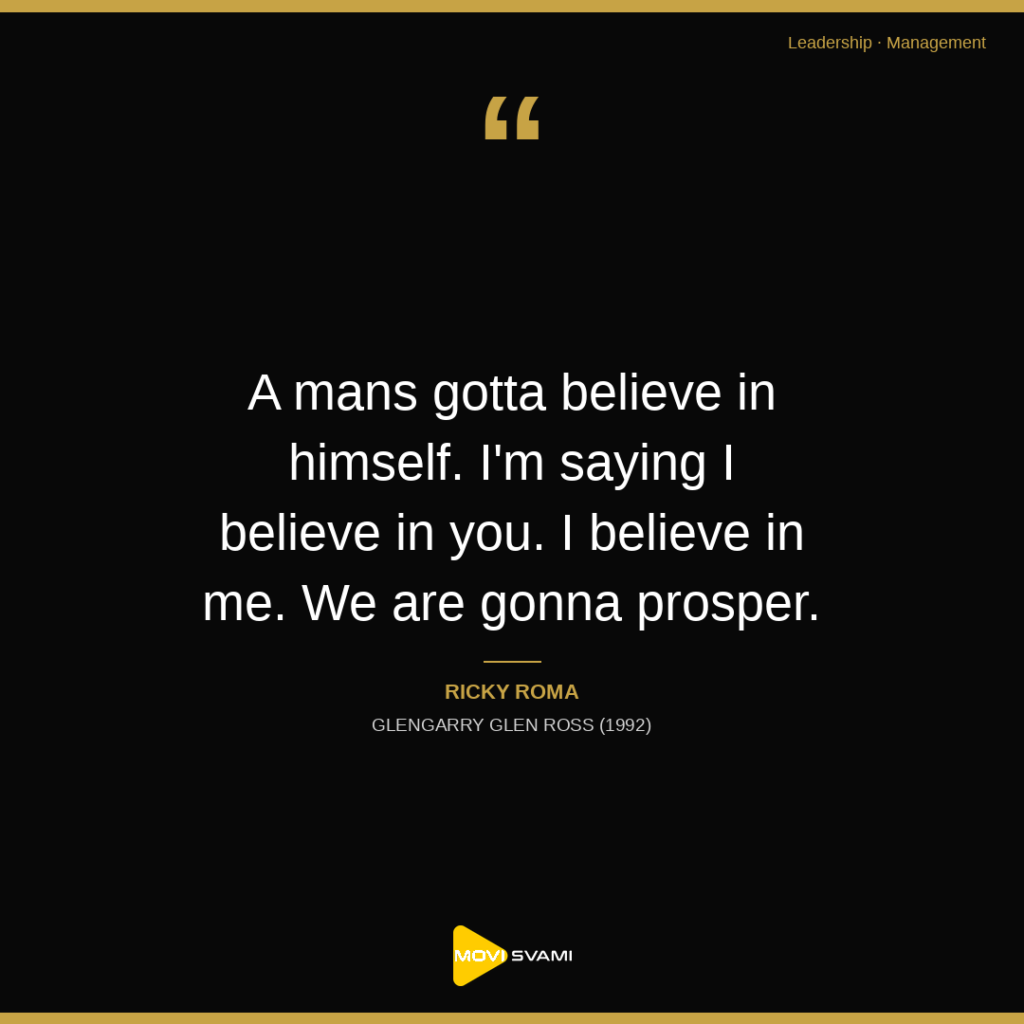
Ricky Roma’s iconic line—*”A man’s gotta believe in himself… What the fuck am I trying to say here? I’m saying I believe in you. I believe in me. We are gonna prosper.”*—is delivered in a moment of fractured clarity. Roma, a desperate salesman in a cutthroat real estate team, is trying to convince his son to join the game. But the conversation is a mirror: it’s not just about persuading his child; it’s about convincing himself. The stakes are monumental. In *Glengarry Glen Ross*, the game is a brutal contest of sales, where only the top two performers earn commissions, and the rest are left with nothing but empty promises and bruised egos. Roma’s words are a cry for salvation, a plea to cling to belief in a system that rewards ruthlessness and punishes vulnerability.
The scene is a microcosm of the film’s central conflict: the collision between human frailty and the unrelenting demands of competition. Roma’s desperation is palpable. He’s a man who has lost his job, his home, and his sense of self, yet he persists, driven by a need to prove his worth. His plea to his son is both a confession and a challenge—a reminder that in this world, belief is not just a virtue; it’s a weapon. The line is a paradox: it’s a moment of self-doubt that becomes a rallying cry for self-belief.
Roma’s moment reveals a fundamental truth about leadership in high-stakes environments: ambition and drive are not just motivators—they are survival mechanisms. In *Glengarry Glen Ross*, the competition is not just external; it’s internal. Every character is battling their own demons, their own limits, and the crushing weight of expectations. Roma’s relentless drive is both his strength and his curse. He’s willing to sacrifice everything to win, but that same hunger leaves him vulnerable to self-destruction. This duality is a mirror for real-world leadership challenges. In any competitive arena—whether corporate, political, or creative—leaders must balance the need to push forward with the risk of burnout. Roma’s belief in himself is a reminder that in high-stakes environments, leaders cannot afford to waver. They must cultivate a mindset that thrives on adversity, where failure is not an endpoint but a stepping stone. Yet, this mindset also demands a dangerous level of self-awareness. Leaders must ask: Is their drive rooted in a genuine desire to succeed, or is it a compulsion to prove their worth at all costs?
Imagine a CEO navigating a sudden industry disruption, such as a technological shift or a global economic downturn. The stakes are existential: the company’s survival depends on rapid adaptation. In this scenario, a leader must channel Roma’s hunger to win by fostering a culture of relentless problem-solving. This means making tough decisions, reallocating resources, and communicating with clarity and conviction. The leader’s belief in the team’s ability to adapt becomes the glue that holds the organization together. Just as Roma clings to his belief in himself, the leader must cling to the belief that the team can overcome the crisis.
Consider a manager leading a sales team in a hyper-competitive market, where performance metrics are visible to all and the pressure to outperform is constant. Here, Roma’s lesson is clear: the leader must balance recognition of individual achievement with a shared vision of success. This could involve creating a system that rewards not just top performers but also those who demonstrate resilience and innovation. The leader’s own belief in the team’s potential must be evident in every action, from setting ambitious goals to celebrating small wins. In this context, the leader’s drive becomes a catalyst for collective motivation.
In high-stakes situations, such as launching a groundbreaking product or securing a major client, leaders face the risk of losing momentum. Roma’s moment reminds us that belief is not a one-time decision but a continuous act. A leader must actively cultivate this belief through transparency, empathy, and accountability. For example, during a critical project, the leader might hold regular check-ins to address concerns, acknowledge progress, and reinforce the team’s shared purpose. This mirrors Roma’s plea to his son: the leader must remind the team of their collective potential, even when the path is fraught with uncertainty.
Roma’s line—*”I believe in you. I believe in me. We are gonna prosper.”*—is a call to action for leaders in any high-stakes environment. It challenges us to examine our own motivations: Are we driven by a genuine desire to achieve, or by the need to prove ourselves? In the end, leadership is not about winning at all costs; it’s about finding the courage to believe, even when the odds are stacked against you. As you reflect on your own challenges, ask yourself: What is your version of “prosper”? And how will you keep believing, even when the stakes are highest?