
# Apollo 13: How Process and Discipline Brought Three Astronauts Home
The Apollo 13 mission control room in 1995’s *Apollo 13* crackles with tension as the crew of the crippled spacecraft battles to survive. A catastrophic oxygen tank explosion has left the lunar module adrift, its systems failing, and the astronauts stranded 200,000 miles from Earth. On the ground, a team of engineers and mission controllers works in silence, their hands moving methodically across consoles, their voices calm but urgent. This is not a moment for panic—it is a moment for precision. The stakes are clear: the lives of three astronauts hang in the balance. In this crucible of crisis, one phrase becomes the rallying cry for a team that would defy the odds.
## “Failure is Not an Option”: A Mantra for Survival
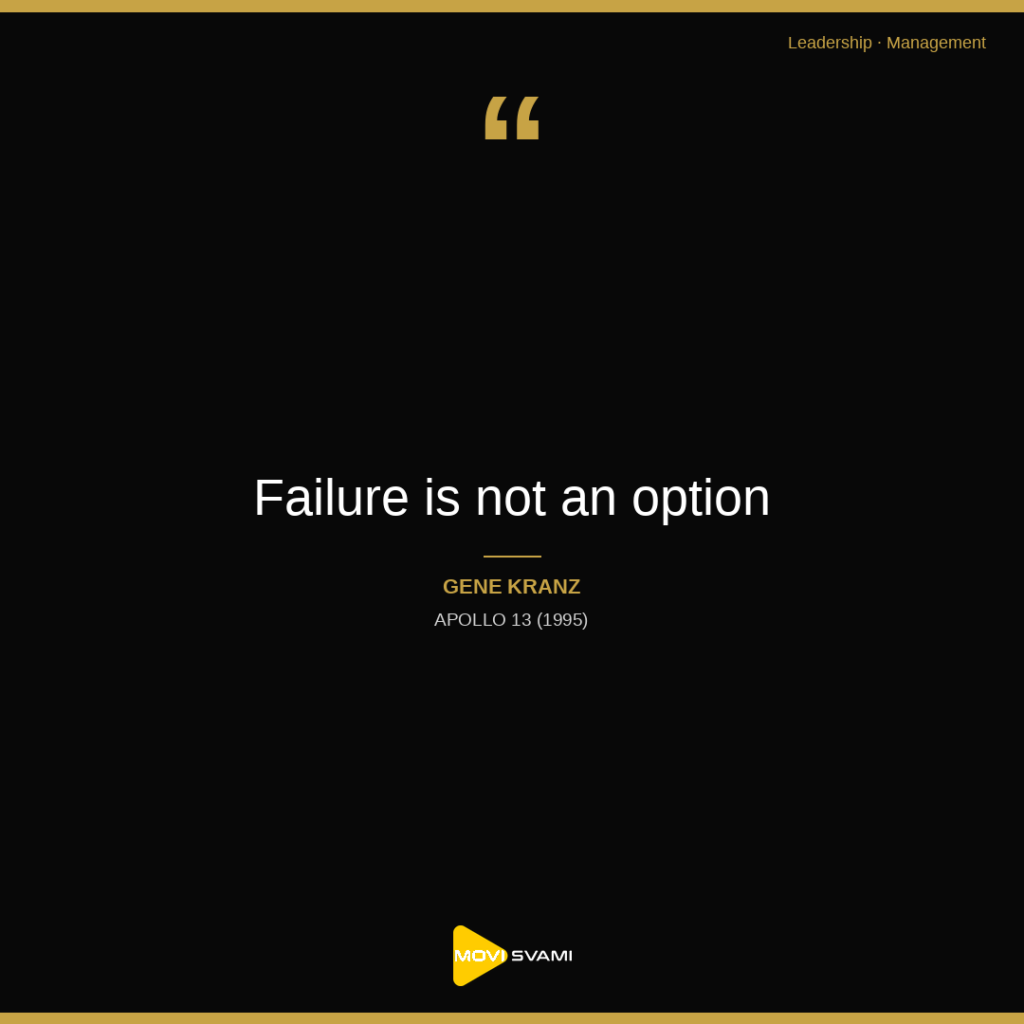
The iconic line “Failure is not an option” is spoken by Gene Kranz, the NASA flight director overseeing the mission. It is not a statement of certainty but a declaration of intent—a reminder that in the face of chaos, discipline and protocol must prevail. The Apollo 13 crisis was a perfect storm of technical failure and human ingenuity. The explosion of an oxygen tank had crippled the command module, forcing the crew to rely on the lunar module as a lifeboat. Communication with the astronauts was intermittent, and the trajectory calculations required to return them safely to Earth were unprecedented.
Kranz’s words are not merely motivational; they are a command to the team. In the movie, he stands before a room of engineers, his voice steady, his message clear: the mission’s success depends on every individual’s commitment to process. The line becomes a mantra, a reminder that in high-stakes environments, improvisation without structure is a recipe for disaster. The team’s response is not one of fear but of methodical problem-solving, each step grounded in the procedures they had drilled for years.
## Discipline as the Foundation of Leadership
Gene Kranz’s leadership in *Apollo 13* is defined by his unwavering commitment to discipline and procedure. As the flight director, he does not seek to inspire through grand gestures but through precision. His role is to ensure that every team member understands their responsibility, that every decision is made with data, and that every action aligns with the mission’s objectives. In the chaos of the crisis, Kranz’s leadership is a stabilizing force, reminding his team that even in the face of the unknown, structure provides clarity.
This approach reflects a fundamental truth about leadership: discipline is not the absence of creativity but the framework within which creativity can thrive. Kranz’s team is allowed to think outside the box, but only within the boundaries of established protocols. The oxygen tank explosion, for example, required an entirely new approach to power management and trajectory calculations, yet every solution was built on a foundation of rigorous analysis. Kranz’s insistence on process is not about rigidity but about ensuring that every step taken is both necessary and safe. In this way, he transforms uncertainty into opportunity.
## Real-World Applications of Discipline in Crisis
The principles demonstrated in *Apollo 13* are not confined to space exploration. In any high-pressure environment, discipline and procedure are the bedrock of effective management. Consider the healthcare industry, where surgical teams rely on standardized checklists to minimize errors. A single misstep during a procedure can have catastrophic consequences, yet the use of structured protocols has been shown to reduce complications by up to 30% (as per the World Health Organization). These checklists are not bureaucratic hurdles—they are lifelines.
Similarly, in aviation, pilots and air traffic controllers follow strict procedures to ensure safety. When a plane encounters mechanical failure, the crew’s training and adherence to checklists can mean the difference between a safe landing and a disaster. The 2009 “Miracle on the Hudson” is a testament to this: Captain Chesley Sullenberger’s decision to ditch the plane in the Hudson River was executed with precision, guided by years of discipline and preparation.
In manufacturing, where quality control is paramount, disciplined processes prevent defects and ensure consistency. Toyota’s “Toyota Production System” is a prime example, emphasizing continuous improvement and adherence to standardized workflows. When a crisis arises—such as a supply chain disruption—these processes allow companies to respond swiftly and systematically, minimizing downtime and financial loss.
## The Leadership Imperative: Staying the Course
The Apollo 13 mission is a masterclass in crisis management, but its lessons extend far beyond the confines of space exploration. Gene Kranz’s leadership reminds us that in moments of uncertainty, discipline is the compass that guides teams toward solutions. For managers, the takeaway is clear: the most effective leaders are those who prioritize process, instill a culture of accountability, and empower teams to act with confidence.
As you reflect on your own leadership challenges, consider this question: How can you ensure that your team’s actions are guided by discipline rather than desperation? In a world where crises are inevitable, the ability to stay the course—through structure, precision, and unwavering focus—is the hallmark of true leadership.