
# Differentiate or Be Drowned Out
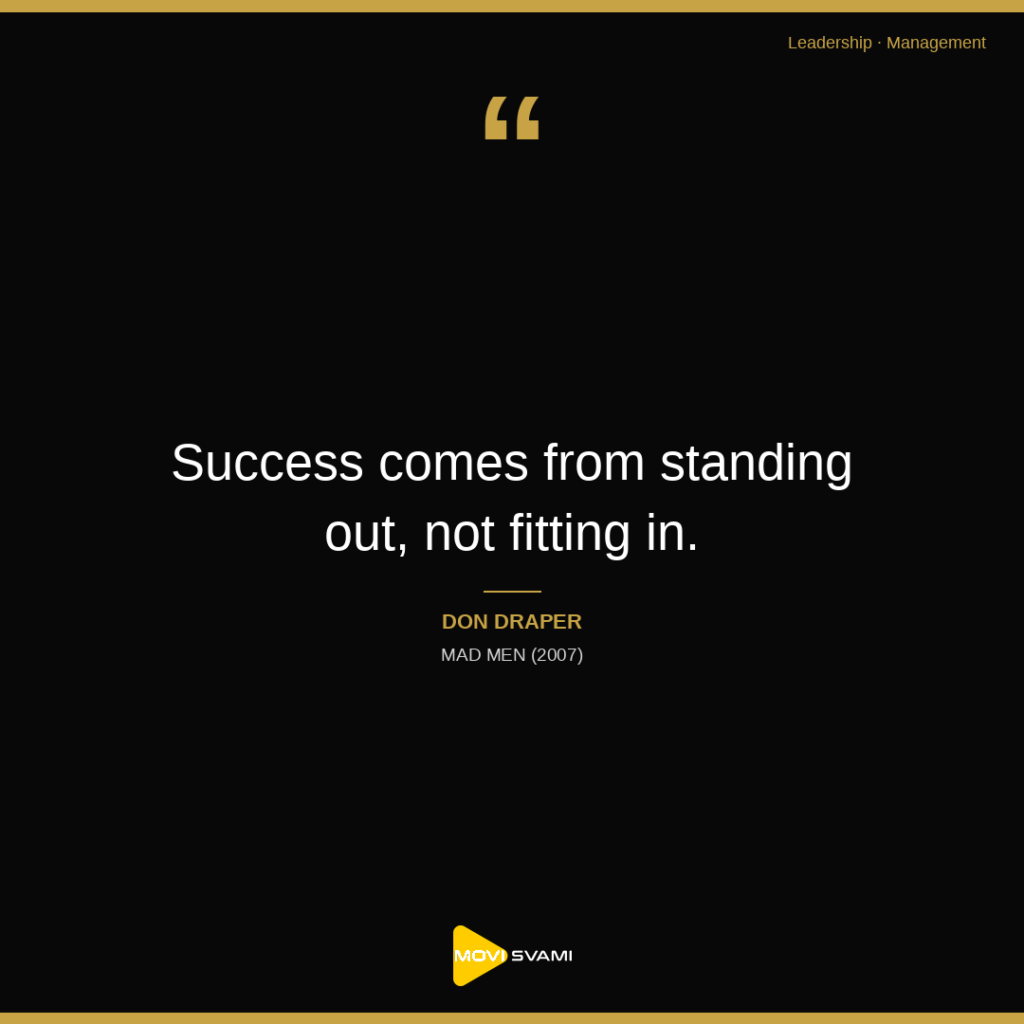
The tension in *Mad Men* Season 1, Episode 9—*The Chrysanthemum and the Sword*—is palpable. Don Draper, seated at his desk in the Sterling Cooper office, stares at Peggy Olson as she nervously waits for his verdict on her work. The room is quiet, the hum of the office a distant backdrop. Don’s words, “Success comes from standing out, not fitting in,” are not just a lesson for Peggy; they are a manifesto for survival in a world where mediocrity is a death sentence. The scene captures the essence of ambition in a cutthroat industry, where differentiation isn’t just an advantage—it’s a necessity.
—
## Differentiation is the Engine of Ambition
Don Draper’s philosophy offers a profound lesson for modern leaders. In an era where homogeneity often masquerades as efficiency, differentiation is not just an advantage; it’s a necessity. The quote reveals that true success stems from carving a distinct identity that resonates beyond mere compliance. This requires courage to challenge norms, yet the ability to align that uniqueness with organizational purpose.
For executives, this principle translates to several critical considerations. How do leaders balance individuality with collective goals? What frameworks can measure the ROI of differentiation? And in a world saturated with sameness, how do we ensure our ambitions remain both original and actionable? The answer lies in redefining success not as conformity, but as intentional, value-driven distinction.
## The Quote in Context: Power Through Distinctiveness
Don’s declaration comes during a mentorship moment, but it also reflects his own contradictions. He tells Peggy to stand out, yet he thrives on fitting in with the elite circles of New York society. He creates a persona as Don Draper, a man of sophistication and power, while hiding his true identity. This duality underscores the complexity of differentiation. It’s not just about being unique; it’s about curating a narrative that aligns with one’s goals. In a world where authenticity is often mistaken for vulnerability, Don’s lesson is both pragmatic and perilous.
## Real-World Application 1: Market Differentiation in Competitive Industries
In the real world, managers face scenarios where differentiation is both a strategic imperative and a cultural challenge. Consider a SaaS company in a saturated market. To stand out, the leadership must identify a unique value proposition—perhaps hyper-personalized customer service or an unparalleled onboarding experience. This requires not only innovation but also the courage to invest in unconventional strategies. When competitors are focused on price cuts and feature parity, differentiation becomes the only path to sustained growth.
## Real-World Application 2: Fostering Innovation Through Distinctiveness
Another scenario arises in corporate environments where risk-averse cultures stifle creativity. A manager tasked with leading a product development team might encounter employees hesitant to propose bold ideas for fear of failure. Here, the leader’s role is to create a safe space for experimentation while reinforcing the importance of standing out. This could involve restructuring incentives to reward innovative thinking, or publicly celebrating small wins that demonstrate the value of unique approaches. The key is to transform differentiation from a solitary act into a collective mission.
## Real-World Application 3: Brand Differentiation in Marketing
A third example is in marketing, where brands must navigate an oversaturated landscape. A company launching a new product might differentiate itself by emphasizing sustainability, ethical sourcing, or revolutionary technology. However, this requires more than a catchy slogan—it demands a cohesive strategy that aligns every aspect of the business with the brand’s unique identity. Leaders must ensure that differentiation is not just a buzzword but a lived reality, permeating everything from product development to customer service.
## Closing: The Price of Standing Out
Don Draper’s wisdom is a timeless reminder that leadership is not about volume but vision. In a world that often demands conformity, the ability to stand out—and to inspire others to do the same—is a rare and potent asset. However, the path of differentiation comes with a cost. It requires resilience, authenticity, and the willingness to challenge convention. As leaders navigate their own journeys, the question becomes not “How do I fit in?” but “What unique value do I create?” The answer will define not just your success, but your legacy.