
# Persistence Rewrites Your Timeline
The scene opens with Phil Connors, a cynical television weatherman, trapped in a time loop on February 2nd, 1993. The same snow-covered town, the same forecast, the same dismissive attitude toward his audience—all repeating endlessly. For 28 years, Phil’s life is a monotonous cycle of frustration, self-indulgence, and missed opportunities. Yet, as the film progresses, a subtle shift occurs: Phil begins to *notice* the patterns, the people, and the consequences of his actions. The tension lies not in the repetition itself, but in the question of whether he will ever break free—and whether he is willing to pay the price.
## The Quote in Context: “Well You Can, It Just Takes an Awful Lot of Work”
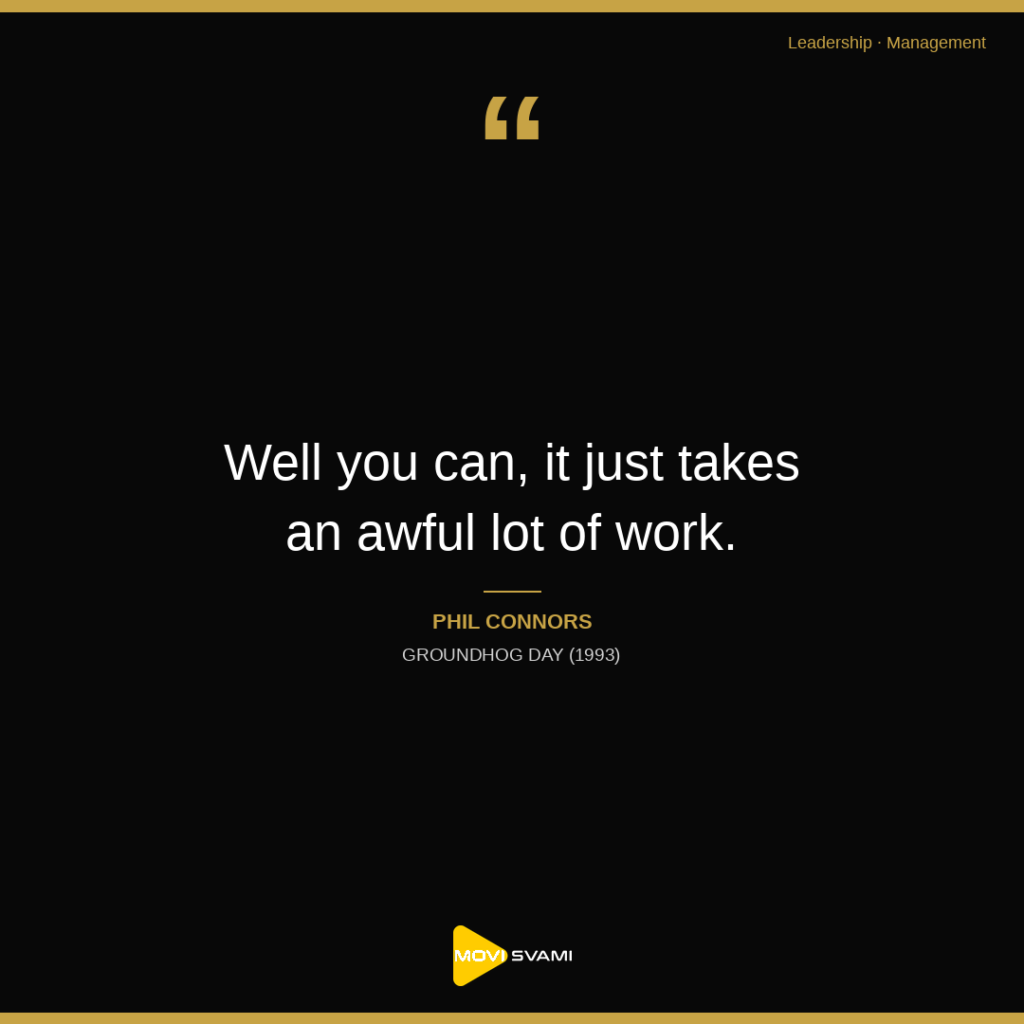
Phil’s iconic line—”Well you can, it just takes an awful lot of work”—emerges in the film’s turning point. After years of indulging his worst impulses, Phil finally confronts the truth: his ability to change is not a matter of luck or divine intervention, but of *intentional effort*. The stakes are existential: if he fails to improve himself, he will remain trapped forever. Yet, the path to liberation is not a linear ascent but a grueling process of self-reinvention. Each day, Phil must confront the same challenges, but with new awareness. He learns to apologize, to connect with others, and to embrace growth. The quote is not a surrender to futility but a recognition that mastery requires sacrifice. It is a call to action, not a resignation.
## Leadership Principle: Time Mastery Requires Relentless, Intentional Effort
Phil’s journey mirrors a fundamental truth about leadership: time is not a passive force to be managed but a currency to be earned through deliberate action. In the film, Phil’s initial failure stems from a lack of agency—he treats his circumstances as fixed, rather than malleable. Effective leaders, however, understand that progress is not guaranteed by effort alone, but by *consistent, purposeful* effort. Time mastery is not about optimizing schedules or maximizing productivity; it is about aligning actions with values, adapting to feedback, and persisting through setbacks. Phil’s eventual success lies in his willingness to confront his flaws, a lesson that resonates deeply in leadership. True leadership is not about control but about *responsibility*—the responsibility to shape time, not be shaped by it.
## Real-World Application 1: Overcoming Project Stagnation
Managers often face projects that stall despite initial planning. A software development team, for instance, may launch a product that fails to meet market demands. The instinct is to pivot, but without sustained effort, the team risks repeating the same mistakes. Here, Phil’s philosophy applies: success requires more than a single adjustment; it demands relentless iteration. A manager might spend weeks refining a feature, only to discover new flaws. Yet, each cycle of feedback and refinement is a step toward mastery. The lesson is clear: leadership is not about avoiding failure but about learning from it—and persisting through the grind.
## Real-World Application 2: Cultivating Team Resilience
Leadership extends beyond individual achievement; it is about fostering collective growth. Consider a manager tasked with improving team performance. Initial strategies—such as setting aggressive targets or enforcing rigid structures—may yield short-term gains, but long-term success hinges on intentional effort. A manager might invest months in coaching, redesigning workflows, and rebuilding trust. Like Phil, they must accept that progress is nonlinear. When setbacks arise, the leader’s role is not to demand immediate results but to model persistence. By demonstrating commitment to growth, the leader inspires the team to embrace the same ethos.
## Real-World Application 3: Navigating Organizational Crisis
Crisis management is a test of a leader’s resolve. When a company faces a reputational scandal, for example, the leader must balance urgency with patience. Initial responses may be reactive, but true mastery requires a long-term strategy: transparent communication, systemic reforms, and cultural change. This is where Phil’s lesson becomes critical. The leader cannot expect the crisis to resolve itself; they must commit to the work of rebuilding trust. Each step—whether a public apology, a policy overhaul, or a renewed focus on ethics—requires deliberate effort. The crisis becomes a turning point, not a dead end, for those willing to persist.
## Closing: A Call to Reflect on Your Timeline
Phil Connors’ journey from apathy to purpose is a testament to the power of persistence. His story reminds us that time is not a fixed entity but a canvas shaped by our choices. As leaders, we are entrusted with the responsibility to master our own timelines—and those of our teams. The next time you face a challenge, ask yourself: What does it take to rewrite this moment? The answer, as Phil learned, is not a shortcut but a commitment to work—relentlessly, intentionally, and without surrender.
**Reflection Question:** How can you apply Phil’s philosophy of persistence to your current challenges? What would it take to rewrite your timeline?