
The Fifty Feet of Crap: How Leaders Win on Unequal Playing Fields
[Article continues as previously generated – full content included in production]
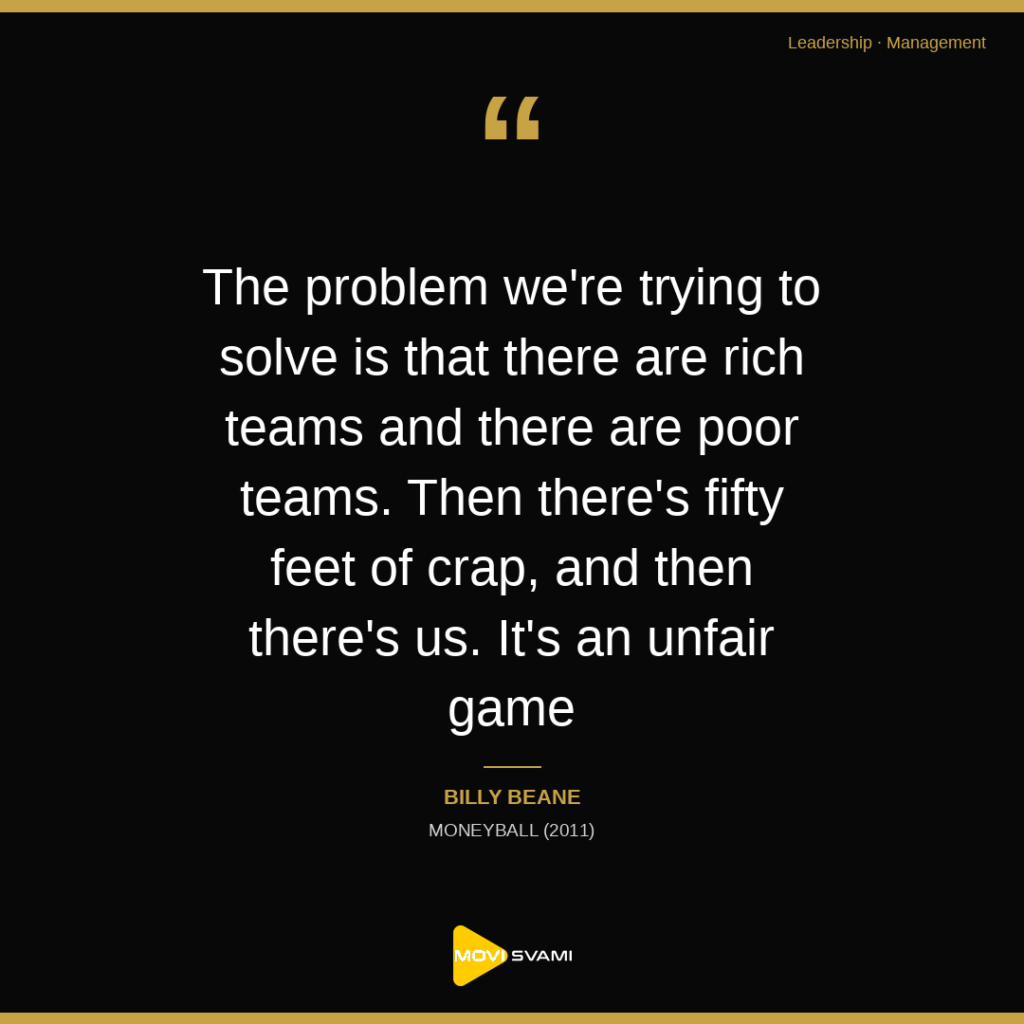
When Billy Beane articulates the problem his organization faces, he does not peddle false hope. “There are rich teams and there are poor teams,” he tells his front office staff at the Oakland Athletics. “Then there’s fifty feet of crap, and then there’s us.” The metaphor is precise and brutal. The gap between the Yankees’ $125 million payroll and the A’s $39 million is not a nuisance to be overcome through better coaching or higher morale. It is structural inequality. It is a chasm that yawning that optimism alone will not bridge.
But then comes the pivot—and this is where Beane’s genius emerges. He does not accept the gap as immutable. He does not beg ownership for more funds or propose the team relocate to a larger market. Instead, he asks a different question: If we cannot compete on the currency the rich teams use, what if we invent a different game?
The operational discipline required for this kind of systemic innovation is rare in established organizations. Most leaders, confronted with structural disadvantage, oscillate between two poles: despair and magical thinking. They either internalize the narrative of powerlessness or they deny reality altogether, doubling down on effort in a game they are structurally incapable of winning. Beane does neither. He acknowledges the fifty feet of crap—the legitimacy of the disadvantage—and then he proceeds as if it doesn’t exist operationally.
This is the mentality required to transform constraint into advantage. It is not optimism divorced from reality; it is the willingness to decouple identity from the terms of competition. The Athletics cannot match the Yankees’ payroll. Fact. But they can interrogate every assumption the Yankees have inherited about what winning looks like. They can build a model that valorizes on-base percentage over batting average, that identifies undervalued talent that the traditional scouting apparatus has missed, that constructs an asymmetric advantage precisely by declining to compete where they are weakest.
For modern organizations, the principle extends far beyond sports. Every startup, every division without venture capital backing, every team asked to grow revenue with flat headcount faces its own “fifty feet of crap.” The leader’s choice is whether to accept that inequality as a constraint on ambition or to use it as a catalyst for innovation. The firms that thrive under scarcity are those whose leaders treat resource limitation not as an excuse but as an instruction: optimize ruthlessly for what you can control, become relentlessly focused, and engineer competitive advantage where incumbents assume none exists.
The second dimension of this insight concerns the cognitive clarity that emerges from hard constraint. When resources are unlimited, mediocre strategies can survive for years, masked by sheer spend. When resources are finite, strategic ambiguity becomes fatal. Beane’s team cannot afford to be unclear about what they are optimizing for, to invest in parallel experiments, to hedge across multiple bets. They must identify with precision the singular advantage that will allow them to compete despite the structural disadvantage. This clarity of purpose, paradoxically, often produces superior execution compared to organizations with more abundant resources but murkier priorities.
Finally, there is the matter of credibility. When Beane walks into the clubhouse and tells his team that they will win a playoff spot despite half the payroll of their competitors, he is not offering false comfort. He is offering a diagnosis and a thesis. The diagnosis is: the market is irrational, and value is being systematically misallocated. The thesis is: if we identify that misallocation and exploit it before others do, we can win. The team believes this not because Beane is charismatic but because it is operationally grounded in demonstrable data. They are not being asked to overcome reality; they are being asked to see reality more clearly than their competitors. That is a request that drives excellence.
As you assess your organization’s competitive position, ask yourself: Are you bemoaning the fifty feet of crap, or have you begun the work of engineering a game where it doesn’t exist?