
Asset Leverage: How Leaders Navigate Organizational Resistance
In the 1988 film *Working Girl*, Tess McGill arrives on the Staten Island Ferry each morning carrying more than a briefcase. She carries the cognitive load of a woman determined to breach the titanium ceiling of 1980s corporate New York. As a secretary at the investment bank Pierce & Pierce, she is surrounded by a culture that expects her to serve coffee, endure casual harassment, and quietly absorb the strategic insights she is never invited to voice. The sexism she encounters is not merely interpersonal; it is structural, baked into the assumptions about who possesses the “head for business” and who merely offers the “bod for sin.” For years, Tess tries to play by the rules of a game designed to exclude her. She takes night classes, pitches ideas that are stolen or dismissed, and contorts herself into the mold of the compliant assistant. Yet the resistance she faces is not just external. It is the internal tax of compartmentalization—the exhausting work of hiding the parts of her identity that the organization has deemed inappropriate or distracting. Her breakthrough comes only when she stops apologizing for the totality of who she is.
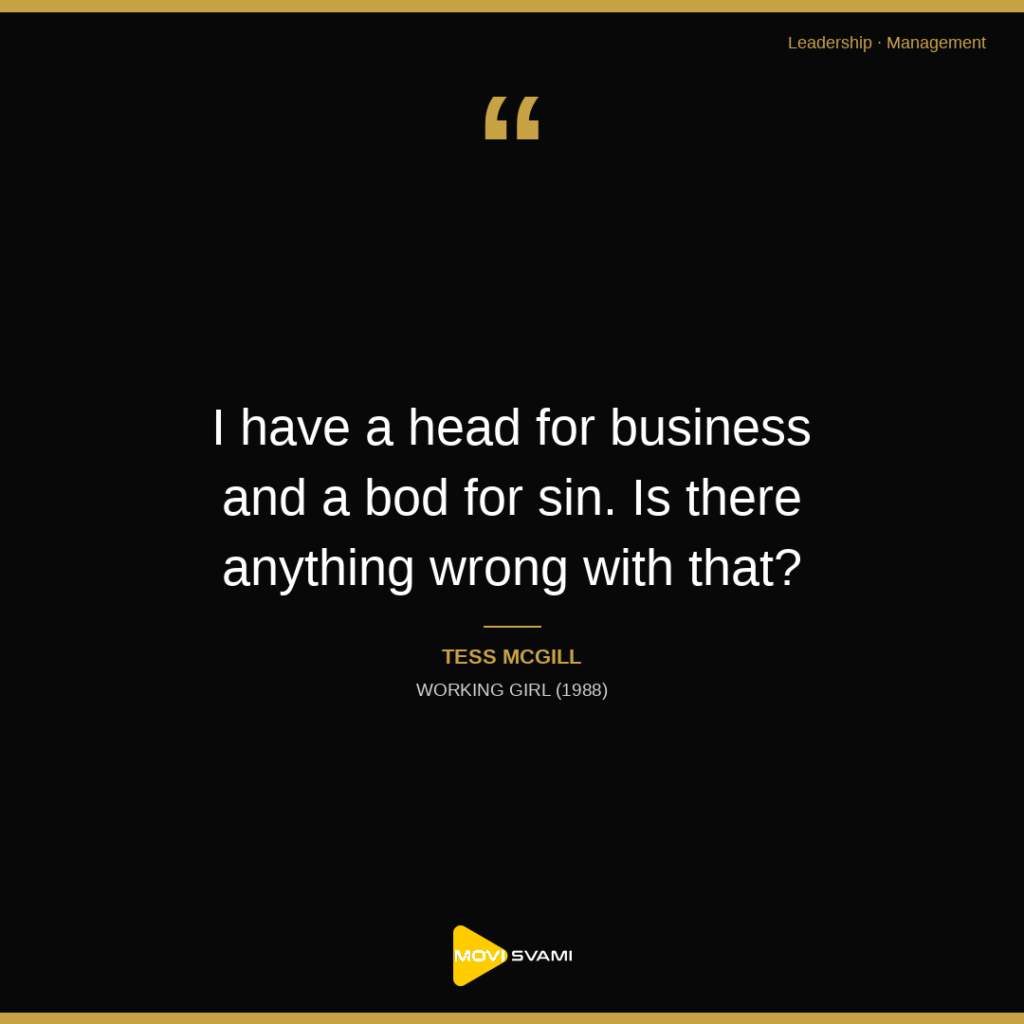
The film’s most iconic moment arrives not in a boardroom but at a cocktail party, when Tess, played with velocity by Melanie Griffith, looks at Jack Trainer and says, “I have a head for business and a bod for sin. Is there anything wrong with that?” On the surface, the line reads as flirtatious banter, lubricated by gin. But its real function is declarative. Tess is naming, for the first time without shame, the full inventory of assets she brings into the room. She refuses to accept the false dichotomy that corporate culture has imposed: that intellect and desirability, ambition and femininity, steel and softness, must occupy separate compartments. By uttering the question—”Is there anything wrong with that?”—she shifts the burden of justification onto the organization. She is no longer asking permission to be whole. She is challenging the architecture of resistance itself, and in doing so, she reclaims the terms on which she will be evaluated.
That challenge contains a leadership principle rarely taught in business schools: authenticity not as an emotional luxury, but as a strategic resource. Conventional executive wisdom has long treated identity as a portfolio to be hedged—dial down the class markers, mute the regional accent, code-switch into the dominant dialect, save the wit for after hours. The underlying assumption is that organizations reward assimilated neutrality. But Tess McGill’s trajectory suggests the opposite. When she uses her own lived experience—her familiarity with talk radio, her working-class ear for mass-market appeal, her refusal to mimic the patrician polish of her superiors—to identify the radio station acquisition opportunity, she is leveraging assets that cannot be replicated by the establishment. The integrating leader does not ask which self to bring to work; she asks how the totality of her experience creates value that homogeneity cannot see.
The cost of compartmentalization is less visible than a rejected proposal, but it is no less real. Every hour spent managing others’ perceptions is an hour diverted from solving market problems. The leader who partitions herself into “acceptable” fragments pays a cognitive tax in vigilance, eventually mistaking self-suppression for professionalism. Authenticity, in this framework, is not the raw oversharing often mistaken for vulnerability in contemporary corporate culture. It is the disciplined refusal to treat one’s own identity as a liability. Tess does not perform wholeness; she simply stops treating her wholeness as a debt owed to the organization. The result is a clarity of focus that cuts through institutional inertia and redirects energy toward opportunity.
In practice, this principle collides with three persistent realities of modern organizational life. The first is the enduring physics of gender dynamics. Despite decades of diversity initiatives, women in majority-male industries still navigate the warmth-competence bind: signal too much capability and you are punished for coldness; signal too much approachability and you are stripped of authority. Tess’s declaration does not resolve this paradox by choosing a side. Instead, she owns both registers simultaneously, forcing the room to recalibrate rather than forcing herself to shrink. The lesson for contemporary leaders is that navigating resistance does not always require conformity to the masculine prototype of dispassionate analysis nor the performance of appeasing femininity. Sometimes it requires the audacity to make the organization swallow the contradiction whole.
Second is the culture of impostor syndrome that has become the quiet wallpaper of corporate life. Impostor syndrome is frequently pathologized as an individual deficit in confidence, but it is more accurately read as a rational response to environments that systematically devalue certain contributors. Tess’s early doubt is not a personality flaw; it is evidence of a system that treats her ideas as disposable until they are laundered through a male superior’s approval. The corrective is not positive self-affirmation in the mirror but an honest inventory of one’s actual assets versus the organization’s manufactured deficits. Effective leaders push through resistance by grounding their authority in demonstrable, unique value rather than in the endless quest for institutional validation. They stop asking whether they belong and start asking whether the organization can afford to lose what only they see.
Third is the mechanics of hierarchy itself, which produces resistance through gatekeeping. Katharine Parker, Tess’s manipulative boss, represents the middle-management class that hoards credit, polices boundaries, and treats subordinates as extensions of her own status. Most organizations are populated by Parker-types who have mastered the art of instrumentalizing others while presenting themselves as indispensable nodes in the network. Tess’s breakthrough occurs when she bypasses these gatekeepers not through insurrection but through irreplaceability. By framing the radio station deal through the prism of her own cultural fluency—not the firm’s usual metrics—she makes her perspective structurally necessary. Authentic leadership in hierarchical systems is not naive transparency. It is the strategic deployment of a self that cannot be easily substituted, rendering the gatekeeper obsolete by becoming the gateway.
The arc of *Working Girl* is often reduced to a bootstrap fantasy, but its sharper insight is about the reduction of friction. Tess McGill does not become a more effective leader by acquiring a new credential or a better mentor. She becomes one by shedding the weight of apology. The question she poses at that bar is the same question every leader facing institutional resistance must eventually confront: not whether the organization is ready for them, but whether they are ready to stop negotiating their own existence.
What assets are you still leaving in the ferry terminal, and what would change if you treated them, finally, as leverage?