
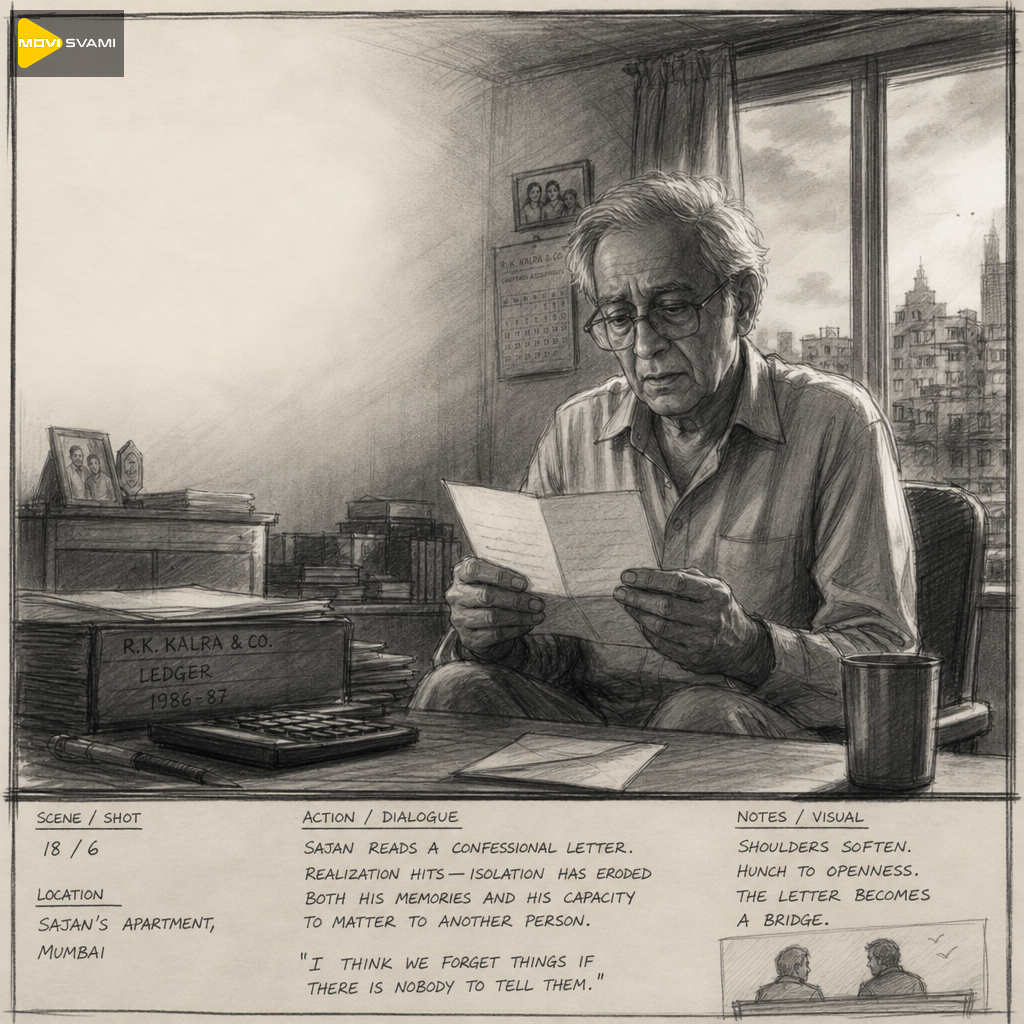
In the precise, clockwork ballet of Mumbai’s dabbawala system—where lunchboxes move with near-perfect accuracy from home to office and back again—Ila’s tiffin goes wrong. It goes to Saajan Fernandes instead of her husband. This error, this crack in the system, creates a space for something increasingly rare: genuine human witnessing.
‘I think we forget things if there is nobody to tell them,’ Saajan writes to Ila, explaining why he remembers her stories when her own husband does not. In this simple admission lies a profound leadership truth: truth requires a container, and stories require an audience to survive. Without the witness, the experience evaporates.
Irrfan Khan’s Saajan is a man of few words, a soon-to-retire accountant who has calcified into loneliness. Yet when presented with Ila’s accidental confessions—her marital disappointments, her cooking experiments, her quiet desperations—he doesn’t offer solutions. He doesn’t fix her. He simply listens, remembers, and responds. He bears witness. This is the leadership competency that modern organizations have forgotten in their rush to optimize, automate, and algorithmically manage.
Effective leadership requires active listening and bearing witness. Not listening to reply, not listening to diagnose, but listening to remember. As Saajan demonstrates, retention of truth depends on human connection and shared narrative. When we speak into the void, when our emails disappear into the abyss of unread inboxes, when our concerns are noted in HR files but never in human hearts, we experience the specific loneliness of being unheard. We forget our own stories because no one else is holding them.
In the film, Ila’s marriage is failing not because of dramatic betrayal but because of this specific absence. Her husband has stopped listening, stopped witnessing. He consumes her cooking mechanically without tasting the care in it, just as many leaders consume employee feedback surveys mechanically without tasting the human experience behind the data. Saajan, by contrast, notices everything. He notices the smell of the food, the Kebab Magic incident, the subtle shifts in her mood. His attention is his gift.
For leaders, this is a radical proposition. We are trained to solve, to strategize, to move forward. We are not trained to archive, to hold, to simply be present with someone’s truth without trying to productivity-hack it into submission. Yet teams don’t disengage because their ideas are rejected; they disengage when their stories evaporate, when they become forgettable, when their specific human experience is reduced to a manpower statistic or a performance rating.
The loneliness epidemic in modern workplaces is not just a mental health issue; it is a leadership failure of witness. When employees feel invisible, when their contributions go unnoted, when their struggles happen in isolation, they experience the same erasure Ila fears in her marriage. The leader who listens—truly listens with the intent to remember and understand—becomes an antidote to this isolation. They create what psychologists call ‘held experience,’ the sense that one’s reality is validated by another’s attention.
Saajan’s leadership—though he holds no formal authority over Ila—is exercised through his capacity to remember. He proves that he has listened by referencing details she mentioned letters ago. He validates her experience not by agreeing with her interpretation, but by confirming that the experience happened, that it mattered, that it was real enough to be retained. This is the active preservation of organizational memory that no digital filing system can replicate.
The modern workplace worships at the altar of efficiency, but The Lunchbox suggests that inefficiency—specifically, the inefficiency of deep listening—is where loyalty is forged. When leaders treat their team’s concerns as interruptions rather than information, they create a culture where truth is compartmentalized and eventually forgotten. ‘I think we forget things if there is nobody to tell them’ is not just a comment on memory; it is a warning about knowledge management. The stories we don’t tell our leaders disappear, taking with them the invisible data points that could have predicted disaster or innovation.
Consider the last time you shared a concern with a manager. Did they bear witness, or did they immediately pivot to solution mode? Did they remember your specific situation weeks later, or did you have to re-explain yourself from zero each meeting? Saajan teaches us that leadership is not always about movement. Sometimes it is about stillness, about creating a container large enough to hold someone’s truth without crushing it with premature advice.
In an age of AI and automation, where chatbots can simulate listening but cannot simulate caring, the human leader’s competitive advantage becomes precisely this capacity for witness. The algorithm can process data, but it cannot remember that last quarter’s failure happened while you were caring for a dying parent. It cannot hold the context that makes facts meaningful.
Saajan’s transformation throughout the film—from isolated misanthrope to connected participant—happens not because he finds love in the romantic sense, but because he practices the radical act of paying attention. He becomes a leader in the relationship not by directing Ila, but by directing his attention fully toward her. This is the leadership lesson for our distracted times: the revolution you seek in your organization might not require new strategy or new technology. It might simply require leaders who remember what their people tell them, who refuse to let the truth be forgotten, and who understand that bearing witness is the first act of transformation.
When there is nobody to tell, we forget who we are. The leader who listens becomes the mirror in which organizational identity is preserved and clarified. That is no small power, and it costs nothing to wield—only time, only attention, only the willingness to be present. In a world of increasing velocity, Saajan’s stationary, attentive leadership offers the counterintuitive truth that sometimes the fastest way to move forward is to stop moving and simply remember.