
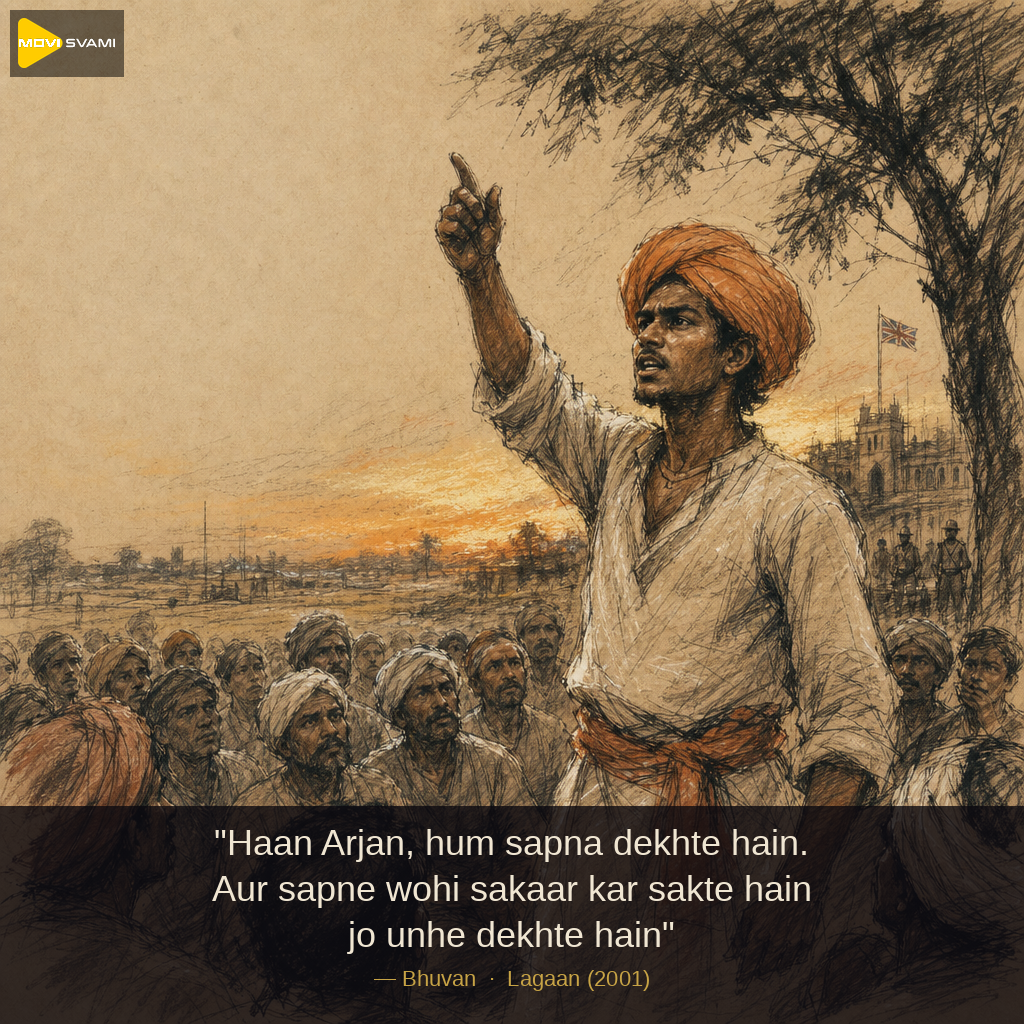
The scene is cinematic legend: a cricket pitch carved from drought-stricken earth, British officers in pristine whites, and Bhuvan, standing with ill-equipped villagers who have never held a cricket bat, accepting a wager that will determine the survival of his entire community. When Captain Russell offers to cancel three years of lagaan—crippling taxation—if the villagers win, and threatens to triple it if they lose, Bhuvan doesn’t hesitate. He sees something no one else can see yet: possibility.
‘Haan Arjan, hum sapna dekhte hain,’ he tells his skeptical friend. ‘Aur sapne wohi sakaar kar sakte hain jo unhe dekhte hain.’ We dream. And only those who dream can make dreams come true. This isn’t naive optimism. It is visionary leadership of the highest order—the audacity to turn collective hope into reality against impossible odds.
The odds are, objectively, insane. The British have played cricket for centuries; the villagers don’t know the rules. The British have professional equipment; the villagers have farm tools and religious superstitions. The British have the umpire; the villagers have a deaf eccentric. Every rational calculation says surrender. But Bhuvan understands something that rational calculators miss: vision creates its own physics.
Visionary leadership isn’t about seeing the probable. It is about seeing the possible when everyone else sees the impossible. It is about turning collective anxiety into collective hope through the sheer force of conviction. Bhuvan doesn’t just believe they can win; he makes the villagers believe it too, before they have any evidence. He installs the vision in their minds like software, and once installed, it changes their behavior, which changes the outcome.
This is the lesson for every leader facing their own ‘Lagaan moment’—the quarter when revenue seems impossible, the product launch the market says will fail, the transformation everyone claims is too radical. The visionary leader doesn’t deny the difficulty. Bhuvan never pretends the British are bad players or that the match will be easy. Instead, he reframes the meaning of the struggle. He makes the cricket match about dignity, not sport. He makes the victory about self-determination, not just tax exemption. He elevates the stakes from material survival to moral triumph.
The psychology here is crucial. The villagers aren’t afraid of losing a game; they are afraid of surviving another year of drought while paying triple taxes. Their anxiety is existential. Bhuvan’s leadership converts this existential dread into existential hope. He shows them that the same effort that might barely sustain them under oppression could liberate them from it entirely. This is the alchemy of vision: it doesn’t change the external circumstances immediately, but it changes the internal response to those circumstances, which eventually changes the circumstances themselves.
Consider the composition of his team. He includes a Muslim potter in a Hindu-majority village, breaking communal barriers because he needs the skill. He includes a Sikh trader who has never farmed. He includes a disabled farmer whom others dismiss. Bhuvan’s vision is inclusive not just because it is nice, but because it is strategic. He sees capabilities others miss because he is looking through the lens of possibility rather than prejudice. This is what vision does: it reveals hidden resources in plain sight.
The modern leader can learn from Bhuvan’s refusal to ‘be realistic.’ Realism is often just pessimism wearing a mask of sophistication. When stakeholders say ‘be realistic,’ they often mean ‘accept the constraints I accept.’ Bhuvan refuses. He insists on holding the vision until reality conforms to it. This requires tremendous emotional stamina—the ability to maintain clarity of vision while surrounded by anxiety, doubt, and rational objections.
Elizabeth Russell, the British officer’s sister, captures this when she notes that Bhuvan has something her brother lacks: the ability to inspire voluntary sacrifice. Visionary leadership doesn’t command through hierarchy; it compels through meaning. The villagers don’t follow Bhuvan because they must; they follow because he has shown them a version of themselves that is braver, stronger, and more capable than the version they knew.
When the final runs are scored and the villagers win, it feels both miraculous and inevitable. Miraculous because the odds were impossible; inevitable because once a group truly believes they can win, their behavior aligns to make it so. The victory is won not on the pitch but in the minds of the players, days before the match, when Bhuvan convinced them to see what he saw.
For leaders today, the application is immediate. What impossible odds are you facing? What vision are you shrinking to fit inside ‘realistic’ expectations? Bhuvan teaches us that the leader’s primary job is not to manage current reality but to imagine future reality so vividly that others can inhabit it. The odds don’t determine the outcome; the vision does. Dream audaciously, communicate relentlessly, and bet everything on the capability of your team to become what they must become to win. That is how you beat the empire, whatever form it takes in your industry.