
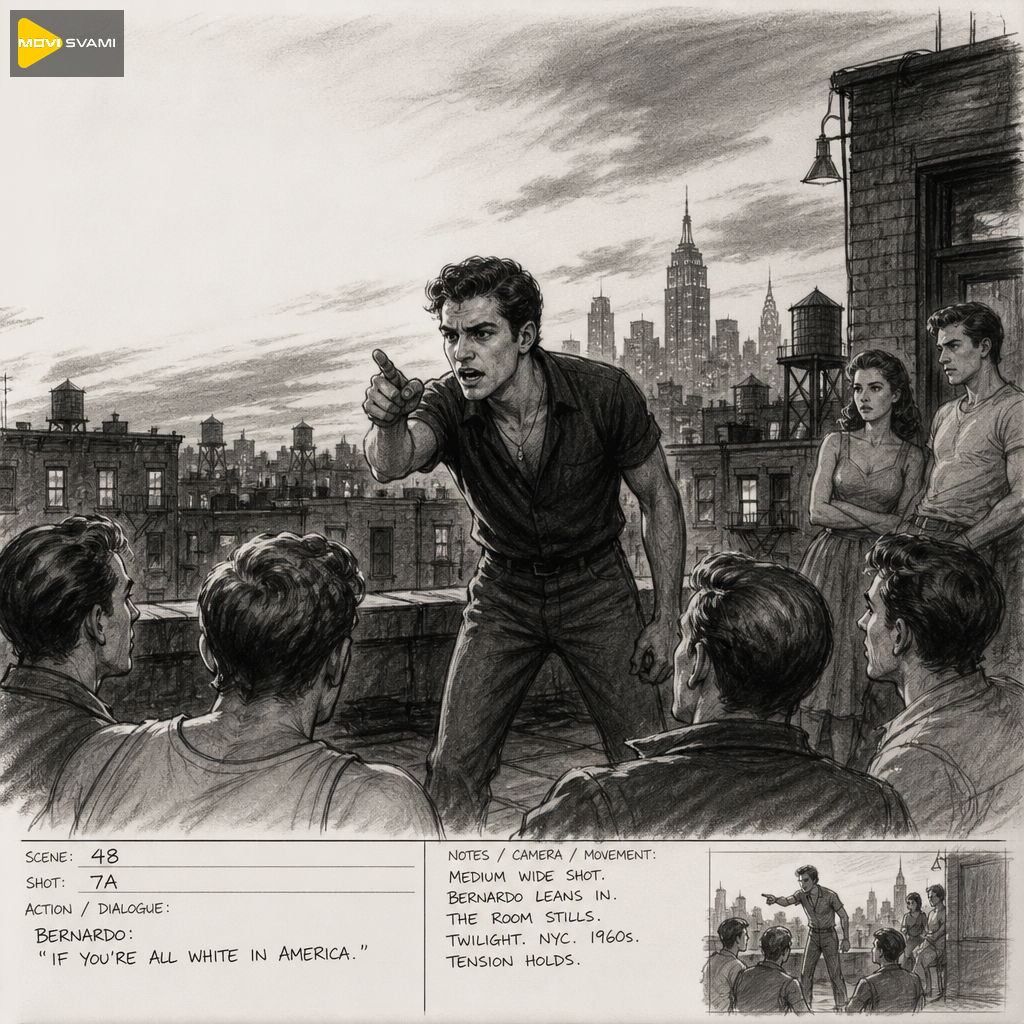
The pavement is still wet. Under the humming streetlamps of 1957 Manhattan, the Sharks trade verses about the promise of America—its supermarkets, its modern conveniences, its shining upward mobility. Anita sings the dream with electric conviction. Rosalia counters with the memory of the island. And then Bernardo, still as a blade, interrupts the rhythm with a line that silences the room: ‘If you’re all white in America.’
In Steven Spielberg’s 2021 adaptation of West Side Story, this moment is not merely dialogue. It is an accusation, a correction, and a leadership lesson compressed into seven words. While the ensemble claps and pivots around him, Bernardo refuses to let the number become a celebration of a country he knows will not celebrate him back. He names the condition. He names the cost. And in doing so, he offers a blueprint for inclusive leadership that most modern organizations have yet to follow.
To understand the weight of Bernardo’s interjection, one must hear what he is interrupting. The song ‘America’ has always been an argument set to music—a debate between immigrant hope and immigrant mourning. In the 1961 film, the tension was largely geographic: island versus mainland, past versus future. But in Tony Kushner’s screenplay for the 2021 version, the geography is secondary to the architecture of power. Bernardo is not simply homesick. He is diagnosing a machine.
His line arrives after Anita has catalogued the material luxuries available in New York—washing machines, skyscrapers, perfume by the gallon. The seduction of the chorus is almost complete. Then Bernardo inserts the condition that undermines the entire sales pitch: access to these wonders is racially gated. He does not shout. He does not plead. He states the structural truth with the calm finality of a closing door. And by doing so, he shifts the scene from a musical fantasy to a political reality.
The most common failure of inclusive leadership is not malice; it is omission. Leaders draft diversity statements, host cultural heritage months, and celebrate demographic shifts while remaining silent on the systems that made those shifts necessary in the first place. Bernardo demonstrates that inclusion does not begin with invitation. It begins with accusation—specifically, the accusation that the room itself is compromised.
When a leader names systemic inequity out loud, they perform two functions simultaneously. First, they validate the lived experience of those who have been whispering the truth in break rooms and group chats. Second, they prevent the organization from mistaking performative optimism for actual progress. Bernardo does not let the Sharks enjoy the second half of the song without acknowledging the first. In the same way, an inclusive leader does not allow a team to celebrate ‘how far we’ve come’ without publicly accounting for who paid for the mileage and who was denied the ride.
This requires a specific kind of courage: the courage to be the discordant note in a harmony everyone else is enjoying. It means interrupting boardroom enthusiasm with data about pay gaps. It means correcting the narrative that a single hire represents systemic change. It means refusing to let the optimistic half of the song stand alone.
Organizations are exceptionally skilled at branding. They compose mission statements that sound like anthems. They produce culture decks that look like Broadway posters. But Bernardo reminds us that the chorus is not the contract. If the verses describe exploitation, segregation, and erasure, then the chorus is either a lie or a prayer—and a leader cannot build strategy on either.
Performative inclusion happens when leaders amplify the aspirational narrative while suppressing the critical one. They speak of belonging while enforcing assimilation. They measure diversity as a headcount but refuse to measure equity as a lived condition. Bernardo’s leadership is instructive because he treats the dream of America as contingent. He does not reject the dream; he rejects the delusion. Inclusive leaders must do the same. They must hold their organization’s stated values in one hand and its operational realities in the other, and they must describe the gap between them in unvarnished terms.
In talent strategy, organizations often release annual reports celebrating diversity recruitment metrics. The chorus is loud: ‘We are committed to inclusion.’ But the verses—the promotion rates, the attrition data, the compensation bands across ethnicity, the distribution of high-visibility assignments—often tell a different story. Inclusive leaders must publish what Bernardo would demand: the condition. If leadership is overwhelmingly white, name it. If retention for underrepresented groups lags behind, name it. Do not let the recruitment headline drown out the retention truth.
Bernardo’s line forces a question: who gets to be simply ‘American’ without a modifier? In organizational life, this translates to who gets to be ‘professional’ without code-switching, without translation, without tax. Inclusive leadership requires naming the ways that corporate culture is not neutral terrain but cultivated soil—often fertilized by white, Western, masculine norms that are presented as universal. Leaders must ask: whose communication style is read as ‘assertive’ and whose as ‘aggressive’? Whose hair, whose name, whose holidays require accommodation, and whose are simply the default? Naming these defaults is the equivalent of Bernardo’s interruption. It says: the America you are celebrating has a color line. Draw it so we can erase it.
One of the subtle cruelties of the original scene is that Bernardo must be the one to stop the music. Anita is not wrong to want the dream; she is simply singing in a different key. But Bernardo is tasked with the labor of disillusionment. In organizations, this labor is constantly outsourced to Employee Resource Groups, to chief diversity officers, to the single person of color in the meeting who is expected to correct the room. Inclusive leadership redistributes this burden. It asks senior leaders—especially those who hold power because of the existing architecture—to be the ones who name the architecture. Do not wait for the Bernardo in your organization to raise his voice. Be the one who quiets the room first.
The final frame of the ‘America’ number does not resolve the argument. The dancers swirl on. The music swells. But the audience has been changed because Bernardo spoke the condition out loud. He did not let the song end on a note of false unity.
Inclusive leadership demands the same discipline. It asks us to resist the pressure to conclude our meetings, our memos, and our missions on uplift when the data still describes a canyon. It asks us to be comfortable with the incomplete, the unresolved, and the accusatory—because that is where the truth lives.
So the question is not whether your organization has a song worth singing. Most do. The question is whether you are brave enough to sing the verse that makes the chorus honest. Bernardo was. The room kept dancing. But they could no longer pretend they did not know the steps were borrowed.