
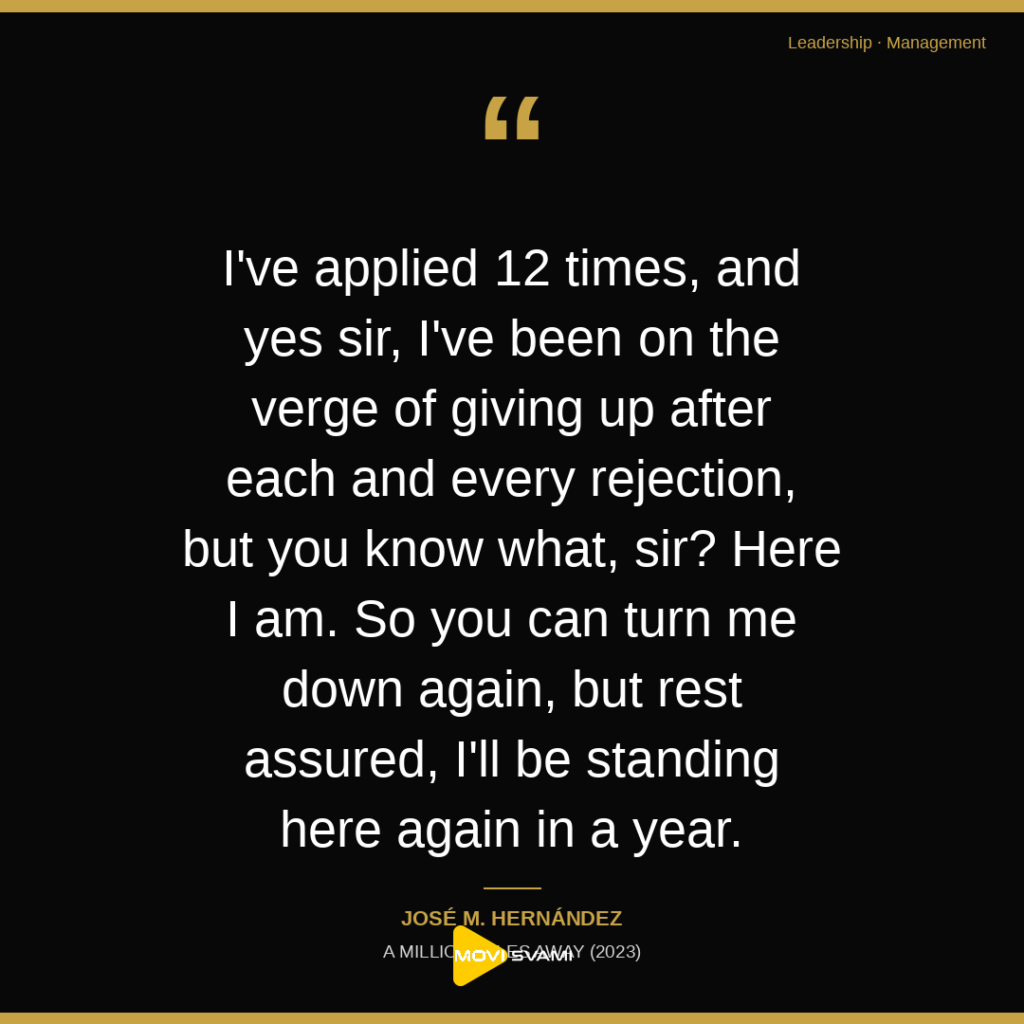
The conference room at Johnson Space Center falls silent after José M. Hernández stops speaking. In *A Million Miles Away* (2023), the 41-year-old engineer sits before a NASA selection panel that holds his decades-long dream in its hands. He has already been rejected eleven times. His résumé lists impressive technical credentials, but the unspoken question hovering in the room is whether a former migrant farmworker who learned English as a teenager and began college in his twenties truly belongs in the astronaut corps. Rather than tiptoe around his record of failure, Hernández places it squarely on the table. He frames his twelfth application not as a plea, but as a statement of operational fact: he will return whether they say yes or no.
The scene distills the real-life determination of José M. Hernández, portrayed by Michael Peña, into a moment of personal and institutional reckoning. When a panel member alludes to his repeated rejections, Hernández responds: “I’ve applied 12 times, and yes sir, I’ve been on the verge of giving up after each and every rejection, but you know what, sir? Here I am. So you can turn me down again, but rest assured, I’ll be standing here again in a year.” It is a remarkable reframe. He is not asking for mercy; he is offering evidence. In an organization where mission failure can mean death, the ability to absorb setback without abandoning the objective is not soft motivation—it is an operational necessity. By naming his eleven rejections aloud, he transforms them from liabilities into a longitudinal record of institutional commitment. The stakes are not merely personal. NASA’s Apollo and Shuttle eras were built on engineers who watched rockets explode, recalculated, and returned to the assembly bay. Hernández is arguing that his history of rejection has made him a safer bet than candidates who have never heard the word “no.”
For senior leaders, the scene exposes a tension that most strategy decks prefer to ignore. Vision is easy to celebrate. Executives are trained to articulate audacious goals—10x growth, market transformation, category creation—and to inspire teams to reach for them. What is rarely modeled is the leadership discipline required in the years when the goal recedes rather than approaches. Hernández demonstrates that sustainable success is not a function of charisma during the pitch; it is a function of cadence during the rejection. Visionary managers must set the destination, but operational managers must build the machinery of return. The twelfth application only exists because the first eleven were not treated as terminal events.
In organizational terms, this is the difference between a moonshot and a martyrdom. A moonshot requires a guidance system that corrects after every drift; martyrdom requires only a single, spectacular attempt. Leaders who conflate boldness with haste often burn through talent, budget, and credibility before the trajectory has time to stabilize. Hernández’s quote is a reminder that the most important variable in long-term execution is not the intensity of the try, but the inevitability of the next one. The manager’s task is to make persistence systematic rather than heroic.
Consider a product director whose new venture initiative is killed by the board after three quarters of investment. The temptation is to disband the team and reallocate resources to safer bets. But the Hernández standard asks a harder question: Has the manager built a process for capturing what was learned, preserving team cohesion, and scheduling the next review cycle? Sustainable innovation requires not just the courage to launch, but the administrative discipline to reapply—armed with new data, adjusted unit economics, and a team that was told, explicitly, that rejection is a waypoint, not a tombstone.
Or examine talent development. A high-potential manager is passed over for a senior leadership role. The default organizational response is to hand her a standard feedback packet and hope she stays engaged. A leader applying the twelfth-try logic treats the rejection as a joint project. He maps the exact competencies that closed the gap, assigns stretch opportunities with measurable milestones, and schedules the next evaluation conversation before she leaves the room. The manager’s job is not merely to console; it is to ensure that when the panel reconvenes, the candidate returns with an irrefutable record of growth earned in the interim.
Then there is the realm of strategic transformation. A division head proposes a fundamental restructuring of the supply chain to improve resilience. The CEO declines, citing short-term margin pressure. Many leaders would shelve the plan and wait for a crisis to make the case again. Instead, the disciplined manager uses the rejection to refine the business case, models incremental scenarios that require less capital, and returns at the next planning cycle with a phased approach. The vision remains audacious, but the path is now built to survive executive skepticism. Rejection becomes an input for scenario planning, not an off-ramp.
José Hernández eventually flew aboard Space Shuttle Discovery in 2009. The launch was dramatic, but the leadership lesson resides in the eleven years that preceded it. As you set goals for your organization this quarter, ask yourself: If your team hears “no” tomorrow, have you built the systems, relationships, and credibility to ensure they are still standing in this same room a year from now?