
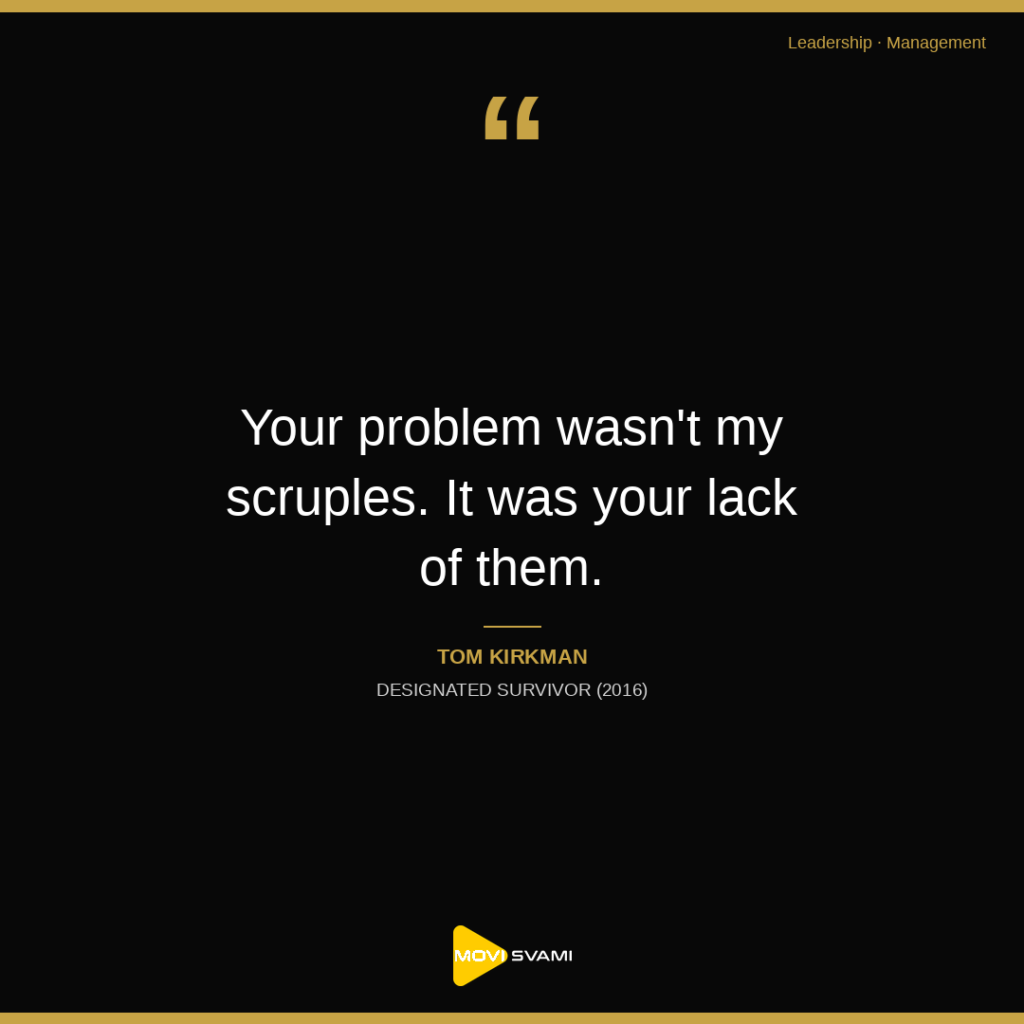
There is a moment in every high-stakes negotiation when a leader decides whether to treat moral compromise as a diplomatic necessity or as a structural weakness to be exposed. In *Designated Survivor*, Tom Kirkman faces that moment across from Alton, a developer whose empire rests on calculated leverage and transactional ruthlessness. Kirkman does not flatter, negotiate, or seek common ground. He sees the pattern immediately: a man who has mistaken accumulated advantage for enduring power, who treats scruples as obstacles rather than foundations. Rather than accommodate that worldview, Kirkman names it. He refuses to enter the architecture of compromise that governs Alton’s life, defining the battlefield on his own terms—terms built on principle rather than leverage.
The conflict centers on a land-development deal reaching back into their shared history, encapsulating everything Kirkman has rejected and Alton has exploited. Where Alton sees a chessboard of regulatory shortcuts and political pressure, Kirkman sees a house of cards. Their confrontation is not merely personal; it is a clash of operating systems. Alton has constructed a career on the assumption that everyone, eventually, can be pressured or incentivized into moral elasticity. He expects Kirkman to weigh integrity against accommodation and find the math favorable to expediency.
Kirkman does not oblige him. He reframes the exchange with surgical precision: “Your problem wasn’t my scruples. It was your lack of them.” The line is not defensive. It is a diagnosis. Alton’s predicament arises not because Kirkman is difficult, but because Alton’s power is contingent on continued moral compromise. Without the steady application of leverage, manipulation, and ethical erosion, his influence collapses. Kirkman’s power requires no such maintenance. It rests on a foundation that does not need to be hidden or reinforced through new transgressions. The asymmetry is stark, and Kirkman forces Alton to stare directly at it.
This is the scruples advantage, and it is best understood not as moral restraint but as organizational architecture. Integrity functions as a scalable asset because it reduces the transaction costs of leadership. When decisions are grounded in transparent principle, organizations spend less energy on internal surveillance, political calculation, and narrative repair. Trust becomes operational efficiency. Conversely, power built on corruption behaves like a depreciating asset requiring escalating investment. Each compromise demands the next—bigger lies to cover smaller ones, stronger leverage to compensate for evaporating loyalty, more complex structures to distance leadership from accountability. Over time, the organization shifts its core competency from value creation to self-preservation.
What Kirkman grasps—and what Alton cannot afford to admit—is that principle-based leadership compounds while shortcut-based leadership decays. The former builds reservoirs of credibility that can be drawn upon during crisis; the latter creates fragility that reveals itself precisely when pressure mounts. In an era where institutional trust is both scarce and volatile, integrity is no longer merely an ethical baseline. It is a competitive advantage that determines who survives systematic scrutiny and who unravels under it.
Executives encounter this dynamic most acutely when facing pressure to cut corners for quarterly returns. A CEO might obscure supply-chain liabilities, recognize revenue prematurely, or depend on a lucrative client whose ethics do not withstand daylight. The immediate arithmetic seems favorable: the market rewards the beat, the board approves the direction. Yet the cost is silent erosion of institutional credibility. When the correction arrives—an audit, a whistleblower, a regulatory inquiry—the organization discovers that short-term gains purchased with integrity cannot be reinvested. The currency is counterfeit. Teams stop believing stated priorities. Investors learn to discount leadership statements. The advantage was illusory because it required suspending the trust that sustains long-term valuation.
The same decay appears in board relationships when executives choose strategic ambiguity over uncomfortable transparency. A leader who softens bad news or selectively discloses risk might preserve short-term harmony. Yet this approach transforms governance from a strategic asset into performative theater. Directors cannot exercise fiduciary judgment with curated data, and over time they cease to function as genuine partners. The executive gains temporary insulation from accountability but loses the board’s defensive capability precisely when it is needed. Each episode of misleading narrative compounds into a credibility deficit that leaves the organization exposed when crisis intervention becomes necessary.
At the managerial level, ethical rot often enters through tolerance of high-performing toxic actors. A divisional leader who protects a rainmaker despite misconduct may believe they are optimizing for results. In reality, they are issuing organizational debt. Colleagues observe the gap between declared values and enforced norms; they recalibrate their own risk assessments and reduce discretionary effort. Culture becomes a compliance exercise rather than a shared operating system. Like Alton’s empire, this arrangement requires constant managerial energy to maintain—cover stories, shifted assignments, whispered warnings—energy that is no longer available for innovation or talent development.
The question for any leader reading this is not whether you hold principles, but whether you are currently paying to violate them. What accommodations are you financing with credibility you cannot replace. What shortcuts, tolerated for expediency, are already converting into structural liabilities. Integrity is rarely lost in a single dramatic transaction; it is taxed in small, recurring withdrawals until the account is empty. Consider what it would actually cost you—in time, comfort, and political capital—to stop tolerating the compromise that has become invisible through familiarity. The scruples advantage does not ask you to be naive. It asks you to recognize that in a landscape of collapsing leverage and multiplying scrutiny, the only sustainable power is the kind that does not require hiding.