
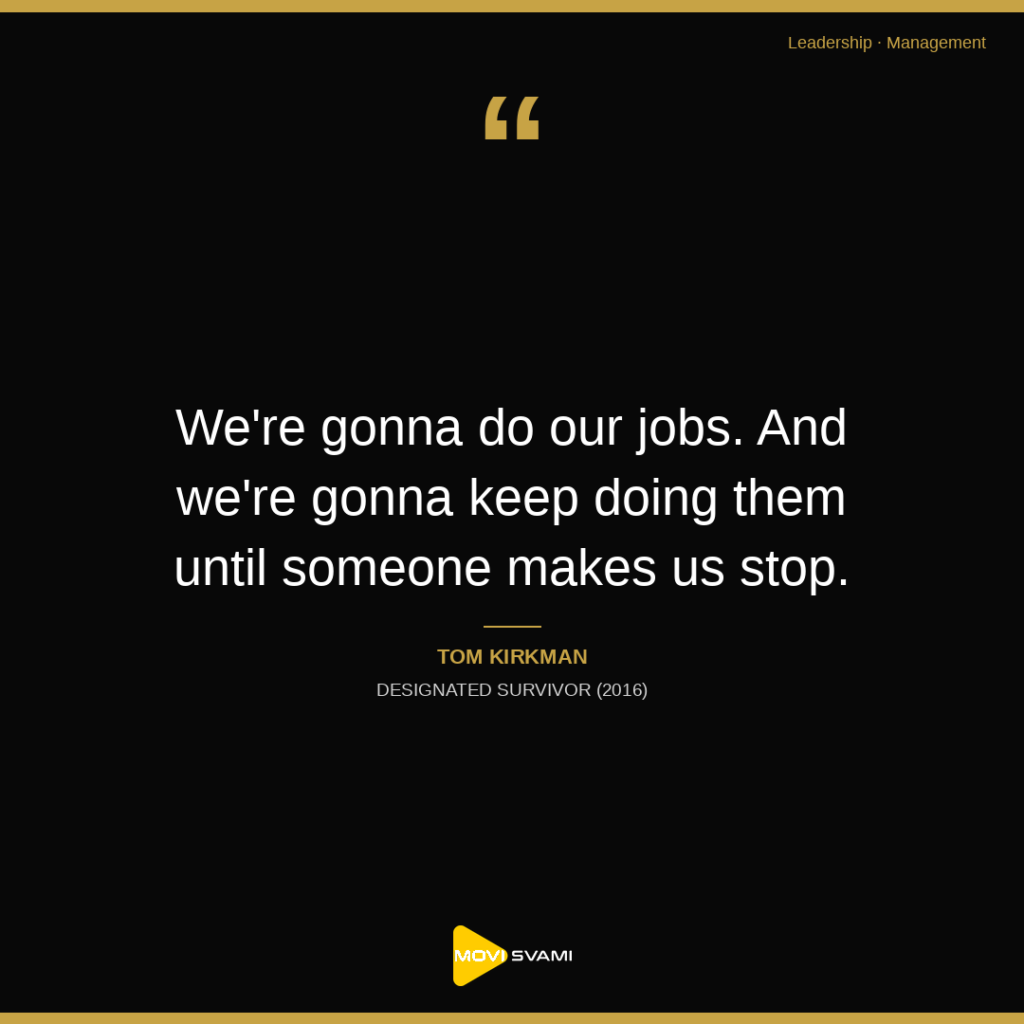
The chandeliers in the West Wing had barely stopped swaying. Outside, a city smoldered. Inside, President Tom Kirkman stood before a cabinet he had inherited by catastrophe, not election, facing questions no briefing could answer. The Capitol lay in ruins. The line of succession had been severed with surgical precision by an enemy still unknown. And in that suffocating moment of uncertainty—when every instinct screamed for pause, for deliberation, for the comfort of a plan—Kirkman chose something harder. He chose motion. “We’re gonna do our jobs,” he told them. “And we’re gonna keep doing them until someone makes us stop.” It was not the speech anyone had rehearsed. It was the only speech that mattered.
This was Season 1, Episode 2 of *Designated Survivor*, hours after Kirkman’s accidental ascension to the presidency. The former Secretary of Housing and Urban Development had been tucked away during the State of the Union address, a constitutional contingency in a bombproof room, precisely so that government might survive even its own decapitation. Now he was the government. His chief of staff pressed for deference to military commanders. His poll-addicted deputy urged caution, lest certain actions alienate Congress. Intelligence offered fragments, not answers. Kirkman heard them all, then dismissed the temptation to philosophize. The country needed electricity, water, air traffic control, debt service, diplomatic channels—the dull, relentless machinery of state. Eloquence could wait. Execution could not.
The Kirkman Principle, as we might call it, inverts the romantic narrative of crisis leadership. We are conditioned to expect Churchill in the bunker, Kennedy during the missile crisis—leaders whose greatness manifests in precisely chosen words that crystallize national will. But crisis management research tells a different story. In high-uncertainty environments, organizational paralysis often stems not from insufficient analysis but from excessive waiting for analytical closure. Psychologist Gary Klein’s studies of naturalistic decision-making reveal that experts in pressure situations rarely compare options systematically; they recognize patterns and act, adjusting course through feedback rather than front-loading certainty. Kirkman’s directive operationalizes this insight: when the fog is thickest, the imperative is maintaining organizational momentum through tactical continuity. The “until someone makes us stop” clause matters profoundly—it creates a presumption of action, shifting the burden of justification to those who would halt progress rather than to those who must initiate it.
This principle finds uncomfortable resonance in executive experience. Consider the technology leader facing a cybersecurity breach of unknown scope. The instinct to convene war rooms, engage forensics firms, and map the full attack surface before communicating is understandable. Yet hours of forensic perfection may cost days of customer trust. The Kirkman response: isolate affected systems, begin notification protocols, activate backup operations—doing the known job while intelligence catches up. Or take the hospital administrator at the onset of a novel respiratory illness, before testing capacity or treatment protocols exist. The temptation to await CDC guidance or perfect PPE supply chains is human. The necessary action: surge ICU capacity, conserve ventilators, protect staff through improvised barrier nursing—executing the core mission of patient care while the science evolves. In both cases, the alternative to imperfect action is not perfect action; it is organizational drift while competitors, adversaries, or pathogens compound their advantage.
The manufacturing sector offers perhaps the purest illustration. A plant manager confronting supply chain collapse cannot wait for geopolitical stabilization or supplier financial restructuring to conclude. The Kirkman mandate translates to: identify which outputs are truly customer-critical, reconfigure production lines for available inputs, qualify alternative suppliers through accelerated testing protocols, and maintain workforce deployment through cross-training. Each element is reversible, improvable, subject to later optimization. None awaits strategic clarity that may arrive too late for quarterly obligations or covenant compliance. The executive who distinguishes herself in such moments is not the one with the most elegant scenario planning deck; she is the one whose organization has practiced continued operation under degraded conditions, whose muscle memory of execution persists when analytical confidence has evaporated.
What makes this principle genuinely difficult—not merely intellectually but organizationally—is that it requires subordinating executive ego to operational rhythm. The leader who craves the visible moment of decision, the dramatic pivot announced to acclaim, will find Kirkman’s approach unsatisfying. It offers no catharsis, only continuation. Yet organizational resilience research consistently identifies this capacity for “mundane operational persistence” as the differentiator between firms that survive systemic shocks and those that do not. Lehman Brothers possessed eloquent risk models; it lacked the cultural willingness to keep doing the boring work of position reduction when markets challenged those models. Johnson & Johnson’s handling of the 1982 Tylenol tampering crisis succeeded not through strategic brilliance but through immediate, unglamorous execution of product recall and contamination prevention—doing the job, at extraordinary cost, until safety was restored.
Kirkman’s presidency, ultimately, was fiction. The principle he articulated is not. In your own organizational life, what critical function are you treating as contingent upon conditions that may never align? What project awaits a clarity that the crisis itself is systematically degrading? The reflection is uncomfortable because it exposes how often we disguise risk aversion as prudence, how frequently we substitute planning motion for operational momentum. The Kirkman challenge is personal: identify the work you were hired to do, stripped of its ceremonial scaffolding, and do it with sufficient conviction that stopping you would require active intervention. The presidency, in the end, is maintenance under fire. So is most executive responsibility. The eloquence we remember from historical crisis leadership was almost always retrospective construction; the execution was contemporaneous, invisible, and decisive.