
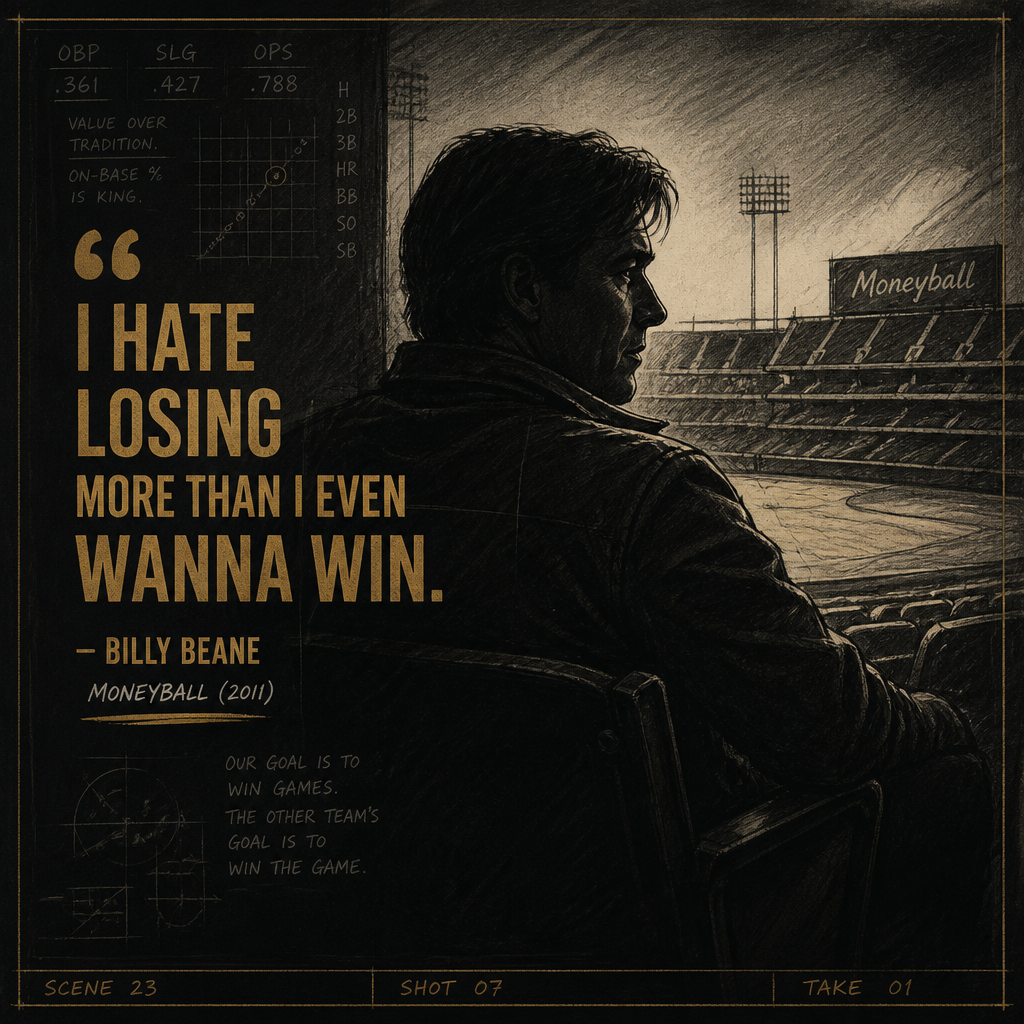
In a dimly lit office, the air is thick with anticipation and the quiet rustling of shuffling papers. Billy Beane, portrayed by Brad Pitt in the film *Moneyball*, sits across from one of his analysts. The atmosphere is tense, not unlike a high-stakes negotiation, but the negotiation isn’t with another executive or a star athlete; it’s with failure itself. Beane, the General Manager of the Oakland Athletics, admits something that resonates deeply: “I hate losing more than I even wanna win.” This offhand remark bears the weight of an innovative philosophy that reshapes how we view success and leadership.
In *Moneyball*, the stakes were more than just a season’s performance; they were the validity of an unorthodox approach to America’s pastime. Billy Beane, depicted with quiet intensity, is committed to breaking away from traditional scouting methods. His team might not have the payroll comparable to baseball powerhouses, yet he is determined to outmaneuver them by employing sabermetrics — a methodology rooted in analytical and evidence-based insights that serves as a rebellion against convention. At its core, his strategy is less about the hunger for victory and more about an aversion to loss. This approach fundamentally challenges the two most sacred elements of baseball folklore: intuition and tradition. The numbers, in Beane’s framework, are not a path to glory. They are a shield against the agony of defeat.
The story behind the quote reveals a nuanced leadership principle — the anti-victory mindset. It is a philosophy that can be particularly powerful in driving genuine innovation. Leaders embracing this mindset are not consumed by the thrills of winning but are, instead, motivated by an aversion to accepting defeat. This form of motivation differs substantially from the fear of success. The latter often paralyzes initiatives due to an underlying dread of the implications of achievement. In contrast, the fear of failing propels leaders towards persistence — a force that pushes them to explore new avenues, untested methods, and bold strategies that the victory-chaser never needs to consider, because they are waiting for inspiration while the loss-avoider is already building the next layer of defense.
The anti-victory mindset calls for a pragmatic and sometimes discomforting approach to leadership and innovation. It demands a relentless pursuit of excellence, where the avoidance of failure serves as a mirror reflecting areas needing improvement. Such leadership does not dwell on aspirational victory but instead focuses on negating pitfalls through careful scrutiny and calculated risks. It is a colder, more structural kind of ambition — one that shows up most clearly not in press releases or earnings calls, but in the architecture of systems, the depth of post-mortem analysis, and the willingness to overturn a consensus the moment the data suggests it is wrong.
This mindset translates into actionable principles in the real world, starting with entrepreneurial resilience. Consider the founder who pivots their strategy not to capture a market but to ensure the viability of their venture. Netflix serves as a fitting example. In its early days, Netflix was not thriving in the DVD rental market against Blockbuster. Rather than basking in the glow of minor successes, the company iterated swiftly, eventually shifting its model toward streaming — a move that stemmed from the necessity to survive rather than a mere ambition to win. The pivot was not bold optimism. It was the structural consequence of a leadership team that could not tolerate a losing trajectory and refused to defend the status quo once the data made the direction clear.
A second application is found in the executive sphere, where some leaders establish systems with inherent redundancies precisely because they cannot tolerate the thought of failure. This is vivid in sectors like aviation, where the cost of mistakes is immense. Executives in this domain focus on creating fail-safe protocols, often multiple levels deep, ensuring that any single point of failure does not result in catastrophe. Redundancies are placed not to boast about success rates but to ensure that the shadow of potential loss remains permanently at bay. The same logic applies in financial services, in healthcare operations, and in any infrastructure where a Beane-like aversion to loss drives architectural decisions that the victory-focused competitor would dismiss as excessive caution.
Then there is the team culture meticulously built around post-mortem analysis rather than only celebrating victories. This is prevalent in industries like software development and technology, where agile methodologies prioritize learning from failed sprints or releases. Amazon’s practice of institutionalizing post-mortem analyses for every significant outage reflects a deep-rooted discomfort with failure at the leadership level. Within such cultures, the focus is consistently on what went wrong and how processes can improve — fostering continuous improvement over complacency, and ensuring that the organization’s collective intelligence is updated by every setback rather than simply absorbed into the background noise of forward momentum.
Billy Beane’s aversion to losing encapsulates a leadership ethos that is intensely instructive for modern-day founders, executives, and teams. It shifts the lens from the high euphoria of success to the pragmatism of sustained and thoughtful innovation. The question for any leader, then, is not whether they wish to win — that answer is obvious — but whether they feel an intense, visceral aversion to losing. What steps are they taking today to ensure they are not merely celebrating victories, but actively dismantling potential failures before they occur?